There Are Asteroids Named After Our Students
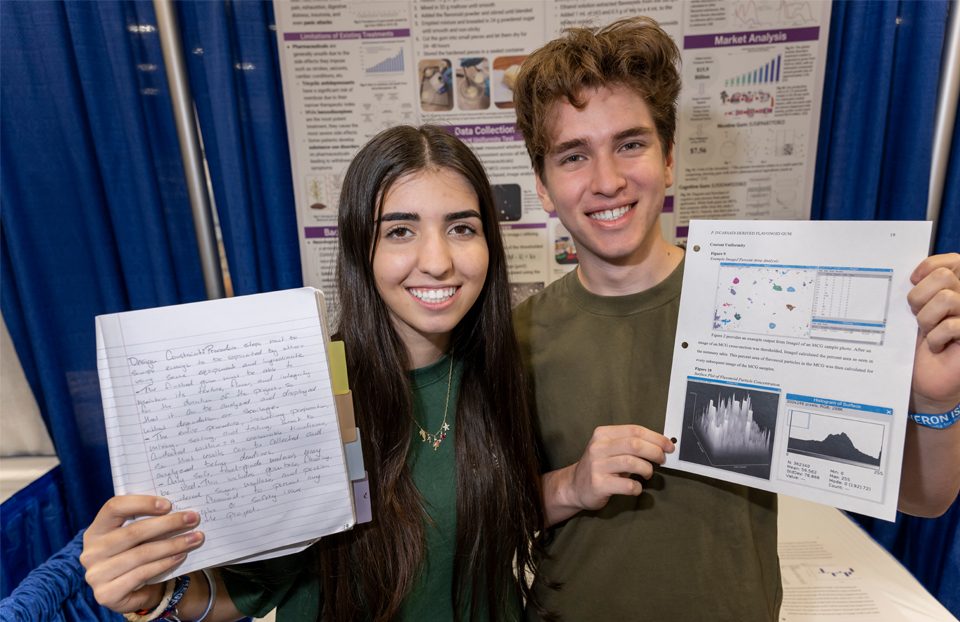
That sentence is not a metaphor. Four years in a row, Embark students have earned minor-planet naming rights at the Regeneron ISEF finals — the distinction reserved for the fair’s top Grand Award winners. It sits on top of a record built season after season: awards every single year, across more disciplines each time.
The Asteroid Honour
Section 01 — What It TakesEach year, the students who place first or second in their category at the ISEF finals receive something no trophy can match: a main-belt asteroid officially named in their honour, through the Ceres Connection program run with MIT Lincoln Laboratory. The name is permanent. It is catalogued by the International Astronomical Union and orbits the sun whether or not anyone is watching.
Earning it once requires a top Grand Award at the world’s most competitive pre-college science fair. Embark students have now earned it four years in a row — a streak that reflects not one exceptional student, but a coaching system that reliably produces award-level research.
See the system behind it →
Season by Season
Section 02 — The RecordPrivacy note, before the numbers: our coaching agreements protect student identities, so this page reports team-level results only — no names, no schools, no identifiable project details. The record speaks well enough in aggregate.
The Record-Breaking Season
Team Embark students took home more than ten awards — the team’s highest total ever, with the broadest discipline coverage in its history: biomedical engineering, biomedical and health sciences, materials science, translational medicine, behavioural and natural sciences, chemistry, biochemistry, robotics and intelligent machines, physics and astronomy, embedded systems and more — twelve fields in all. Winners came from mainland China’s four qualifying tracks, Hong Kong, and high schools in the US and Canada.
First and Second Grand Awards, Across Disciplines
Against 1,657 finalists from more than 60 countries and regions, Embark students swept first and second place Grand Awards in their categories — the placements that carry asteroid naming rights — while the team’s cumulative competition record passed 750 awards.
Multiple First-Place Awards, Back to Back
For the second consecutive year, Embark students earned multiple first-place awards at the finals — and extended what was then a three-year asteroid-naming streak. Roughly 2,000 young scientists from some 70 countries competed that season.
Research Across Disciplines
Section 03 — A Sample of Past ProjectsAward-winning research is not confined to one field. A sample of past Embark project titles — across medicine, chemistry, computing, physics and economics — shows the range our mentors can take a student into. Titles only; student identities are protected under our agreements.
- Bufalin inhibits colorectal cancer by blocking the classical Wnt signalling pathway
- Decoding the neural activity of neurodegeneration in traumatic brain injury
- Customized treatment of extended-spectrum beta-lactamase bacteria for individual patients
- Fluorinated adaptive ionic conductive coatings for stabilizing lithium-metal anodes
- Improving photoelectric conversion efficiency of solar cells with silica aerogel thin films
- Coordination cisplatin liposomes: stabilizing hydrophilic drugs within nanoparticles
- Contextualized EHR data analysis based on large language models
- A lower-limb exoskeleton for resistance training of stroke survivors
- Conditional image generation and editing based on latent diffusion models
- Spectral variations of black-hole X-ray binaries via Monte Carlo simulation
- Transfer of nonlinear mechanical waves in coupled metamaterials
- A Miyaoka-Yau type inequality for complete-intersection subvarieties
- Using natural language processing to analyze the impact of tweets on Bitcoin prices
- The impact of carbon tariffs on welfare in China and the United States
- The polarization of the Chinese labour market and its influence
- Using generative models to predict RNA sequences that fold into target structures
- A molecular phylogeny revealing a new blind cave species in Southern China
- Causal relationship between metabolic disease and coronary heart disease
Where They Go Next
Section 04 — After the Fair
“An awarded, genuinely-owned research project is the rarest signal in selective admissions — and the one judges and admissions officers both trust.”
- Embark alumni hold offers from Harvard, Stanford, MIT, Cornell, Penn and Northwestern, among other leading universities.
- Many continue the research they began with us — into university labs, publications and beyond.
- The asteroid stays named after them either way.
Student Journeys
Section 05 — Where the Work LedA few alumni, by the numbers. We identify students only by initial, in line with our agreements — the awards and admissions are theirs.
- 4 ISEF Awards
- STS Top 300
- USACO Platinum
Built an AI approach to detect degenerative brain disease — a practical, original project that stood out among the entries.
- ISEF Regional 1st
- HiMCM Meritorious
Researched the link between the COVID-19 pandemic and the economy — a topic chosen out of genuine interest, then carried to a regional first place.
- STS Top 300
Linked long-standing hobbies into a single research project, then took it to an international competition — research became the difference-maker in the application.
Ask Us About the Record
Want specifics we can share within our privacy agreements? Message us — we will walk you through what the results mean for a student like yours.
- Competition registration guidance
- 1-on-1 research topic planning
- End-to-end competition coaching
- Lab technique & equipment support