The Science Talent Search selects 300 scholars and 40 finalists by direct application — there is no qualifying fair — and it is open only to U.S. high-school seniors. That combination makes the research timeline, not the fair season, the binding constraint: the project has to be substantially finished and written up before the application is filed. Here is what that requires, and what it means if your school is in China.
What STS is, and the eligibility line that decides whether this article is about you
The Science Talent Search has run since 1942 and is a programme of Society for Science. The official program books describe it as “the nation's oldest and most highly regarded science competition for high school seniors” — worth reading twice, because the last three words are the part families skip. Its title sponsors have run in sequence: Westinghouse, then Intel, then Regeneron, whose commitment is described as ten years and $100 million.
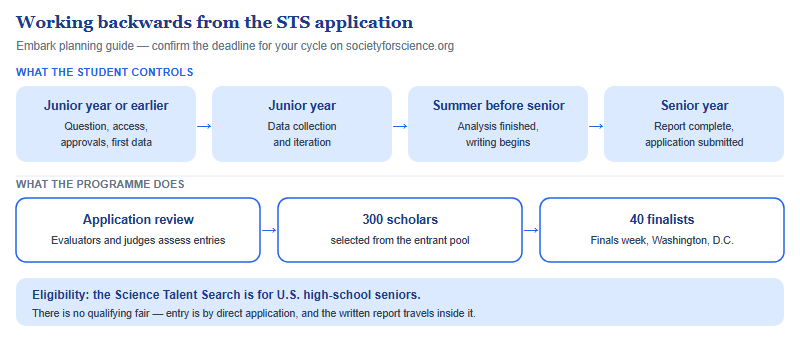
The structure is unusual among the competitions we coach. Students submit an extensive application including a written research report plus supporting documentation from schools, advisors and mentors. Evaluators and judges then select 300 scholars and 40 finalists from the entrant pool. The top 40 attend a finals week in Washington, D.C., displaying their research publicly. In 2026, finalists competed for more than $1.8 million, within a total annual distribution of $3.1 million.
Now the line that governs everything else. STS is for U.S. high school seniors. A student attending a school in mainland China cannot enter it, and no amount of project quality changes that. For that student the realistic route into the same ecosystem is Regeneron ISEF, entered by winning at a Society-affiliated local, regional, state or national fair — there is no direct entry there either. STS is in scope for students on a U.S. high-school path, which includes Chinese students studying at U.S. high schools.
That route is not a consolation prize. The 2026 fair ran 9–15 May in Phoenix with more than 1,700 young scientists, engineers, entrepreneurs and inventors, drawn from 365 affiliate fairs in more than 60 countries, regions and territories, across 22 categories. ISEF has run since 1950 and admits grades 9–12, individually or in teams of up to three. Our understanding from operator channels is that the 2027 fair returns to Los Angeles in May 2027; the Society has not published that, so confirm it on societyforscience.org. Embark coaches both routes — the paths into the ISEF finals are mapped separately, and our coaching programme starts from the route a student is eligible for.
Why the timeline — not the science — is the binding constraint
Compare the two deliverables. At ISEF you qualify by winning at an affiliated fair, and what you present in May is a board plus a live interview. A late-forming project can still be carried some distance by a student who explains it brilliantly standing beside it.
At STS there is no fair and no booth at the point of entry. The evaluators meet a document. Whatever is not in that document did not happen, and no charisma is available to rescue a method that reads as vague on the page. Worse, the application is filed in senior year — so the report gets finished while coursework and university applications peak.
So we plan STS entries backwards from one assumption: treat the written report as due before senior autumn begins, and confirm the actual deadline for your cycle on societyforscience.org. The whole schedule falls out of it. If the report is written in senior autumn, the analysis must be complete over the preceding summer. If so, data collection is a junior-year activity. And if data collection occupies junior year, the question, the access to a venue or dataset, and any approvals have to be settled in or before junior year. There is no version of this that starts in senior September.
One trap deserves naming. Students planning both routes often assume STS is “the same project, submitted later.” Do not assume the ordering — check the actual dates for your cycle and build one calendar from whichever comes first. Assuming you can assemble the STS report after an ISEF season is how a good project misses an entry entirely.
What the written report has to carry that a fair poster does not
Students who have done a fair season arrive with a mental model of “presenting the project” built around a board and a conversation. The STS report demands a document that survives being read alone, by someone who cannot ask a follow-up question. Every place a poster relies on the author being present is a place the report must do extra work.
| Element | On a fair board | In the STS written report | What we ask students to draft |
|---|---|---|---|
| Research question | A headline and a sentence | Positioned against what is already known, with the gap stated explicitly | A one-paragraph gap statement built on three papers you have read |
| Methods | Condensed; the interview fills the gaps | Reproducible from the prose alone | A methods section a stranger in the field could follow without you |
| Data and analysis | Selected figures | Full treatment, including the analysis you tried and rejected | An analysis record covering variability, sample size and what failed |
| Uncertainty | Often implicit | Quantified and discussed by the author | Error sources listed with rough magnitudes attached |
| Limitations | Raised in conversation if a judge asks | Stated unprompted, before anyone else finds them | A limitations paragraph written before the results are final |
| Your own contribution | Probed live at the booth | Must be legible on the page | Two plain sentences: what you did, and what your mentor did |
| Format | Board dimensions set by the fair | Specified in the official entry instructions | Confirm requirements on societyforscience.org before drafting |
The practical consequence is that writing is not the last fortnight of the project. In our experience the report exposes structural problems in the science — a control never run, a comparison never justified — at exactly the moment when no time is left to fix them. That is the argument for drafting the methods section during data collection, while a fix still costs a fortnight rather than a season.
Single authorship changes how the work should be scoped
Each finalist's entry at STS is a single-author original research project. ISEF, by contrast, allows an individual or a team of up to three. That difference should change project design early.
With no co-authors, there is no division of labour to hide behind. The scope has to fit one student's hands, one student's calendar and — the part that catches people — one student's understanding. A three-part study is not available to you if it only works when three people run it. The mentor relationship changes character too: advisory rather than co-productive, which is harder to manage than it sounds, because a generous mentor will offer to do the difficult part.
We use four scoping tests before committing a student to an STS-directed project:
- Can you state the entire method in five minutes, without notes? If it takes longer, the project is scoped for a team.
- Can you re-run the analysis from raw data, alone, today? If a script came from someone else and you cannot reproduce its logic, that section is not yours in a form the report can carry.
- Did you make every figure? Not “did you approve every figure”. The distinction becomes visible in writing.
- Can you defend your weakest decision? Every project has one — a reagent concentration, a hyperparameter, a sampling cutoff. If you cannot say why it was set that way, find out before it reaches the page.
These tests push toward narrower, deeper work — the correct direction for a single-author entry. Breadth is what teams buy; depth is what one student can own.
Where the finalist categories cluster — our own classification, with its limits stated
We maintain our own classification of finalist fields, derived from the phrasing used in the official program books. Two disclosures before any number: this is our classification, not a Society for Science statistic, and its coverage is incomplete. We could classify between 29 and 40 of each year's 40 finalists, and 2019 has no program book in our set — that year is a gap. Across eleven years we classified 371 finalists.
| Category (our classification) | Finalists classified, eleven years | Share of 371 |
|---|---|---|
| Mathematics | 45 | 12.1% |
| Computational Bio & Bioinformatics | 39 | 10.5% |
| Engineering | 34 | 9.2% |
| Medicine & Health | 32 | 8.6% |
| Cell & Molecular Biology | 31 | 8.4% |
| Chemistry | 29 | 7.8% |
| Computer Science | 28 | 7.5% |
| Environmental Science | 23 | 6.2% |
| Physics | 19 | 5.1% |
| Animal Sciences | 17 | 4.6% |
| Behavioural & Social Sciences | 17 | 4.6% |
| Materials Science | 14 | 3.8% |
The movement inside that table is more interesting than the ranking. Computational Bio & Bioinformatics sat outside the top four in both 2015 and 2018, but finished first or joint-first in 2020, 2021, 2022 and 2026. The composition of the classified cohort has shifted toward computational work over the decade we can see.
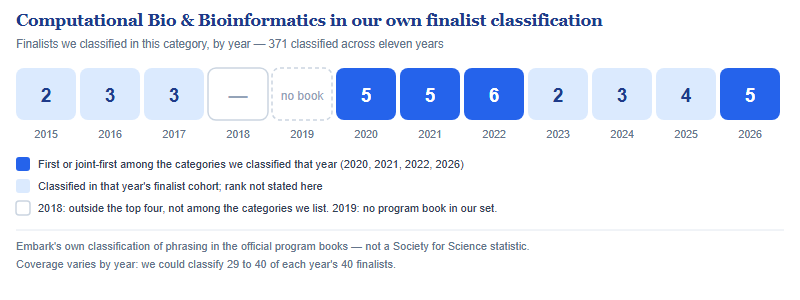
We read that shift as feasibility rather than fashion. Computational work has no wet-lab scheduling bottleneck and no institutional access gate a seventeen-year-old cannot open, and it scales with the student's own effort — precisely the profile that fits a single-author project on a fixed timeline. That is a very different claim from “choose bioinformatics to improve your odds”, and we push back on students who read it that way. Mathematics leads our totals and is also the least forgiving field to enter without a genuine result. The categories describe what was selected; they are not a formula.
Documentation, and what our own record does and does not tell you
The application includes supporting documentation from schools, advisors and mentors. Families consistently under-plan this, because it is the one part of the entry that depends on other people's calendars. A teacher asked in senior autumn is asked during their own busiest term.
What we ask students to prepare before making the request: a one-page summary in language a non-specialist can follow; a plain statement of what the student did unaided and what was supervised; the dates of the work; and the deadline in writing, with margin to absorb a delay. Handing over a well-prepared packet is not politeness — it is the difference between a substantive letter and a generic one.
On our own record, stated as our record and nothing more. Per Embark: in the 2023–24 STS season, two of our students were selected as finalists — the top 40; in the 2024–25 season, three were selected as scholars — the top 300. Those are our own de-identified figures, not an official statistic; we publish no names, schools or project titles. Those students were on U.S. high-school paths, which is what made them eligible. Results vary between students and seasons; we cannot promise a competition result, and nothing here is a claim about any university outcome.
The pattern in our own files is duller than the headline: in both seasons, the students who reached a tier had finished their analysis before senior year began. Those who did not were not weaker scientists — several were doing more ambitious work — they were writing up a project that was still moving. That is this article's whole thesis, arrived at the expensive way. Our results page sets out what we do and do not claim, and how the coaching is structured follows from it.
FAQ
Can a student in mainland China enter the Science Talent Search?
No. STS is for U.S. high-school seniors. The realistic route from a school in China is ISEF, through a Society-affiliated fair.
How many students are selected as STS scholars and finalists?
Evaluators and judges select 300 scholars and 40 finalists from the entrant pool. There is no qualifying fair; entry is by direct application.
When does the research for an STS entry need to be finished?
Plan for the report to be finished before senior autumn; the application carries it. Confirm the deadline for your cycle on societyforscience.org.
Can an STS project have more than one author?
No. Each finalist entry is a single-author original research project. ISEF, by contrast, allows an individual or a team of up to three.
Work with Embark
The first useful conversation is about eligibility and calendar, not topic. Tell us where your child is enrolled and what year they are in, and we will say plainly whether STS is in scope, whether the ISEF route through an affiliated fair is the one to build, and how much runway is left.
Embark is an independent research-coaching organisation, the international competition team of Youfang Education. We are not affiliated with, endorsed by, or sponsored by the Society for Science, the Regeneron Science Talent Search or Regeneron ISEF. Student results cited here are Embark's own de-identified records and are not official statistics; results vary between students and seasons, and no competition or admissions outcome is promised. Category figures are our own classification of official program-book phrasing, not Society for Science data. Eligibility, deadlines and entry requirements change between cycles — confirm all details on societyforscience.org. Factual errors are corrected within 7 working days of notice.