Many students begin their Regeneron ISEF journey with ambitious hypotheses but lack the practical groundwork to execute them. A well-designed pilot study serves as a critical checkpoint, allowing you to test methodology, refine variables, and confirm resource availability before committing months to a full-scale experiment. This article focuses on the specific reasoning failure that occurs when pilots are skipped or poorly executed, offering two worked hypothetical examples, one contrasting mistake, and a usable practice decision framework to help you diagnose potential issues in your own planning.
The Specific Difficulty: Why Pilots Fail
A pilot study is not merely a “small version” of the final experiment; it is a diagnostic tool designed to answer logistical and methodological questions. The primary difficulty lies in distinguishing between scientific uncertainty (which the main project addresses) and procedural uncertainty (which the pilot must resolve). Students often conflate these, leading to pilots that fail to catch fatal flaws such as equipment incompatibility, insufficient sample sizes for statistical power, or unmanageable time constraints.
Worked Hypothetical Case 1: The Successful Diagnostic
Consider a student investigating the effect of different soil pH levels on bean plant growth. Their hypothesis requires precise control of pH across ten groups over eight weeks. A successful pilot would involve running only two groups (one control, one treatment) for one week using the exact same pots, soil mixture, and measurement tools intended for the full study. The goal is not to see if pH affects growth (the literature already suggests it does), but to verify:
- Does the pH meter maintain calibration over daily measurements?
- Is the watering schedule sustainable given school access hours?
- Do the plants show signs of stress unrelated to pH (e.g., lighting inconsistencies)?
If the pilot reveals that the pH drifts significantly within 24 hours, the student learns they need a buffering agent or more frequent adjustments before scaling up. This saves the entire project from invalid data.
Worked Hypothetical Case 2: The Shortcut That Fails
In contrast, another student studying water filtration efficiency assumes that because they have a prototype filter, they can skip the pilot and run the full trial immediately. They use tap water from a single source for all tests. During the full experiment, they discover that the mineral content of the tap water varies day-to-day due to municipal changes, introducing an uncontrolled variable that ruins the comparison between filters. Had they conducted a pilot testing the consistency of their water source over three days, they would have identified the need for distilled water spiked with known contaminants, ensuring reproducibility.
The Contrasting Mistake: Confusing Scientific and Procedural Questions
The critical error in both cases above is the failure to separate what the pilot must answer from what the full experiment will answer. In Case 1, the pilot succeeds because it targets only procedural uncertainty: calibration stability, schedule feasibility, and environmental control. In Case 2, the student skips the pilot entirely, mistaking possession of a prototype for validated methodology. The contrasting mistake is treating the pilot as a preview of results rather than a test of process. A pilot that asks “Does pH affect growth?” is wasted effort; a pilot that asks “Can I maintain stable pH?” prevents project failure.
Diagnostic Table: Common Pilot Mistakes
| Mistake Type | Symptom in Full Project | Pilot Question That Prevents It |
|---|---|---|
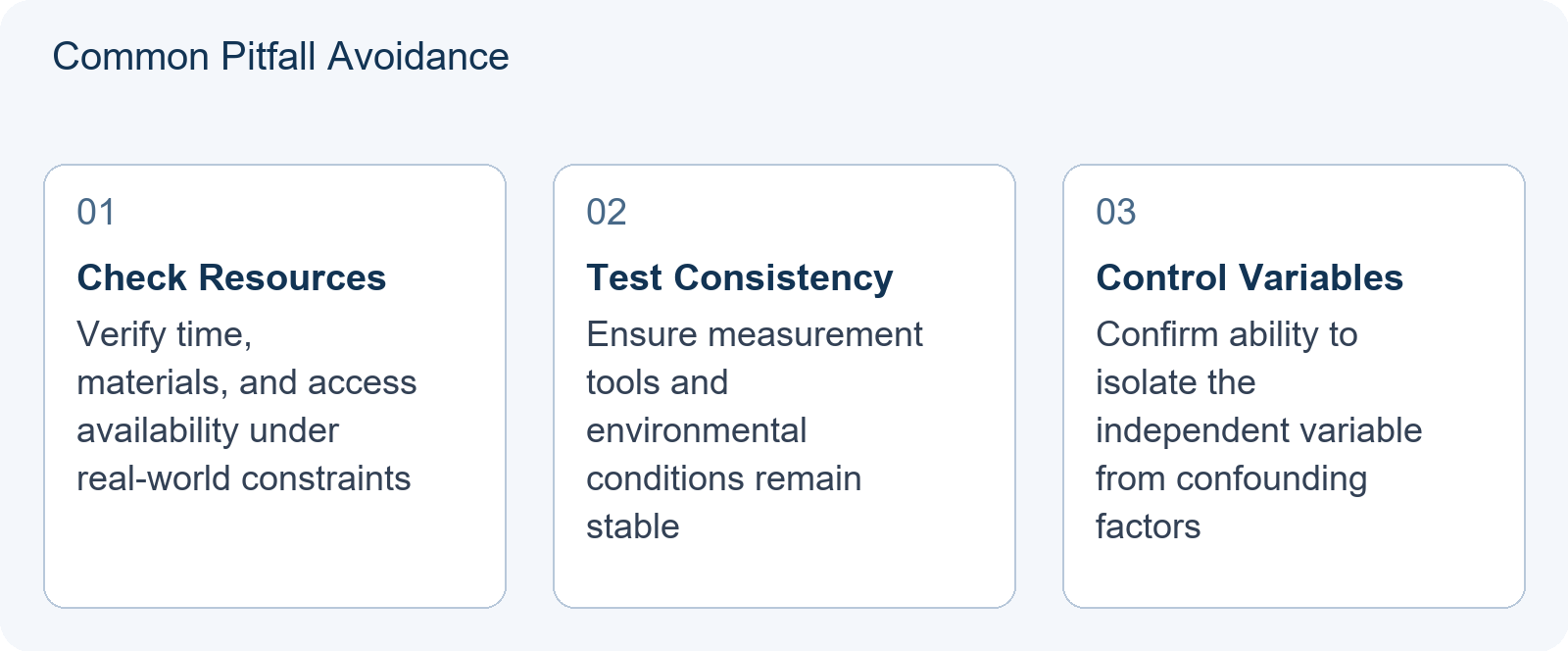
| Resource Overestimation | Running out of materials or time mid-experiment | Can I complete one unit of work within my available weekly hours? |
| Methodological Noise | Data variance too high to detect trends | Does my measurement tool produce consistent results on identical samples? |
| Variable Control Failure | Confounding factors invalidate conclusions | Are environmental conditions stable enough to isolate my independent variable? |
Usable Practice Decision: The Three-Step Pilot Framework
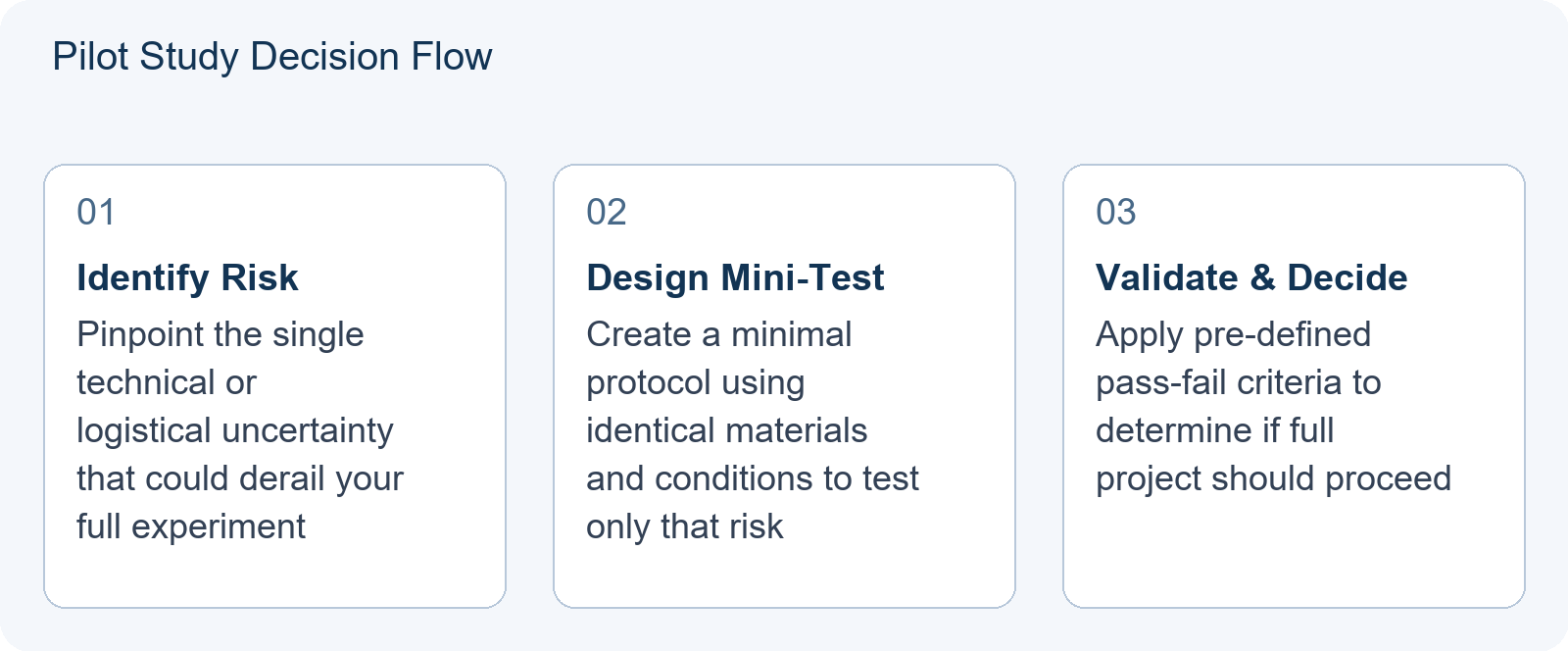
To integrate pilot thinking into your workflow, use this decision framework before finalizing your proposal. This framework transforms pilot design from an afterthought into a deliberate, repeatable practice that connects directly to your broader preparation strategy.
Step 1: Isolate the Procedural Risk
Identify the single aspect of your experiment most likely to fail technically. This is not your scientific question but the operational dependency beneath it. Examples include sensor accuracy, biological survival rate, reagent stability, or equipment access constraints.
Step 2: Design a Minimal Viable Test
Create a protocol that tests only this risk factor, ignoring the broader scientific question. The test must use the same materials, environment, and schedule as the planned full experiment. A pilot that substitutes cheaper or more convenient versions of your actual materials will miss critical failure modes.
Step 3: Define Pass-Fail Criteria Before Execution
Establish quantitative thresholds for success before running the pilot. For example: “pH must remain within 0.2 units of target for 72 hours” or “measurement repeatability must yield coefficient of variation below 5%.” This prevents post-hoc rationalization of failed pilots as “good enough.”
For guidance on managing the practical costs of rigorous methodology, see What an ISEF Project Actually Costs — and Why the Expensive Parts Rarely Win (2026-27). For understanding how engineering prototypes are actually evaluated beyond mere construction, refer to “I Built a Thing” Is Not an ISEF Project: How the Engineering Rubric Actually Scores Your Prototype (2026-27). And for students preparing to defend methodological choices under interview conditions, see Defending Your ISEF Project in English: The 25-Point Interview When English Is Your Second Language (2026-27).
Next Skill Demonstration
After reading this, you should be able to draft a one-page pilot plan for your current idea. This plan must explicitly state: (a) the procedural risk being tested, (b) the minimal viable test protocol, and (c) the pre-defined pass-fail criteria. If you cannot identify a specific procedural risk to test, your pilot may be unnecessary—or your main experiment may be too simple to require one. The skill to demonstrate is not running a smaller experiment, but designing a diagnostic that prevents wasted effort. To strengthen this skill, review the cost-management considerations in the linked guidance above, then practice explaining your pilot rationale to a peer using the interview preparation framework from the English defense article.
Frequently Asked Questions
How long should an ISEF pilot study last?
Duration depends on the specific risk being tested. For equipment calibration, it might take a few days. For biological viability, it could require several weeks. The key is to run it long enough to observe stability or failure patterns relevant to your main timeline.
Can I use pilot data in my final ISEF presentation?
Generally, no. Pilot data is used to refine methodology and is typically excluded from the main results section to avoid bias. However, you can mention the pilot process in your methods to demonstrate rigorous preparation and problem-solving skills.
What if my pilot shows the experiment won’t work?
This is a valuable outcome. It allows you to pivot early without wasting months. You can either adjust the methodology to overcome the obstacle or choose a new topic. Judges respect the ability to recognize and address feasibility issues proactively.