ISEF judges engineering projects on a different 100-point rubric from science projects. It rewards a defined need, explicit solution criteria and constraints, alternatives you actually explored, and a prototype “tested in multiple conditions/trials.” A working build with none of that documented is not a weak project — it is an unscored one.
There are two rubrics, and you are being scored on the other one
Most preparation advice a student encounters describes the science rubric: research question, variables and controls, data analysis, conclusions. If you entered a robotics, embedded systems, mechanical, environmental or biomedical engineering category, that advice is aimed at someone else’s scoresheet.
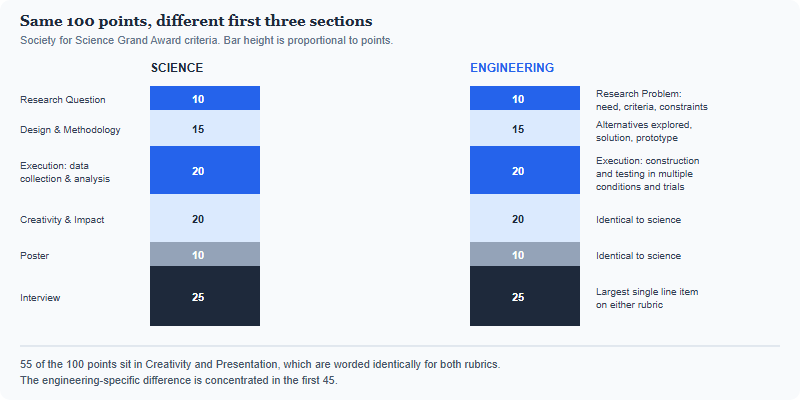
Society for Science publishes both. The totals are identical at 100 points and the last two sections are shared, but the first three sections use different language for a reason — they are asking for a different kind of evidence.
| Pts | Science project | Engineering project | What changes for you |
|---|---|---|---|
| 10 | Research Question — “clear and focused purpose”, “identifies contribution to field of study”, “testable using scientific methods” | Research Problem — “description of a practical need or problem to be solved”, “definition of criteria for proposed solution”, “explanation of constraints” | You must name a need, then commit to measurable criteria and constraints before you build. |
| 15 | Design and Methodology — “well designed plan and data collection methods”, “variables and controls defined, appropriate and complete” | Design and Methodology — “exploration of alternatives to answer need or problem”, “identification of a solution”, “development of a prototype/model” | Alternatives you rejected are scored. The first idea that worked is not, on its own, a methodology. |
| 20 | Execution: Data Collection, Analysis and Interpretation — systematic collection, “reproducibility of results”, statistics, “sufficient data” | Execution: Construction and Testing — “prototype demonstrates intended design”, “prototype has been tested in multiple conditions/trials”, “prototype demonstrates engineering skill and completeness” | Building is one third of this section. Testing across conditions is another, and finish quality is the third. |
| 20 | Creativity & Potential Impact — identical wording in both rubrics | Creativity may be demonstrated in any of the criteria above, not only in the idea. | |
| 35 | Presentation — Poster 10 + Interview 25, identical in both rubrics | The single largest block, and the largest single line item on either rubric is the 25-point interview. | |
Quotations are from Society for Science’s published Grand Award judging criteria at the time of writing; criteria are reviewed periodically, so confirm the current version on societyforscience.org.
Research Problem: the three lines students skip
Ten points looks small until you notice that it is where the rest of the rubric gets its meaning. The three published sub-criteria are a practical need, criteria for the proposed solution, and constraints. Very few student engineering projects arrive with all three written down.
The failure mode is recognisable. A student says: “I built a low-cost air quality monitor.” That is a solution announced without a need, without criteria and without constraints. The judge’s follow-up questions write themselves — low-cost compared with what? Accurate to what tolerance? For whom, in what environment, at what maintenance interval? If those answers are being invented at the booth, the project loses points in section one and then loses them again in sections two and three, because there is no yardstick against which the prototype can be shown to succeed.
The repair is not rhetorical. Write, before building:
- The need, stated as somebody’s problem rather than as a technology you find interesting. Who currently cannot do what?
- Criteria, as numbers with units. Detects PM2.5 within a stated error band against a reference instrument. Runs a stated number of hours on one charge. Costs under a stated figure in parts.
- Constraints, which are the things you may not trade away — power budget, size, safety, availability of components, what you are permitted to do under the rules and under your school’s supervision.
Once these exist, the project becomes falsifiable in the engineering sense: at the end you can state plainly which criteria you met and which you did not, and that honest scorecard is far stronger in an interview than a claim of general success. Our academic director’s consistent observation is that finding a good problem matters more than chasing frontier technology — once the problem is genuinely well posed, ordinary, competent execution reads as original. Students who lead with the technology usually cannot answer the need question at all. If you are still fixing this layer, start with how to choose a research topic that can actually win.
Design and Methodology: the alternatives you rejected are worth points
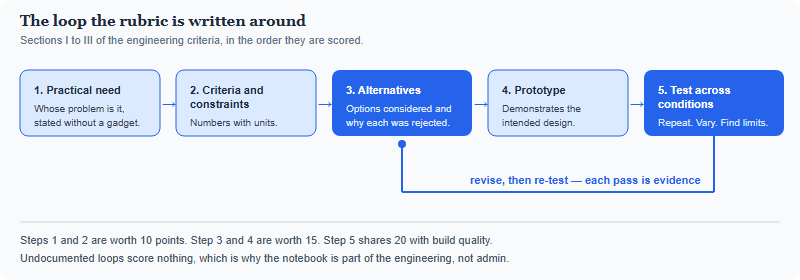
The published wording is “exploration of alternatives to answer need or problem”, then “identification of a solution”, then “development of a prototype/model.” Read in that order, it describes a search, not a build.
Students routinely throw away the most valuable evidence they have. The two motor drivers that overheated, the sensor that drifted, the mechanical linkage that was abandoned for a belt — those are the exploration. Discarded to the bin and undocumented, they score nothing. Recorded with the measurement that killed them, they become the section.
A practical habit: maintain a one-page decision table in your notebook. Each row is a design decision. The columns are the options considered, the criterion used to choose, the evidence, and the date. Three or four such rows across a season turn an unverifiable claim about your process into an exhibit. It also happens to be the fastest way to answer the interview question judges ask constantly — why did you do it that way?
Execution: “multiple conditions/trials” is the sentence that decides this section
Twenty points, three published sub-criteria: the prototype demonstrates intended design, the prototype has been tested in multiple conditions or trials, and the prototype demonstrates engineering skill and completeness.
The middle one is where most otherwise-good builds stop short. A device that has been demonstrated once, indoors, by the person who built it, has been demonstrated — not tested. Testing means varying something deliberately and recording what happens:
- Repetition. The same condition, many trials, so that variability is visible. One run has no error bar.
- Range. Temperature, humidity, load, input voltage, distance, surface, lighting — whatever your criteria implicitly assume. Test the assumption.
- Edge and failure. Where does it stop working, and how? A student who can state their prototype’s failure boundary is showing engineering maturity, not weakness.
- Comparison. Against a reference instrument, an existing product, or your own earlier revision. Against something.
Note that this maps cleanly onto the third sub-criterion too. “Completeness” is not decoration; it is the difference between a breadboard held together by hope and a build somebody else could pick up and operate. And treat negative results as data, not embarrassment — the same testing discipline is what turns a prototype that missed two of five criteria into a defensible project.
The 25-point interview asks an engineer a specific question
Presentation is 35 points — poster 10, interview 25 — and the interview criteria are identical for both rubrics. Among the published sub-criteria are clear and concise responses, understanding of the basic science relevant to the project, understanding of the interpretation and limitations of results, “degree of independence in conducting project”, recognition of potential impact, quality of ideas for further research, and for teams, contributions and understanding by all members.
Two of those deserve attention from engineers specifically.
Independence. A prototype built with heavy adult or purchased assistance is very hard to defend, because the judge can probe any design decision and the student must own it. This is the criterion that quietly punishes projects assembled from a kit or a contractor. It is also why the decision table matters — it is a record of choices you made.
Limitations. Engineering students often present a prototype as a success and stop. The criterion asks for understanding of interpretation and limitations. Saying “we met three of our five criteria; the power criterion failed because of the regulator we chose, and here is what I would change” scores better than an unqualified claim, and it is true.
Our own reading, from coaching students through the booth, is that the presentation carries as much weight as the data — communication is not a finishing touch applied in the last fortnight. It is 35 of 100 points and should be practised from the first month. For the full breakdown of what happens at the booth, see what ISEF judges look for.
The build log that makes all of this provable
Every section above rewards evidence that is only available if you captured it at the time. A build log that satisfies the engineering rubric contains, at minimum:
- The dated need, criteria and constraints statement, written before construction and not edited afterwards.
- The decision table of alternatives, with the evidence that settled each choice.
- Revision numbering, so that “v3” means something specific and you can say what changed between v2 and v3 and why.
- Test logs with condition, date, number of trials and raw results — including the runs that failed.
- A final scorecard: each criterion, met or not met, with the measured value.
That last item is worth building toward deliberately. It converts a season of messy work into one slide that a judge can absorb in fifteen seconds, and it forces the honest conversation about limitations that the interview criteria reward.
One more piece of coaching that applies particularly to engineers: a good topic has to connect to something about the student rather than sit as a separate line on a record. The strongest engineering projects we see usually come from a student who has an actual relationship with the problem — a workshop they use, a sport they play, a family member’s work, a local constraint they have personally run into. That connection is what generates the constraints list, and the constraints list is what makes the whole rubric answerable. If you are still deciding which route into the finals fits your situation, the paths to the ISEF finals is the place to start.
Frequently asked questions
Is the ISEF engineering rubric worth the same 100 points as the science rubric?
Yes. Both total 100. Creativity and Impact (20) and Presentation (35) are worded identically; the first three sections differ.
What does “tested in multiple conditions/trials” mean in practice?
Repeat trials plus deliberate variation of conditions your criteria assume, including where the prototype fails. One demonstration is not a test.
Do I lose points for design alternatives that did not work?
The opposite. Exploration of alternatives is a published sub-criterion under Design and Methodology, so rejected options are scoreable evidence.
How much of the engineering score is the interview?
25 of 100 points — the largest single line item on either rubric, and it explicitly includes degree of independence in conducting the project.
Work with Embark
Embark is the international competition team of Youfang Education — a research school, not a prep shop. Our discipline mentors work through problem definition, design criteria and test planning with students while there is still time to iterate. Per Embark, our students have reached finalist places across 13 categories, including robotics and AI, embedded systems, mechanical engineering and biomedical engineering; results vary by student and season.
Embark is an independent research-coaching organisation, the international competition team of Youfang Education. We are not affiliated with, endorsed by, or sponsored by the Society for Science or Regeneron ISEF. Results cited reflect Embark’s own published record (per Embark) and are not official ISEF statistics; individual results vary. Judging criteria and rules are revised periodically — confirm all competition details on societyforscience.org and with your affiliated fair. Errors of fact are corrected within 7 working days of notification.