To choose an ISEF research topic that can actually win, start from a question you genuinely care about, then pressure-test it on three axes: feasibility (can you finish meaningful work in the ~12 months ISEF allows?), originality (does it add something the literature doesn't already cover?), and fit (does it map cleanly to one of ISEF's 22 categories?). A topic that survives all three is a project. One that fails any of them is a liability you'll defend at the booth.
Win starts with a real question, not a trophy
At Embark, our position is blunt: we are a research school, not a prep shop. The students who do well at the Regeneron International Science and Engineering Fair almost never set out to "win ISEF." They set out to answer something that nagged at them — a measurement that looked wrong, a process they thought could be cheaper, a pattern nobody around them could explain. The award is a by-product of a question worth a year of their life.
This matters more than it sounds, because ISEF judging rewards understanding, not topic glamour. A finalist stands at a booth and is questioned for hours by working scientists and engineers (see what ISEF judges look for at the booth). You cannot fake ownership of a question you chose because it sounded impressive. You can only defend a question you actually chased. So the first filter is not "is this a winning topic?" It is "is this my question, and can I still explain why I cared in twelve months?"
A useful gut-check from our mentors: a good ISEF question is small enough to finish, and deep enough to matter. Most weak topics fail on one side — either so broad you can never close it ("curing cancer") or so trivial that the result is obvious before you start. The work of topic selection is dragging a raw curiosity toward that narrow band where finishable meets meaningful.
The three pressure tests every topic must survive
Genuine interest gets you a candidate question. It does not get you a project. Before you commit a school year, run the candidate through three deliberate pressure tests. Treat any "no" as a signal to reshape the question — not to abandon the curiosity behind it.
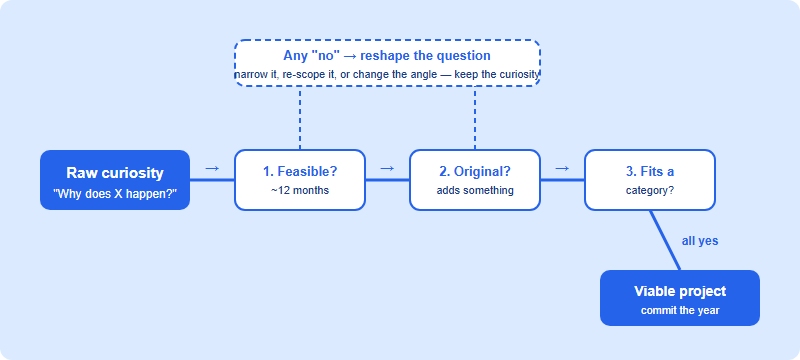
Test 1 — Feasibility: can you finish meaningful work in roughly a year?
ISEF rules cap each project at no more than 12 months of continuous research, and for the 2026 cycle the work could not have begun before January 2026 (always confirm the current dates and limits on societyforscience.org). That single rule should shape your topic more than anything else. The question is not "is this interesting?" but "can I get a clean, defensible result on this within about a school year, working with the equipment, data, samples, and mentorship I can actually reach?"
Feasibility is where ambitious students bleed time. A wet-lab idea that needs a BSL-2 facility you don't have, a survey that needs ethics approval you can't secure in time, a dataset that's paywalled or simply doesn't exist — these aren't bad ideas, they're bad 2026 ISEF ideas. Run the candidate against the access reality before you fall in love with it:
- Resources — What do you actually need (instruments, compute, materials, subjects, a mentor in this subfield), and can you reach it within months, not years?
- Result either way — If your hypothesis is wrong, is the result still meaningful and reportable? Winning projects are designed so that a "no" answer is still a finding, not a dead end.
- Stamina — Could you talk about this for twenty minutes with a stranger, a year from now, without getting bored? If the honest answer is no, the topic will not survive the grind.
Test 2 — Originality: does it add something the literature doesn't already have?
Originality at ISEF rarely means "nobody has ever studied this." It means you are adding a specific, identifiable increment: a new variable, a new population or material, a cheaper method, a local dataset, a replication that exposes a gap. The fastest way to test it is a focused literature scan. Read enough to answer one sentence honestly: "Compared to what already exists, my project adds ______." If you can't fill that blank, you have a science-fair demonstration, not a research contribution — and judges can tell the difference within the first two questions.
A practical move our mentors use: take a published study you admire and ask what it explicitly left for future work, or what would change if you swapped one of its assumptions (different climate, different age group, a constraint it ignored, a material it didn't test). Originality often lives in the margins of work that already exists, not in inventing a field from scratch.
Test 3 — Category fit: which of the 22 ISEF categories is this?
Regeneron ISEF organizes projects into 22 categories — from Biochemistry and Cellular & Molecular Biology to Engineering, Robotics, Environmental Engineering, and the social and behavioral sciences. You compete within a category, against peers framing similar questions, so the category you enter quietly defines who you're measured against and which judges read your work. A topic that doesn't map cleanly to one category — or that could plausibly land in three — is a warning sign that the question isn't sharp yet.
Crucially, you choose your category based on what your project contributes, not just its surface topic. A study of plastic-eating bacteria could be Microbiology, Environmental Engineering, or Biochemistry depending on whether your core contribution is the organism's behavior, a cleanup system, or the enzyme chemistry. Decide what your real contribution is first; the category follows. For the full landscape of how categories and the road to finals fit together, see every path to the ISEF finals.
A reference table: strong vs. fragile topics
The same curiosity can produce a strong or a fragile topic depending on how it's scoped. The contrast below isn't about subject area — it's about whether the question survives the three tests.
| Dimension | Fragile topic (rethink it) | Strong topic (commit to it) |
|---|---|---|
| Scope | "The effects of climate change on agriculture" — unfinishable in a year | "Does a 2°C rise in irrigation-water temperature change germination rate in one local crop variety?" |
| Ownership | Chosen because it sounds prestigious; you can't explain why you care | Grew from something you noticed and couldn't stop thinking about |
| Feasibility | Needs equipment, approvals, or data you can't reach in ~12 months | Buildable with mentorship and tools you can actually access this year |
| Result either way | Only "interesting" if the hypothesis is confirmed | A negative result is still a real, reportable finding |
| Originality | Reproduces a textbook demo everyone has seen | Adds a clear increment: new variable, population, method, or dataset |
| Category fit | Could be three categories; contribution is blurry | Maps cleanly to one of the 22; you know your core contribution |
Notice that the fragile-to-strong move is almost always narrowing. Beginners widen their topic to feel ambitious; experienced researchers narrow it to make it finishable, testable, and defensible. Ambition belongs in the depth of your method, not the breadth of your question.
Scoping a topic to the ISEF calendar
A topic isn't just an idea — it's an idea that fits a timeline. Because qualification runs through Society-affiliated local, regional, state, or national fairs before the ISEF finals each May (always verify your region's pathway and dates on societyforscience.org), you are effectively scoping for two deadlines: your affiliated/regional fair first, then ISEF. Working backward from those dates is the discipline that turns a good question into a deliverable project.
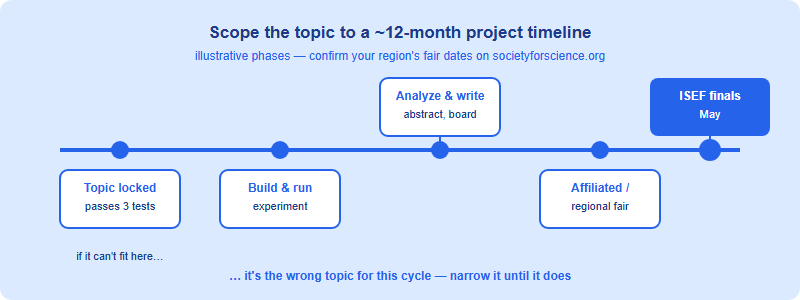
This backward planning is also the most honest feasibility check there is. If you sketch the calendar and the experiment doesn't fit, you've learned something cheap and early: the topic is too big. Better to discover that on paper in week one than in a half-finished project in month nine.
How Embark coaches topic selection (and why it's not topic-picking)
A common misunderstanding is that a coach hands you a winning topic. We don't, and we won't — a topic you didn't choose is one you can't defend at the booth. Embark is the international competition team of Youfang Education (founded 2016), and our mentors are practicing researchers. What we do is run your curiosity through the three tests faster and more honestly than you can alone: surfacing the literature you haven't read, flagging the feasibility wall you haven't hit yet, and matching you with a discipline-specific mentor so the category fit is real rather than guessed.
Per Embark's own published record, our team has worked across all 22 ISEF categories, with more than 3,000 contracted mentors and 750+ competition awards, including four consecutive years of asteroid-naming recognition (per Embark). We share that not as a promise — nobody can guarantee a result — but as evidence that the "real question first" method scales across disciplines. The students who do well are the ones who arrive with a question they can't let go of. Our job is to make that question finishable, original, and correctly placed. For the bigger picture on what research coaching is and isn't, start with how to choose an ISEF research topic.
Frequently asked questions
How long can my ISEF project take?
ISEF rules cap each project at no more than 12 months of continuous research, with a defined start window each cycle. Always confirm the current dates and limits on societyforscience.org.
How many ISEF categories are there, and when do I pick one?
There are 22 categories. Decide your project's core contribution first; the category that best fits that contribution — not just the surface topic — follows naturally.
Does a winning topic have to be something totally new?
No. Originality usually means a clear increment — a new variable, population, method, or dataset — not inventing a field. You just need to add something the literature doesn't already have.
How do I qualify for ISEF finals?
You compete first at a Society-affiliated local, regional, state, or national fair, then advance to the May finals. Verify your region's exact pathway and dates on societyforscience.org.
Work with Embark
Bring the question you can't stop thinking about. We'll help you turn it into an ISEF-caliber project — pressure-tested for feasibility and originality, scoped to the calendar, and paired with a discipline-matched research mentor.
Embark is an independent research-coaching organization, the international competition team of Youfang Education. It is not affiliated with, endorsed by, or sponsored by the Society for Science or Regeneron ISEF. Any results cited reflect Embark's own published record (per Embark). Always confirm current rules, categories, eligibility, and dates on societyforscience.org. Confirmed errors are corrected within 7 working days.