Risk Assessment Form 3 is the ISEF form that documents hazardous chemicals, activities and devices. Society for Science lists “Missing Risk Assessment Form 3” among its top five paperwork problems, and it must be signed by your Direct Supervisor or Qualified Scientist before you experiment. A form signed afterwards does not fix the problem — it documents it.
What Form 3 is, and the two-part test that triggers it
On the current ISEF forms list, Form 3 is titled the Risk Assessment Form. It is not a permission slip and it is not a safety poster. It is the written record of a risk assessment that a student conducts with an adult before the first trial — Society for Science states that the student researcher must conduct the risk assessment in collaboration with a Direct Supervisor or Qualified Scientist prior to experimentation, and that the result of that review is documented on Form 3.
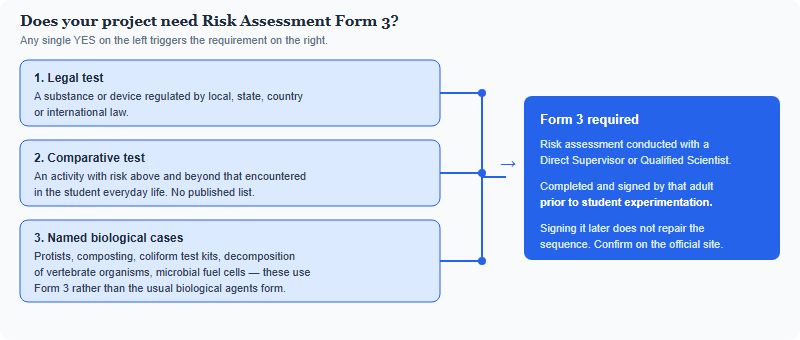
The scope is defined broadly. Society for Science describes hazardous chemicals, activities and devices as “Substances and devices that are regulated by local, state, country, or international law,” and adds that “Hazardous activities are those that involve a level of risk above and beyond that encountered in the student’s everyday life.”
Read those two sentences as a two-part test, because that is how a Scientific Review Committee reads them:
- Part one is legal. Is the substance or device regulated by any law that applies to you? Note the words country and international. A student researching in Shanghai or Shenzhen is bound by Chinese law as well as by the ISEF rules, and a chemical that is unrestricted in one jurisdiction may be controlled in another.
- Part two is comparative. Is the activity riskier than ordinary daily life? This part has no list attached to it. It is a judgement, which is exactly why students skip it — there is nothing to look up.
The categories Society for Science names in connection with Form 3 include high voltage, hazardous equipment, radioactivity, firearms, explosives, prescription drugs, DEA-controlled substances, alcohol and tobacco. That list is not a boundary. Plenty of ordinary school-lab and maker-space work — lasers, drones, machining, kiln work, pressurised systems, custom battery packs — sits squarely inside part two of the test without appearing in any published list. If your project involves something in that grey zone, do not reason by analogy from what a list happens to name. Use the official ISEF Rules Wizard, then confirm with your affiliated fair’s SRC before you start.
The bright lines: what the rules simply prohibit
Most of the Form 3 territory is about documentation. A handful of things are not documentable at all — they are prohibited outright, and no supervisor signature makes them acceptable. Society for Science states these directly:
| Area | The published rule | What it rules out in practice |
|---|---|---|
| Prescription drugs | “A study using prescription drugs is prohibited when the prescription is being used outside of the purpose for which it was prescribed.” | Repurposing a family member’s medication to test an unrelated effect. |
| DEA-controlled substances | “Any study using DEA controlled substances is prohibited in a school or home setting.” | Controlled-substance work cannot be relocated to a kitchen or a school lab. It requires a regulated institution. |
| Alcohol | “Students are prohibited from conducting experiments where consumable ethyl alcohol is produced by distillation.” | Fermentation-to-distillation projects. Fermentation studies that stop short of distillation are a different question — ask your SRC. |
| Underage purchasing | Underage researchers are prohibited from purchasing alcohol, tobacco and vape products; firearms or ammunition, including black powder; and explosives. | An adult buying the material for you does not convert a prohibited purchase into a permitted one. Read the rule with your Adult Sponsor. |
| Ionizing radiation | “All projects involving ionizing radiation may not exceed the personal exposure limits set by the Nuclear Regulatory Commission of 0.5 mrem/hr or 100 mrem/year of exposure.” | A numeric ceiling, not a judgement call. If you cannot compute your exposure, you cannot show you are under it. |
Quotations above are from the Society for Science rules pages as published at the time of writing. Rules are revised annually and wording moves between pages, so treat this table as a prompt for a conversation with your Adult Sponsor rather than as the rule itself.
There is a coaching point buried in this table. Every one of these prohibitions catches the same kind of student: the one who chose a topic because it sounded serious. Our academic director’s reading, from years of running these projects, is that finding a good question matters more than chasing frontier technology — once the question is right, almost any competent execution reads as original. Reaching for a controlled substance or a radiation source is usually a symptom of a question that is not yet interesting enough to stand on its own. If that describes where you are, the fix is upstream, in how you choose the research topic, not in the paperwork.
The trap: Form 3 is not only a chemistry form
Students reasonably assume Form 3 belongs to chemistry and heavy engineering. It also captures a specific set of biological work that most people expect to sit under the potentially hazardous biological agents form instead. Society for Science indicates that Form 3 covers some potentially hazardous biological agents — naming protists, composting, coliform test kits, decomposition of vertebrate organisms and microbial fuel cells.
That list catches a lot of ordinary, low-cost, genuinely good projects. A composting study on food waste. A water-quality project using coliform test kits. A microbial fuel cell built on a school bench. None of these feel dangerous, which is precisely the problem: the student never thinks to ask which form applies, and discovers the answer at fair registration.
The general lesson is that ISEF form assignment does not follow intuition about how risky something feels. It follows categories written by a committee. The only reliable method is to enumerate every material, organism, instrument and procedure in your plan and check each one against the rules, rather than checking the project as a whole against your sense of its riskiness.
Dates beat forms: the signature order that disqualifies good projects
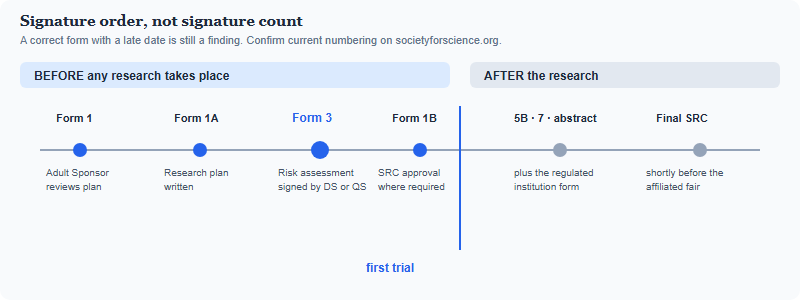
This is the part that costs finished projects their place. Society for Science’s guidance is that the forms should be filled out and signed before any research takes place, with only a small set completed afterwards — the regulated-research-institution form, Form 5B, Form 7, and the abstract.
One caution on that list: at the time of writing, the regulated-research-institution form has carried a different number on prior years’ paperwork than it does on the current list, and the current forms list shows a 2027 set running Form 1, 1A, 1B, 2A, 2B, 2C, 3, 4, 5A, 5B, 6A, 6B and 7. Do not memorise a number from an article — ours included. Pull the current year’s list from societyforscience.org and match by the form’s name.
Among the regional SRC problems Society for Science publishes, two are pure sequencing failures: “Bad dates – paperwork not signed in the appropriate order prior to the start of experimentation” and “Failure to obtain prior SRC approval.” Both describe projects where the science was probably fine. The student simply started work and did the paperwork later, and a date field made that visible.
A risk assessment that is actually useful to your research
Treated as compliance, Form 3 is a chore. Treated as design, it is one of the more useful hours in the project, because a proper risk assessment forces you to name every input before you touch one — and an unnamed input is usually an uncontrolled variable as well as an unassessed hazard.
A workable sequence, done with your Direct Supervisor or Qualified Scientist in one sitting:
- Enumerate. Write down every chemical, organism, instrument, power source and physical procedure. Not categories — items. “Solvent” is not an item; the named compound is.
- Pull the Safety Data Sheet for each chemical. Society for Science notes that Safety Data Sheets provide Globally Harmonized System ratings covering physical, health and environmental hazards, and that the GHS rating should be factored into the risk assessment and safety precautions. The SDS is the source document; your Form 3 is the summary of what you did about it.
- Ask the substitution question. For each hazard, is there a lower-hazard route to the same measurement? Substitution is a legitimate scientific decision, and judges respond well to a student who can explain why they chose the safer method and what it cost them in sensitivity or resolution.
- Write the disposal plan. Waste handling is where school-lab projects most often improvise. Decide it in advance and write it down.
- Date and sign, in order. The adult signs before your first trial, not before your fair.
Keep the assessment in your lab notebook as well as on the form. When a judge asks how you handled a hazard — and in engineering and chemistry categories they often do — the honest answer is a page you wrote in September, not a form you filed in March. That is also the answer that reads as ownership rather than supervision.
Before you start in September: a 30-minute compliance pass
If your project is still forming, this is the cheapest half hour in the whole season, because every problem it finds is still free to fix. Once you have data, the same problem costs you the data.
- Run your written plan through the official ISEF Rules Wizard, item by item rather than project by project.
- List which forms your project needs by name, then match those names to the current year’s numbered list on societyforscience.org.
- Identify your Direct Supervisor or Qualified Scientist now — Form 3 needs a specific human being with relevant expertise, and finding one in March is a different exercise from finding one in September.
- Send the plan to your affiliated fair’s SRC and ask explicitly whether prior approval is required. If you are still working out which fair you belong to, start with the routes into the ISEF finals.
- Diarise the signature dates so the sequence is provable, not just true.
None of this makes a project good. It only stops a good project from being removed for a reason unrelated to its science — which, given how much of the rubric rides on what you can explain at the booth, is the least interesting way to lose. If you want to see what the judging actually rewards once you are through the door, read what ISEF judges look for at the booth.
Frequently asked questions
Is Form 3 required for every ISEF project?
No. It is required for projects using hazardous chemicals, activities or devices, and certain named biological cases. Check each item in your plan.
Who signs Risk Assessment Form 3?
The Direct Supervisor or Qualified Scientist, after conducting the risk assessment with the student and before student experimentation begins.
Can I sign Form 3 after I finish the experiments?
Not correctly. Society for Science lists bad dates and paperwork signed out of order among common SRC problems. Sequence is checked.
Does a composting or microbial fuel cell project need Form 3?
Society for Science names composting and microbial fuel cells among cases documented on Form 3. Confirm the current wording with your SRC.
Work with Embark
Embark is the international competition team of Youfang Education — a research school, not a prep shop. Our discipline mentors work through rules, risk assessment and research design with students before the first trial, when the fixes are still cheap. Per Embark, our students have taken finalist places across 13 categories, including materials science, chemistry, biochemistry, robotics and AI, embedded systems and mechanical engineering; results vary by student and season.
Embark is an independent research-coaching organisation, the international competition team of Youfang Education. We are not affiliated with, endorsed by, or sponsored by the Society for Science or Regeneron ISEF. Results cited reflect Embark’s own published record (per Embark) and are not official ISEF statistics; individual results vary. Rules, forms and numbering are revised annually — confirm all competition details on societyforscience.org and with your affiliated fair. Errors of fact are corrected within 7 working days of notification.