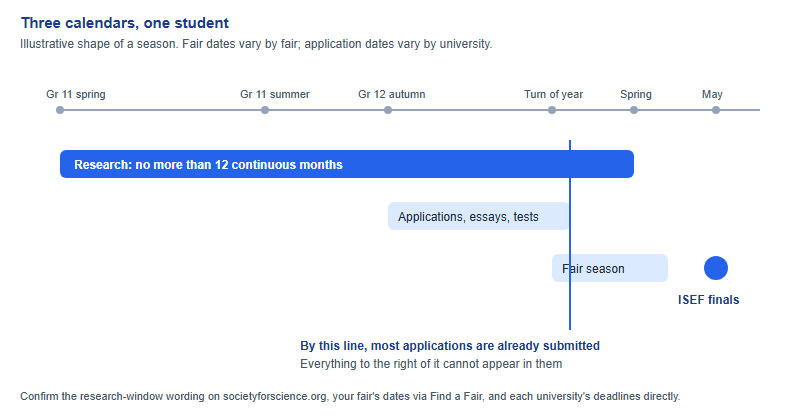
The uncomfortable arithmetic first: Regeneron ISEF finals take place in May, and you cannot enter directly — you must first be nominated at an affiliated fair. For a Grade 12 student applying to universities, that means an ISEF placement almost certainly does not exist yet when applications are submitted or when decisions are made. What can exist is the research itself, and sometimes a fair result.
The date that decides your season is your fair's, not ISEF's
Students plan around May because that is the date they have heard. It is the wrong anchor. The finals are the last event in a chain, and the chain starts with a local or regional fair that has its own calendar, its own registration deadline and its own Scientific Review Committee schedule. Affiliated fairs number in the hundreds — 365 of them fed the 2026 finals, drawing roughly 1,700 finalists from 60-plus countries and regions — and each sets its own dates.
So the first planning question for a Grade 12 student is not “can I make ISEF?” It is: when does my fair happen, relative to my application deadlines? That single date determines whether any competition result at all exists in time to be mentioned. You can trace it through the official Find a Fair directory; if you have not yet identified which fair serves your school, start with every path to the ISEF finals, because in China the route is often less obvious than families expect.
What actually exists by the time you apply
Be concrete about which milestones are real on which date. The abstract, for instance, is submitted after experimentation — so if your data collection runs into the winter, you do not have a finished abstract in the autumn either.
| Milestone | Started in Grade 11 | Started in Grade 12 autumn |
|---|---|---|
| Research underway and describable in your own words | Yes | Yes, but only just |
| Data collected and analysed | Usually yes | Unlikely before deadlines |
| Abstract written (comes after experimentation) | Often yes | Unlikely |
| Affiliated fair entered | Yes | Depends entirely on your fair's date |
| Fair result known before your deadlines | Sometimes | Rarely |
| ISEF nomination known before your deadlines | Rarely | No |
| ISEF placement from this project known before decisions | No — finals are in May | No — finals are in May |
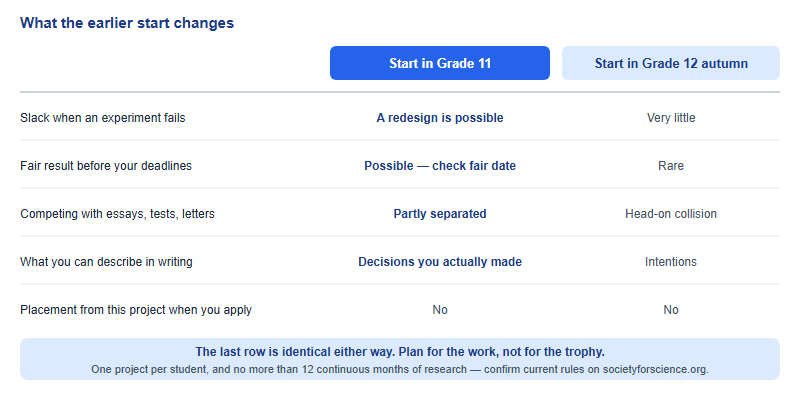
The bottom row is the one worth sitting with, because it is true for both columns. Nobody has an ISEF placement from the project they are starting now to describe when they apply in Grade 12 — only students who already reached the finals in an earlier grade can point to one. If your reason for starting a project is that a trophy will appear in the application, the calendar simply does not support it. What the calendar does support is a student who can write and talk about a real piece of research they are in the middle of, which is a different and more durable thing.
Two rules that stop you hedging
Grade 12 students often try to manage the risk by keeping options open. Two official rules close most of those doors:
- One project each. “Each student is only allowed to enter one project.” You cannot run a safe project alongside an ambitious one and enter whichever matures first. Choosing is compulsory, and choosing late is expensive.
- A bounded research window. The rules allow “no more than 12 months of continuous research,” and each cycle also sets an earliest permitted date — for the 2027 cycle the published wording is that research “may not include research performed before January 2026,” with students evaluated on work conducted between January 2026 and May 2027. That date rolls forward every cycle, so read the current wording rather than assuming last year's.
Eligibility itself is generous at the top end: grades 9–12 or equivalent, and the student must not have reached age 20 on or before May 1 preceding ISEF. Grade 12 is squarely inside the rules. The constraint was never eligibility. It is attention — the same autumn weeks are wanted by your essays, your teacher recommendations, your tests and your data.
Teams change the arithmetic slightly, since a project may have up to three members and work can be parallelised. But judging expects every member to demonstrate significant contributions and real understanding, so a teammate cannot cover for the weeks you spent writing applications. A team is a way to do more science, not a way to be absent.
Grade 11 versus Grade 12: what the earlier start actually buys
The usual argument for starting in Grade 11 is that it “looks better.” That is not the real benefit, and stating it that way leads students to start early for the wrong reason and then rush anyway. Three concrete things change:
- Your data exists while you still have time to be surprised by it. Almost every honest project produces at least one result that forces a redesign. In Grade 11 that is an interesting week. In Grade 12 autumn it is a crisis, because there is no slack.
- The fair can land before your deadlines. Whether it does depends on your fair's calendar, but an earlier project at least makes it possible.
- You can write about the work with real specificity. A student who has run the experiment can describe a decision they made and why; a student two weeks into a literature search can only describe an intention.
If you are already in Grade 12, here are the honest options
None of this means a Grade 12 project is pointless. It means the reason has to be right, because the trophy timeline will not rescue a badly chosen one.
- Scope down, hard. A narrow question you can genuinely finish beats an ambitious one you will abandon in November. Scoping is not lowering your ambition; it is choosing an ambition that fits inside the weeks you actually have.
- Sequence around your own deadlines. Put the design, approvals and any review-committee paperwork before your busiest application weeks, and the analysis after. Approvals in particular sit on someone else's calendar.
- Treat the fair as the finish line. Aim to present well at your affiliated fair and let a nomination be an upside rather than the plan. That is a healthier target and it is the one you control.
- Do not start a project purely as an application line. A rushed project that you cannot discuss in detail is worse than no project, because sooner or later somebody asks you a follow-up question.
That last point connects to something Embark's academic director says about topic choice: a good topic has to connect to the student's own characteristics rather than sit as a separate line on a CV. In Grade 12 that stops being a philosophical preference and becomes a practical filter, because a question you actually care about is the only kind you will still be working on in December when three essay drafts are due. We take that further in how to choose an ISEF research topic, and the reason it matters at the booth is set out in what ISEF judges look for.
Two notes on the coming cycle. ISEF 2026 was held 9–15 May in Phoenix, Arizona. For 2027, the Society has announced that Regeneron ISEF returns to Los Angeles in May 2027 and has published Grand Award judging dates in that month; the full finalist schedule can still change, so confirm current dates on societyforscience.org before booking anything. And on outcomes: Embark reports 24 awards at the 2026 final and finalists across 13 categories, with more than 60 grand awards across 2023–2025 (per Embark — our own record, not an official ISEF statistic; results vary). Students we have coached have gone on to strong universities, which we describe as what they went on to do — not as something a competition result caused.
Questions students ask
Can Grade 12 students compete at ISEF?
Yes. Eligibility is grades 9–12 or equivalent, provided the student has not reached age 20 on or before May 1 preceding the fair.
Will an ISEF result appear in my university applications?
Usually not. The finals are in May, after most applications are submitted and most decisions issued. A fair result may land earlier, depending on your fair's date.
Can I enter two projects to hedge my bets?
No. The rules state each student may enter only one project, so the choice has to be made deliberately and early.
Is it too late to start a project in Grade 12 autumn?
Not necessarily, but scope down and sequence approvals before your busiest application weeks. Aim at your affiliated fair rather than the finals.
Work with Embark
If you are in Grade 11 deciding whether to start now, or in Grade 12 deciding whether to start at all, the useful conversation is about scope and your own two dates — your fair's calendar and your deadlines. Bring the question you are interested in and we will map it honestly.
Embark is an independent research-coaching organisation, the international competition team of Youfang Education. We are not affiliated with, endorsed by, or sponsored by the Society for Science or Regeneron ISEF. Any results cited reflect Embark's own published record (per Embark) and are not official ISEF statistics; results vary, no outcome is guaranteed, and nothing here claims that a competition result causes an admission decision. Rules, eligibility and research-window dates are revised each cycle, fair calendars are set by individual affiliated fairs, and application deadlines are set by individual universities — confirm all of them on societyforscience.org, via Find a Fair, and with each university before relying on them. Factual errors are corrected within 7 working days of notice.