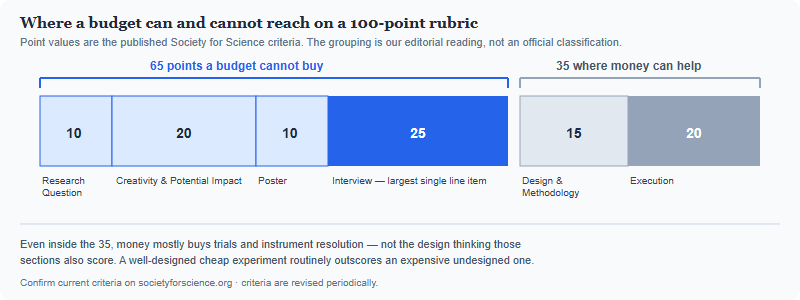
An ISEF project has four real cost buckets: consumables, instrument access, compute, and fair-side logistics. Only the last is genuinely unavoidable. On the published 100-point Grand Award rubric, the sections a budget can move are worth 35 points; the other 65 — research question, creativity, poster and interview — cost nothing but time and thinking.
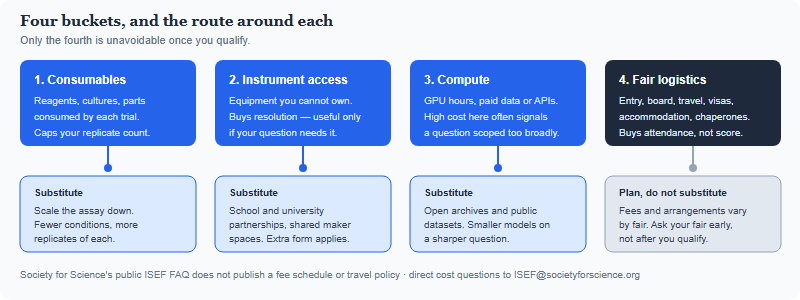
The four buckets, and which ones you can actually escape
Families ask what an ISEF project costs and receive either an evasion or a number pulled from someone else’s project. Neither helps, because the total is almost entirely determined by design choices made in the first month. It is more useful to know where money goes and which routes let you route around it.
| Bucket | What it buys | Rubric section it touches | Can you substitute? |
|---|---|---|---|
| 1. Consumables | Reagents, cultures, plants, filters, printed parts, sensors, replacement components consumed by trials | Execution (20) | Often. Scale the assay down, buy fewer conditions and run more trials, or choose a system whose “consumable” is free — soil, water, weather, publicly available specimens. |
| 2. Instrument access | Time on equipment you cannot own: sequencers, spectrometers, electron microscopes, environmental chambers | Execution (20), Design & Methodology (15) | Sometimes. School and university partnerships, shared maker spaces, and public facilities. Note that working at a regulated research institution brings its own required form — the current forms list on societyforscience.org names it; check the year’s numbering. |
| 3. Compute | GPU hours, cloud instances, paid datasets or APIs | Execution (20) | Usually. Free tiers, institutional allocations, smaller models, and open datasets. Compute cost is frequently a sign that the question was scoped too broadly rather than that it needs scale. |
| 4. Fair-side logistics | Affiliated fair entry, board printing and materials, travel, accommodation, and for international finalists, visas and chaperones | None — it buys attendance, not score | Rarely, and it is the one bucket that is genuinely unavoidable if you qualify. Fees and arrangements vary by fair; confirm with yours directly. |
Two honest caveats. First, we deliberately publish no currency figures here: costs vary enormously by city, category and school, and a made-up range would be worse than no range. Second, Society for Science’s public ISEF FAQ does not publish a fee schedule, a finalist travel policy or a cost breakdown — it directs cost and logistics questions to ISEF@societyforscience.org. If someone quotes you a definitive figure for “what ISEF costs,” ask where it came from.
What the rubric does not pay for
Look at what the 65 points are actually made of. Research Question (10) rewards a “clear and focused purpose” that “identifies contribution to field of study.” Creativity and Potential Impact (20) rewards imagination demonstrated anywhere in the work. Presentation (35) splits into a 10-point poster and a 25-point interview, and the interview criteria include understanding of the underlying science, understanding of the limitations of your own results, and “degree of independence in conducting project.”
None of that is purchasable. Worse for the spending strategy, one of those criteria actively penalises it: a project whose sophistication came from expensive access the student did not really operate is hard to defend under an independence question. Judges probe. A student who ran the machine themselves can answer; a student who sent samples away often cannot.
This is the point our academic director returns to most often: finding a good question matters more than chasing frontier technology — once the question is right, almost any competent execution reads as original. The corollary is financial. Students chase expensive techniques because they are trying to buy the impressiveness that a well-chosen question would have supplied for free. If your project plan’s appeal rests on the equipment named in it, the problem is upstream, and no budget fixes it. That is a topic problem, and choosing a topic that can actually win is where it gets solved.
What money genuinely buys: trials and time
None of this means spending is pointless. It means being precise about what it delivers. Inside the 35 budget-sensitive points, money converts into two things:
- Trials. Execution rewards “systematic data collection and analysis,” “reproducibility of results” and “sufficient data collected to support interpretation and conclusions.” Consumable cost is usually the binding constraint on replicate count, and replicate count is what turns a suggestive result into a defensible one. If you are going to spend anywhere, spend on n.
- Resolution. Better instruments let you detect smaller effects. This matters only if your question needs a small effect detected. Many good student questions do not.
The practical test before any purchase: which sentence in my results section becomes true because of this? If you cannot answer, the spend is buying reassurance rather than data. If the answer is “I can run twelve replicates instead of three,” that is a good purchase, and it is usually a cheap one.
Time is the other currency, and it is fixed by rule rather than by budget. Society for Science states that a project “may include no more than 12 months of continuous research,” and that students are “judged only on laboratory experiment/data collection performed over 12 continuous months.” The window and its start boundary are set for each competition year — confirm the exact dates for your cycle on societyforscience.org. A large budget cannot compress a protocol that needs eight weeks of growth into three, which is why a September planning conversation is worth more than a March equipment order.
Low-capital routes that reach the finals anyway
Several ISEF categories are structurally cheap. That is not a consolation prize; it is a strategic fact, because a student with a laptop and a good question competes on equal footing in these lanes.
- Public archives and open data. Astronomy, earth and environmental science, epidemiology-adjacent public-health work and computational biology all have large, free, professionally curated datasets. The scarce resource becomes the question, which is exactly the resource the rubric weights most.
- Embedded and low-cost hardware. Microcontroller-based instrumentation, sensor validation against a reference, mechanical design tested to failure. Cost sits in parts, not in facility time.
- Field studies. Local ecology, water, soil, air, agriculture. Travel is short, materials are minimal, and the local specificity is often what makes the question original.
- Mathematics and software. Effectively zero marginal cost, and the same 100-point rubric.
- Survey and behavioural research. Low materials cost, but note it carries its own approvals burden — human-participant work requires prior review, so the saving is in money, not in planning.
Per Embark, our own students have reached finalist places across 13 categories, spanning biomedical engineering, biomedical and health sciences, materials science, translational medicine, physics and astronomy, chemistry, biochemistry, robotics and AI, embedded systems, mechanical engineering, and cell and molecular biology; over 2023–2025 our students have taken more than 60 grand awards, and at the 2026 final our cohort took 24 awards spanning first, second and fourth category awards alongside special and grand awards. Per Embark, we have also had students receive asteroid naming rights in five consecutive years. These are our own figures rather than official ISEF statistics, and individual results vary considerably. The reason we mention the spread of categories here rather than the trophies is that it is not concentrated in the capital-intensive lanes — it runs from wet-lab biology to embedded systems, which is what you would expect if the binding constraint were the quality of the question rather than the size of the budget.
The costs nobody budgets for
The bucket families under-plan most is the fourth, because it arrives after the good news. Points worth raising with your affiliated fair early rather than late:
- Fair entry and requirements. Fees, deadlines and any local requirements vary by fair. Society for Science notes that each affiliated fair may send a pre-determined number of projects to ISEF, calculated by participation and high school population — so which fair you belong to affects your odds as well as your costs. If you have not settled that question, start with the routes into the ISEF finals.
- Board and display production. Budget for one reprint. Boards change after the first practice run, and a marked-up board is a bad 10 points.
- Travel, accommodation and visas. For students travelling from mainland China, visa lead time is the real constraint. Begin the conversation with your fair as soon as you are nominated, not once flights are being booked.
- Adult accompaniment. Arrangements vary; ask your fair what it requires and who pays.
Set against this, the award side is real but should not be treated as a budget offset. Society for Science states that more than 600 individual and team awards are presented every year at the Regeneron ISEF, with category prizes ranging from $600 to $6,000 plus a $100,000 top award. Most finalists do not win, and no one should finance a project on the expectation of prize money.
A decision rule for whether to spend
Before approving any significant cost, run four questions:
- Which rubric line does this move? If the honest answer is “it makes the project sound more advanced,” that is the Creativity section, and Creativity is not sold in that shop.
- Does it buy replicates or resolution? Replicates are almost always the better purchase for a student project.
- Can the student operate it themselves? If not, you may be trading independence points — a published interview criterion — for apparent sophistication. See what judges look for at the booth for how that gets probed.
- Does it fit inside the research window? Equipment that arrives with six weeks left in a twelve-month window buys very little.
One last piece of coaching that bears on budget more than it looks. A good topic has to connect to something about the student rather than sit as a separate line on a record. Students working on a question rooted in their own environment — their city’s water, their school’s energy use, a machine they actually use, a condition in their family — tend to build cheap projects, because they already have access to the system they are studying. Students working on a borrowed prestige topic tend to build expensive ones, because they have to buy their way into a system they have no relationship with. The cheaper project is usually also the better one, and it is almost always the one the student can defend for twenty-five points.
Frequently asked questions
How much does an ISEF project cost?
There is no standard figure. Costs are driven by category and design choices; Society for Science does not publish a public cost or fee schedule.
Do expensive projects win more often at ISEF?
The rubric does not score budget. Of 100 points, the sections money can move total 35; the other 65 reward question, creativity and presentation.
Can I do a competitive ISEF project with no lab budget?
Yes. Open datasets, field studies, mathematics, software and low-cost embedded work are all judged on the same 100-point rubric.
Who pays for travel to the ISEF finals?
Arrangements vary by affiliated fair and are not published in the public ISEF FAQ. Ask your fair directly, or email ISEF@societyforscience.org.
Work with Embark
Embark is the international competition team of Youfang Education — a research school, not a prep shop. Our discipline mentors help students scope a question they can actually resource and defend, rather than one that has to be bought. Per Embark, our students have reached finalist places across 13 categories from wet-lab biology to embedded systems; results vary by student and season.
Embark is an independent research-coaching organisation, the international competition team of Youfang Education. We are not affiliated with, endorsed by, or sponsored by the Society for Science or Regeneron ISEF. Results cited reflect Embark’s own published record (per Embark) and are not official ISEF statistics; individual results vary and no outcome is guaranteed. Fees, award values, rules and criteria change — confirm all competition details on societyforscience.org and with your affiliated fair. Errors of fact are corrected within 7 working days of notification.