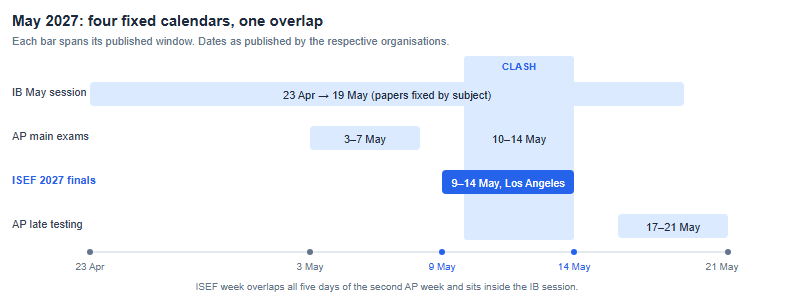
Regeneron ISEF 2027 is scheduled for 9–14 May in Los Angeles. The 2027 AP exams run 3–7 May and 10–14 May. The IB May 2027 session runs 23 April to 19 May. If you qualify, finals week sits directly on top of the entire second week of AP exams and inside the IB window. The conflict is usually solvable — but only if you start solving it in September.
The 2027 calendar, laid out exactly
In our experience students discover this clash in March, when a fair result arrives and flights need booking. By then the useful decisions have already been made for you. So here are the four calendars side by side, with the source for each, because the whole point is that these are published now and you can plan against them today.
| Calendar | 2027 dates | Where it is published | Can it move? |
|---|---|---|---|
| Regeneron ISEF 2027 finals | 9–14 May, Los Angeles, CA (the STEM College & Career Fair runs 9–10 May) | societyforscience.org — note the main ISEF landing page still leads with 2026 content, so check the college-fair and attendee pages for 2027 | No. Fixed date, fixed city. |
| AP exams, main administration | 3–7 May and 10–14 May | College Board: “The 2027 AP Exams will be administered in schools over two weeks in May: May 3–7 and May 10–14.” | Not the main dates. There is a separate late-testing window — see below. |
| AP late testing | 17–21 May | College Board late-testing schedule | This is the escape hatch, but it is not automatic. Read the section below before assuming anything. |
| IB Diploma May 2027 session | Session runs 23 April – 19 May; individual papers fall at fixed points inside that window | The IB’s May 2027 session schedule — confirm the window on ibo.org. Your subject-level timetable is what actually matters — get it from your DP coordinator. | No. Paper times are set globally by subject. |
One honest note on figures. Society for Science’s pages describe the event at slightly different scales depending on which page you read: the ISEF college-fair page describes roughly 1,800 students earning the right to compete from as many as 80 countries, regions and territories, competing for up to $9 million; the main ISEF page, still oriented to 2026, cites more than 1,700 finalists, 365 affiliated fairs in more than 60 countries, more than $7 million in awards and 22 categories. Both are the organiser’s own wording. Treat the scale as “roughly 1,700–1,800 finalists from 60–80 territories” and confirm current numbers on societyforscience.org rather than quoting a precise figure in an application.
Why the second AP week is the real problem
Line the dates up and the overlap is not partial. ISEF 2027 runs Sunday 9 May to Friday 14 May. AP week two runs Monday 10 May to Friday 14 May. That is five consecutive weekday exam slots, every one of them inside finals week. There is no version of this where a student sitting a second-week AP exam is also at their booth.
For students travelling from mainland China the squeeze is worse than the calendar suggests, for four reasons that have nothing to do with the exams themselves:
- Travel days are not free days. Los Angeles is a long-haul flight with a large time difference. Realistically you are gone for longer than 9–14 May at both ends.
- Jet lag lands on judging day. Westbound arrival plus a 25-point interview conducted in English is a demanding combination. If you are also revising for an exam on the flight, something gives.
- Visa lead time is the hidden deadline. This is the item that most often decides the question in practice, and it starts long before May. Begin that conversation with your affiliated fair the moment you are nominated.
- Set-up and public days come before the awards. Finals week is not a single day you can fly in for. Check the published attendee schedule for the year rather than assuming.
The late-testing conversation to have in September, not April
College Board publishes a late-testing window for 2027 of 17–21 May — three days after ISEF ends. On paper that is a clean solution: compete, fly home, sit the exams the following week.
Be careful here, because this is exactly the kind of process students infer instead of verify. What College Board’s public late-testing page actually says is only that “occasionally, circumstances make it necessary for students to test late.” On that page it does not enumerate which circumstances qualify, and it does not name who approves a request. What it does say is that “AP coordinators are responsible for notifying students when and where to report for the exams.”
So the honest position is this: a late-testing window exists, your school’s AP coordinator is the person who orders exams and administers that window, and whether your particular situation is handled through it is a question for your coordinator and College Board — not something to assume from a calendar. Three practical consequences:
- Ask in the autumn term. Exam ordering happens months before May. A coordinator who hears about a possible ISEF trip in April has fewer options than one who hears in October.
- Ask in writing, and ask specifically. Name the subjects, the second-week dates, and the reason. Get the answer before anyone books a flight.
- Do not assume the IB works the same way. IB papers are scheduled globally by subject, and arrangements for missed assessments fall under the IB’s own procedures. Ask your DP coordinator directly; do not reason across from the AP system. Confirm on ibo.org and with your school.
Students taking both programmes have the tightest bind of all, and it is worth seeing why: the IB session runs to 19 May, and the AP late window runs 17–21 May. Those overlap too. If you are a dual-programme student who qualifies, the second week of May and the week after are both spoken for, and this needs a named plan rather than optimism.
Backward-planning the research year so May is survivable
The reason to read this in September is that the fix is not a May fix. It is a research-schedule fix. ISEF permits a project to include no more than 12 months of continuous research, and students are judged on data collection performed within that window — confirm the exact boundary dates for your cycle on societyforscience.org. Within that constraint, you choose where the work sits.
The students who survive May well are the ones whose data collection finished in winter. That is the whole trick. If your last experimental run is in April, you are writing, printing, revising and rehearsing while sitting exams, and you will do all of it badly. If your last run was in February, May contains only rehearsal and travel — which is survivable alongside exams in a way that active lab work is not.
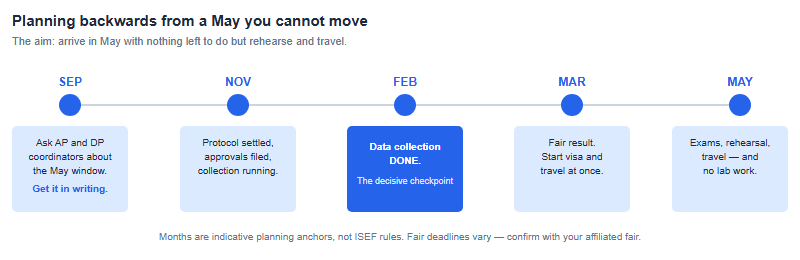
Two scheduling details deserve attention early rather than late. First, approvals: any project needing prior review has to clear it before experimentation starts, which pushes the real start date earlier than students expect. Second, your affiliated fair’s own calendar sits upstream of all of this and varies by fair — if you have not worked out which fair you belong to and when it runs, that is the first thing to settle, and the routes into the ISEF finals is where to start.
The honest options if it genuinely cannot be made to work
Sometimes the answer is that a student should not do both in the same year, and pretending otherwise serves nobody. The realistic choices:
- Run the ISEF year in Grade 10 or 11 instead of the exam-heavy year. This is the single most effective fix and it is a September decision, not a May one. It also puts a completed result in hand earlier, which is worth something when the file is being read.
- Treat this year as year one of a two-year arc. Build the groundwork now, compete at the affiliated-fair level, and target finals in the following cycle when the exam load is lighter.
- Compete regionally and stop there. An affiliated fair in the spring is a real accomplishment and usually sits outside the exam fortnight. Not everyone needs to chase the finals in a year when the finals are unaffordable in time.
- Reduce the exam load, deliberately. Dropping one AP so that the remaining papers fall in week one is a legitimate trade-off. Make it consciously in the autumn, with your counsellor, rather than discovering it in April.
What we would not advise is the common improvised version: qualify, then panic-book, then sit an exam jet-lagged in a hotel or abandon the booth for half a day. Judges at ISEF interview finalists, and interview points are the largest single block on the published 100-point Grand Award rubric — 25 of them. Arriving unable to defend a year of work is an expensive way to protect an exam grade, and arriving unable to sit the exam is an expensive way to protect a booth. Choose on purpose. If you want to know what you would be trading away, what judges actually look for at the booth sets out how that conversation goes.
Per Embark, our students have reached finalist places across 13 categories, and in practice the ones who handle May calmly are almost never the ones who worked hardest in May — they are the ones whose experimental work closed in winter. These are our own figures rather than official ISEF statistics, and individual results vary. But the pattern is the part worth borrowing: a research calendar that respects the exam calendar is a design decision made in September, and it is close to free if you make it now.
Frequently asked questions
Does ISEF 2027 really clash with AP exams?
Yes. ISEF 2027 runs 9–14 May and the second AP week runs 10–14 May — a full five-day overlap.
Can I take AP exams late because of ISEF?
A late window exists (17–21 May 2027), but College Board does not publish qualifying reasons. Ask your AP coordinator early.
Does the IB session overlap ISEF 2027 too?
Yes. The IB May 2027 session runs 23 April to 19 May, so ISEF week falls inside it. Check your subject timetable.
When should I decide about the clash?
September of the season, before exam orders and research scheduling are fixed. By March the useful options have closed.
Work with Embark
Embark is the international competition team of Youfang Education — a research school, not a prep shop. Our discipline mentors help students build a research calendar that closes before the exam fortnight, so May contains rehearsal rather than rescue. Per Embark, our students have reached finalist places across 13 categories; results vary by student and season.
Embark is an independent research-coaching organisation, the international competition team of Youfang Education. We are not affiliated with, endorsed by, or sponsored by the Society for Science or Regeneron ISEF. Results cited reflect Embark’s own published record (per Embark) and are not official ISEF statistics; individual results vary and no outcome is guaranteed. Competition dates, exam schedules, rules and criteria change — confirm ISEF details on societyforscience.org, AP dates with College Board, and IB dates on ibo.org and with your school coordinator. Errors of fact are corrected within 7 working days of notification.