Society for Science runs a public, searchable archive of ISEF finalist abstracts covering 2014 to 2026, filterable by keyword, category, year, fair country and fair state — and, crucially, filterable down to winning projects only. In Embark’s experience, few students open it before choosing a topic. Used properly it answers four questions that otherwise take a coach a month to answer for you.
What is actually in the archive
The tool sits at abstracts.societyforscience.org and describes itself plainly: “Select the criteria to limit the abstracts to be displayed.” Behind that sentence is one of the largest structured records of what pre-college research looks like at the top of the pipeline — finalist abstracts, year by year, across thirteen listed cycles.
The year list also tells you something about the sample before you start reading it:
| Years in the archive | Host | What to keep in mind when reading |
|---|---|---|
| 2026 | Phoenix, AZ | The most recent full cycle — the closest proxy for what a current category contains. |
| 2022–2025 | Atlanta, Dallas, Los Angeles, Columbus | The core of any modern search. Recent enough that category structures and expectations broadly resemble today’s. |
| 2020–2021 | Virtual ISEF | Two atypical cycles. Project mix, scale and access to facilities were not normal. Do not draw trend conclusions from these years. |
| 2014–2019 | Los Angeles, Pittsburgh, Phoenix, Los Angeles, Pittsburgh, Phoenix | Useful for long-run pattern spotting, but category names and boundaries have shifted since. Older is not a template. |
Seven filters are available: a keyword or phrase field, finalist last name, project category, fair country, fair state, year, and a results toggle that switches between all matching abstracts and winning abstracts only. That last one is the reason to bother.
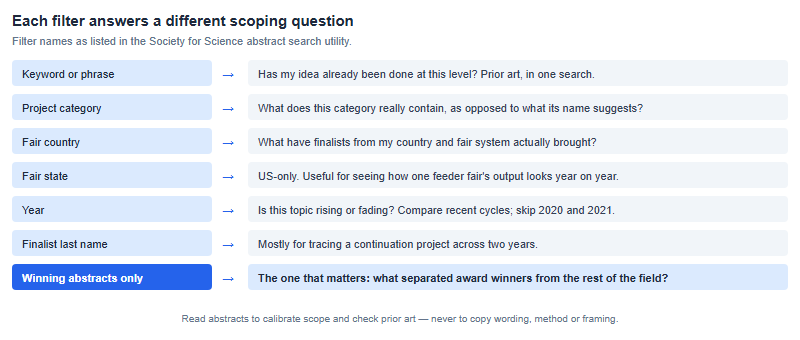
The winners-only toggle is the whole point
Run any category search twice — once showing all matching abstracts, once showing only winning abstracts — and read the two sets side by side. The comparison is the closest thing a student has to seeing the judging standard from the inside, because both groups cleared the same bar to reach the finals. Everyone in both sets was selected by an affiliated fair. The difference between them is therefore not “good student versus weak student.” It is something narrower and much more learnable.
What you are looking for in that comparison is not subject matter. It is the shape of the claim. Read twenty abstracts from each set and ask, of every one:
- How narrow is the question? The most common difference students notice is that award-winning abstracts tend to promise less and demonstrate it more completely. A broad question with thin evidence reads worse than a narrow question answered properly.
- Is there a comparison or a control described at all? An abstract that describes only what was built, with nothing to measure it against, reads differently from one that names a baseline.
- Does the abstract state a result, or only an intention? “We investigated whether…” with no outcome is a recognisable weak pattern.
- Is the contribution stated in one sentence? The published Grand Award rubric awards 10 points for a research question with a clear and focused purpose that identifies a contribution to the field. Abstracts make it visible whether the student could actually articulate one.
This is the same skill the booth interview tests, which is worth knowing before you start: 25 of the 100 rubric points sit in the interview, and much of what is probed there is whether you can state your question, your limits and your contribution crisply. An abstract is that skill compressed into 250 words. If you want to see how the questioning goes, what judges look for at the booth covers it directly.
Two traps in the interface itself
Both of these trip up careful students, and neither is documented on the page.
The category dropdown carries more entries than today’s category list. The archive spans thirteen years, and category names, splits and boundaries have changed over that time; the dropdown reflects the historical naming as well as the current structure. So a dropdown entry does not necessarily map one-to-one onto a category you can enter today, and an entry that looks unfamiliar may simply be a retired label. Do not conclude from the dropdown that a category exists, has been discontinued, or has a particular scope — confirm the current category list on societyforscience.org before you build a plan around it. This matters most for students trying to choose between two adjacent categories, which is a decision with real consequences for who judges you.
Keyword search reads abstracts, not projects. A null result means nobody described their work with your words. It does not mean nobody did your project. Search the concept three or four ways — the method, the material, the organism, the application — before concluding your idea is untouched. Conversely, a hit on your keyword does not mean you are blocked; it usually means you have found the people whose work you should be building on, which is a gift rather than a setback.
A 45-minute session that changes a topic decision
In our coaching experience, students either ignore the archive entirely or lose an afternoon browsing it. Here is the version that produces a decision.
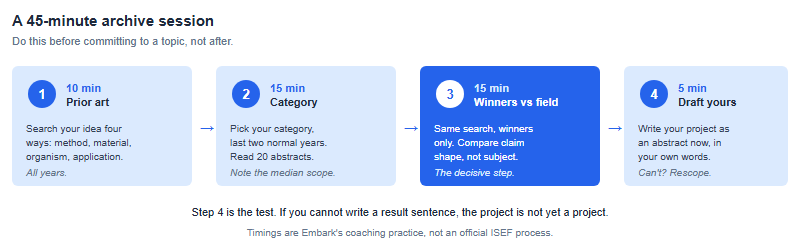
Step four deserves the emphasis. Write your intended project as a 250-word abstract — before you have any data, in the past tense you hope to be able to use. If the results sentence comes out as “we will investigate” and you cannot say what the outcome would even look like, you have a topic rather than a question, and that is a fixable problem now and an unfixable one in April. This is the same diagnostic we describe in choosing a topic that can actually win, applied with the archive as a calibration set.
What the archive cannot tell you
It is a calibration instrument, not an oracle, and reading it badly is worse than not reading it. Four limits worth holding onto:
- Abstracts hide the methods. ISEF abstracts are capped at roughly 250 words — confirm the current limit on societyforscience.org. That is enough for a question, an approach and a result, and nothing like enough to reconstruct a protocol. Students who read abstracts and conclude “that looks easy” are reading the compressed version of a year of work.
- You are only seeing survivors. Every abstract in the archive belongs to a finalist. The projects that did not clear an affiliated fair are invisible, so the archive cannot tell you what fails or why. It shows you the ceiling, not the distribution.
- Winning then is not winning now. A topic that took an award in 2018 may now be a crowded lane. Judges reward creativity and contribution relative to the current state of a field, not relative to the archive.
- It is a reading list, not a source of text. This should not need saying, but: these are other students’ words. Use the archive to understand scope, spot prior art and find people to cite. Never lift phrasing, framing or a research plan from it. Beyond the obvious integrity problem, judges in a category read that category’s field every year, and a borrowed frame is more recognisable than students imagine — and it collapses instantly under an interview question about why you made that choice.
Where this fits in the season
Archive work belongs in the first weeks of a research year, alongside literature reading and before any approvals paperwork is filed — because its main function is to stop you spending a year on a question that was answered better in 2023, or to push a promising but sprawling idea down to a scope you can finish. Rescoping in September costs an afternoon; rescoping in February costs the season.
It also pairs naturally with the fair-route question. The fair-country filter shows you what has historically travelled from a given fair system to the finals, which is context worth having while you are still working out which affiliated fair you belong to — a question the routes into the ISEF finals sets out in full.
Per Embark, our students have reached finalist places across 13 categories spanning wet-lab biology through embedded systems, and the single most common intervention our discipline mentors make in the first month is narrowing a question rather than enlarging it. These are our own figures rather than official ISEF statistics, and individual results vary. The archive is simply the cheapest way for a student to reach that conclusion themselves — by noticing, twenty abstracts in, that the projects taking awards are consistently smaller and more completely finished than the one they had been imagining.
Frequently asked questions
Where is the official ISEF abstract archive?
At abstracts.societyforscience.org. It covers finalist abstracts from 2014 through 2026 and is free to search.
Can I see only award-winning ISEF projects?
Yes. The results toggle switches between all abstracts matching your criteria and winning abstracts only.
Can I search ISEF projects from my own country?
Yes. A fair-country filter lets you see which projects reached the finals from a given country’s fair system.
Is it acceptable to base my project on an abstract I find there?
Use it to check prior art, calibrate scope and find work to cite. Never copy wording, framing or a research plan.
Work with Embark
Embark is the international competition team of Youfang Education — a research school, not a prep shop. Our discipline mentors work with students in the first month of a season, when narrowing a question is still cheap and an archive session can still change the plan. Per Embark, our students have reached finalist places across 13 categories; results vary by student and season.
Embark is an independent research-coaching organisation, the international competition team of Youfang Education. We are not affiliated with, endorsed by, or sponsored by the Society for Science or Regeneron ISEF. Results cited reflect Embark’s own published record (per Embark) and are not official ISEF statistics; individual results vary and no outcome is guaranteed. Archive contents, category lists, abstract limits, rules and criteria change — confirm all competition details on societyforscience.org and with your affiliated fair. Errors of fact are corrected within 7 working days of notification.