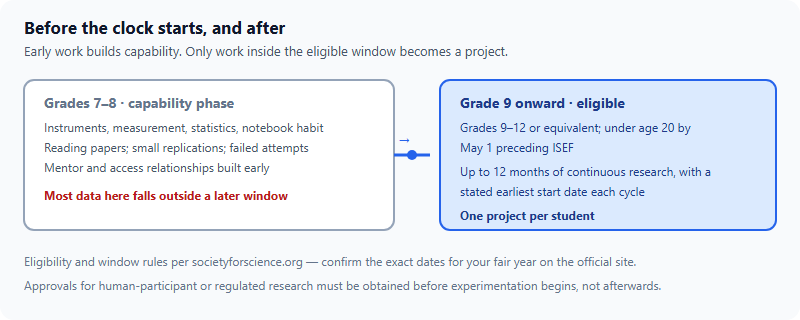
ISEF eligibility is grades 9–12 or equivalent, and the research window is set by calendar date rather than by grade — so most experiments you run in grade 7 or 8 will sit outside the window for the fair you eventually enter. Confirm the stated cutoff for your fair year on societyforscience.org. That sounds discouraging and is actually liberating: the years before eligibility are not for banking results. They are for building the capability that makes a twelve-month research cycle survivable when the clock finally starts.
The two rules that decide what early work is worth
Two lines in the ISEF rules govern everything a younger student should do. First, eligibility: students must be “in grades 9–12 or equivalent” and must “not have reached age 20 on or before May 1 preceding ISEF.” Second, the research window: a project may “include no more than 12 months of continuous research,” and the rules state it may not include research performed before a specified cutoff — the current rules page specifies research may not include work performed before January 2026, so verify the exact cutoff for the fair year you are targeting.
Put those together and the conclusion is blunt. A grade-8 student who spends a year collecting beautiful data will usually find most of it sits outside the window for the fair they eventually enter, because the window is fixed by a stated calendar cutoff rather than by grade — check that cutoff before assuming either way. And the escape hatch students imagine — running the same study again in grade 9 with a bigger sample — is closed too: the continuation rules name “repetition of previous experimentation with the same methodology and research question, even with an increased sample size” as an unacceptable continuation. Early experiments are training. They are not a savings account.
Once you accept that, the planning question changes from “what project should my child start?” to “what should they be able to do by the first week of grade 9?” That is a much better question, and it has concrete answers.
What a grade 7–9 runway should actually produce
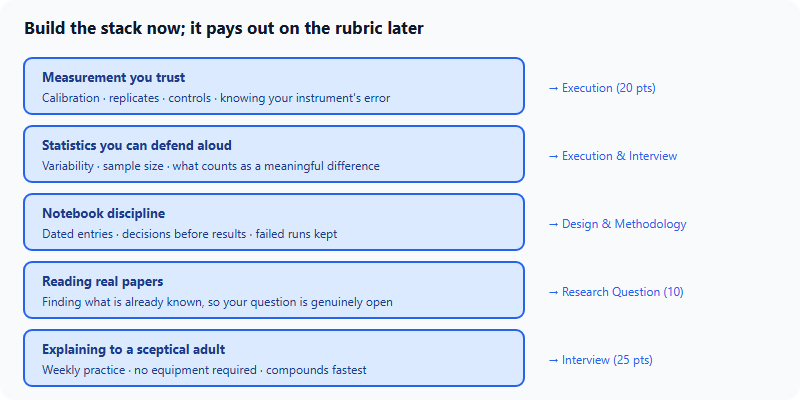
Look at what the Grand Award criteria reward and work backwards. Of 100 points, the research question or problem is worth 10, design and methodology 15, execution 20, creativity and potential impact 20, and presentation 35 — of which the interview alone is 25. Nothing in that list is bought with an early head start on data. Every item on it is bought with skill. Five capabilities do most of the work:
- Measurement. Being able to take a reading you trust: calibration, replicates, controls, and knowing your instrument's error. Students who skip this stage produce data nobody can interpret, including themselves.
- Statistics you can defend out loud. Not advanced modelling — distributions, variability, sample size intuition, the difference between a difference and a meaningful difference. This is the single most common gap in first-year projects.
- Notebook discipline. Dated entries, decisions recorded before results, failed runs kept. A notebook is a habit, and habits take a year to form, which is exactly the year you have.
- Reading real papers. Slowly, badly at first, with a supervisor to translate. The ability to find what is already known is what separates a fresh question from a rediscovery.
- Explaining your work to a sceptical adult. The interview is 25 points. It is also, conveniently, the one skill you can practise every week with no equipment at all.
Notice what is missing from that list: a topic. Students who lock onto a research topic at 13 usually end up defending a decision made by a person who no longer exists. Topic selection is a grade-9 task, done deliberately — the reasoning is set out in how to choose an ISEF research topic that can actually win.
Is there a junior version of ISEF? Read this before you plan around one
Families often assume there is a middle-school ladder feeding into ISEF the way a regional fair feeds the finals. Society for Science does run a middle-school competition — the Thermo Fisher Scientific Junior Innovators Challenge — and its structure is worth understanding precisely. Society-affiliated fairs may nominate the top 10% of their 6th, 7th and 8th grade participants; nominees then complete an online application to compete nationally, with finalists showcasing projects in Washington, D.C.
The detail that matters for readers here: to participate, a student must first complete a science fair project and compete in a Society-affiliated fair in the United States or a U.S. territory. For a student in an international school in China, that pathway is generally not available, and building a two-year plan around it would be planning around a route you cannot enter. That is not a reason for discouragement — it is a reason to spend the pre-eligibility years on capability and on local and school-based science opportunities, then enter the ISEF system through a recognised affiliated fair once you are in grade 9. The available routes are mapped in every path to the ISEF finals. Confirm all eligibility details for any competition on its official site before committing a year to it.
A 24-month runway that does not waste a year
| Period | Primary goal | Concrete output | What to avoid |
|---|---|---|---|
| Grade 7–8, first term | Curiosity with instruments | Three small measurement exercises; a notebook started and actually kept | Choosing a “forever topic” |
| Grade 8, second term | Replicate, don't innovate | Reproduce one published simple result and explain why your numbers differ | Treating a replication as an original discovery |
| Summer before grade 9 | Statistics and reading | Comfort with variability and sample size; five papers read with a supervisor | Assuming early work counts — check it against the stated window first |
| Grade 9, first term | Question and access | A shortlist of three questions; a mentor conversation; venue and equipment confirmed | Committing before you know if you can get the materials |
| Grade 9, before the window | Approvals and design | Written plan; any human-participant or regulated-research approvals started | Collecting data first and seeking approval later — not permitted |
| Window open | Execute | Twelve months of documented, in-window research | Reusing pre-eligibility data |
Three ways families waste the runway
Starting the “real project” two years early. The most common and the most expensive. The data will not count, the student will be attached to a question chosen at 13, and the temptation to recycle it will run straight into the continuation rules.
Buying a finished project. A younger student cannot defend work they did not do, and the interview is where that becomes visible — judges converge quickly on what a student actually understands, as our note on what ISEF judges look for at the booth describes. Beyond the ethics, it wastes the only asset the runway years are meant to produce.
Chasing breadth. Six competitions in six fields at grade 8 produces a student who has practised registration, not research. One instrument learned properly beats six certificates.
How we handle younger students
Embark is the international competition team of Youfang Education, and being a research school rather than a prep shop shows up most clearly here: when a grade-7 family asks us to start an ISEF project, our honest answer is usually not yet — not because the student is incapable, but because the rules make early data uncountable and early topic-lock actively harmful. Per Embark, our coaching record spans projects across ISEF's 22 categories, and the students who do well in grade 9 are rarely the ones who started “a project” earliest. They are the ones who arrived already able to take a measurement they trusted and explain it to a stranger.
So the pre-eligibility programme we actually recommend is unglamorous: build one skill per term, keep the notebook, read above your level with someone who can translate, fail at small things on purpose, and leave the topic decision until the year it counts. That is a plan a family can execute without spending money on outcomes nobody can promise — and no programme, ours included, can promise a competition result or an admissions outcome.
FAQ
What grade do you have to be in to enter ISEF?
Per Society for Science, students must be in grades 9–12 or equivalent and must not have reached age 20 on or before May 1 preceding ISEF.
Can research I did in grade 8 count toward my ISEF project?
The rules limit a project to 12 months of continuous research and set an earliest start date each cycle, so work done before that date cannot be included. Confirm the cutoff on societyforscience.org.
Is there a middle-school version of ISEF I can enter from China?
The Society's Junior Innovators Challenge requires competing at a Society-affiliated fair in the U.S. or a U.S. territory, so it is generally not an available route.
Should a grade 8 student pick their ISEF topic now?
Usually no. Early topic-lock commits a student to a question chosen years before the eligible window opens. Build skills first.
Work with Embark
If your child is in grade 7, 8 or early 9, the useful conversation is about which skills to build in which term — not which project to start. We will tell you honestly whether it is time to begin, and what to do if it is not.
Embark is an independent research-coaching organisation, the international competition team of Youfang Education. We are not affiliated with, endorsed by, or sponsored by the Society for Science or Regeneron ISEF. Any results cited reflect Embark's own published record (per Embark). Eligibility rules, research-window dates and competition structures change between cycles — confirm all details on societyforscience.org and with your affiliated fair. Factual errors are corrected within 7 working days of notice.