There is no direct registration for the Regeneron International Science and Engineering Fair (ISEF) — it is a closed event, so a student cannot enter on their own. Every finalist earns their place by winning the right to attend at a Society-affiliated local, regional, state, or national science fair. Per societyforscience.org, the finals draw finalists from 365 affiliated fairs across more than 60 countries, regions, and territories. This guide maps that path — and where international students, including those in mainland China and Hong Kong, plug in.
The one rule that changes everything: you qualify upward
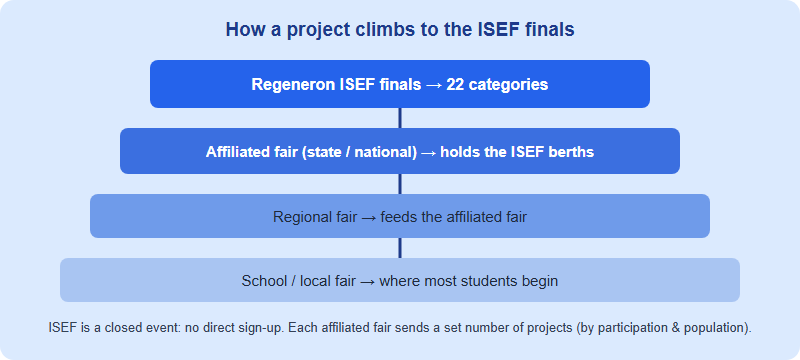
Most students new to ISEF assume there is an application form somewhere. There is not. The Society for Science describes ISEF as a closed event: “Students cannot represent themselves at Regeneron ISEF.” Instead, you compete in a Society-affiliated fair and win the qualification to advance. In practice the journey runs from a school or local fair, up through regional and (in the US) state levels, to the affiliated fair that holds the actual ISEF berths. That last fair is your real gateway — not the ISEF website.
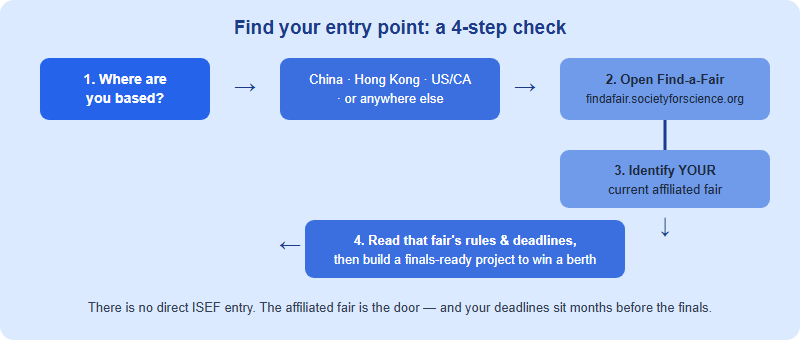
Two consequences follow, and both should shape your year. First, the project that wins at the fair is the project that reaches the finals — so the work has to be ready for an in-person judging table, not just a slide deck. Second, your timeline is set by your affiliated fair’s deadlines, which sit months before ISEF itself. If you want to understand the deeper why behind a finals-grade project, our companion piece on how to choose an ISEF research topic is the place to start; this article is about the route.
The affiliated-fair pyramid, stage by stage
The Society for Science runs an affiliated fair network — by its own count, nearly 400 affiliated fairs around the globe, in all 50 US states, the District of Columbia, and more than 75 countries, regions, and territories. Fairs operate at local, regional, state, and national levels, and only Society-affiliated fairs can send projects onward. Crucially, each affiliated fair may send a pre-determined number of projects to ISEF — a quota calculated from participation and high-school population, per the official FAQ. That is why the same project can be a clear winner at one fair and just miss the cut at another: the number of berths differs.
Who is eligible — and the timing rules that quietly disqualify projects
ISEF is for students in grades 9–12 or the equivalent. Beyond grade level, two research-timing rules catch students out, and both come straight from the official FAQ: a project may present no more than 12 months of continuous research, and it may not include research performed more than 18 months before ISEF. Read together, these rules reward a focused, recent body of work over a sprawling multi-year program — and they are a strong argument for planning the experimental window deliberately rather than backdating old data.
| Eligibility / rule | What the official source states | Source |
| Grade level | Grades 9–12 or equivalent | societyforscience.org FAQ |
| Entry route | Must compete in a Society-affiliated fair and win the right to attend; no self-representation (closed event) | societyforscience.org |
| Categories | 22 categories at the finals | societyforscience.org |
| Research window | ≤ 12 months continuous research; nothing from more than 18 months before ISEF | societyforscience.org FAQ |
| Fair quota | Each affiliated fair sends a pre-determined number of projects (by participation & HS population) | societyforscience.org FAQ |
| Age limit, team size, forms | Confirm on the official site — set by the current ISEF Rules & Guidelines and your affiliated fair | societyforscience.org |
One honest caveat: precise figures such as the maximum competition age, team-project size, and the required pre-fair paperwork are governed by the current ISEF Rules & Guidelines and can shift year to year. We are deliberately not quoting numbers we cannot verify on societyforscience.org right now. Before you commit, read your affiliated fair's rules and the official ISEF guidelines for the exact season — confirm on the official site.
International students: the path is the same, the entry point is local
The headline relief for families outside the US: the rule book does not change because you are international. The affiliated-fair network spans more than 75 countries, regions, and territories, and finalists arrive from more than 60 of them each year. The only difference is which affiliated fair is your door. You do not apply to ISEF in the US; you find the Society-affiliated fair that serves your country or region and win a berth there.
The single most reliable move — for any country — is the official Find-a-Fair directory at findafair.societyforscience.org. It is the authoritative list of which fairs are currently affiliated and where. Affiliations are reviewed periodically, so a fair that qualified students in one year is not guaranteed to be the route the next; the directory, not last year's rumour, is the source of truth. Below is how the major tracks for our students generally work — with the firm reminder to verify the current specifics yourself.
| Where the student is | General route to an ISEF berth | How to confirm |
| Mainland China | Compete in the relevant Society-affiliated science & technology competition for your region/level and win an ISEF nomination. The China Association for Science and Technology (CAST) is long associated with the ISEF community, but the affiliated entry point and its qualifying tracks must be checked for the current year. | Find-a-Fair (findafair.societyforscience.org) — confirm the current affiliated fair for your province/region |
| Hong Kong | Compete in the local Society-affiliated student science competition and win a place to represent Hong Kong at ISEF. Hong Kong has an established affiliated-fair presence; the specific competition and its rules should be confirmed each season. | Find-a-Fair (findafair.societyforscience.org) — confirm the current Hong Kong affiliated fair |
| US / Canada high schools | Begin at a school or local fair, advance through regional and (in the US) state-level Society-affiliated fairs; the affiliated fair that serves your area holds the ISEF berths. | Find-a-Fair (findafair.societyforscience.org) — locate your regional/state affiliated fair |
We are intentionally not stating the internal selection mechanics, deadlines, or quotas of any specific national or regional fair, because those are set by each fair and the Society and change over time — inventing them would be worse than useless. Treat the table as a map of where to look, and let the official Find-a-Fair directory and your affiliated fair's own rules give you the binding details.
Where coaching actually moves the needle on qualification
Knowing the path is the easy half. The hard half is that the qualifying fair rewards a genuinely strong, defensible project — and the affiliated-fair quota means you are often competing for a handful of berths against the best work in your region. This is exactly where method beats luck. At Embark — the international competition team of Youfang Education, founded in 2016 — we treat qualification as a research problem, not a registration errand: a real question the student cares about, an experiment rigorous enough to survive a judge's “why?”, and an honest data story. Per Embark, that approach has produced 750+ research-competition awards and a record across all 22 ISEF categories, with discipline-matched mentors drawn from a network of 3,000+ researchers (per Embark).
We are explicit about what we will not do: we do not promise a berth, we do not rank ourselves as anyone's “#1 shortcut,” and we do not manufacture projects a student cannot defend — those collapse at the judging table, which is precisely where qualification is decided. The point of coaching is to make the work good enough that the fair result follows. For the next links in the chain, see every path to the ISEF finals and what ISEF judges look for at the booth.
Frequently asked questions
Can I sign up for the ISEF finals directly?
No. Per societyforscience.org, ISEF is a closed event — you must win the right to attend at a Society-affiliated local, regional, state, or national fair first. There is no direct application.
How do students in mainland China or Hong Kong qualify?
Through a Society-affiliated fair serving your region. Use the official Find-a-Fair directory (findafair.societyforscience.org) to confirm the current affiliated fair and its rules — these can change year to year, so verify.
What grade do I need to be in, and is there a research time limit?
ISEF is for grades 9–12 or equivalent. A project may show no more than 12 months of continuous research and nothing from more than 18 months before ISEF. Confirm age and form rules on the official site.
How many students can my fair send to ISEF?
Each affiliated fair sends a pre-determined number of projects, calculated by participation and high-school population. The exact quota differs by fair — check your affiliated fair directly.
Work with Embark
The fair rewards a real project, defended well — we help you turn a genuine question into an ISEF-caliber project with a discipline-matched mentor who has done the science, not a rushed entry built to a deadline.
Embark is an independent research-coaching organization, the international competition team of Youfang Education; it is not affiliated with, endorsed by, or sponsored by the Society for Science or Regeneron ISEF. Any results cited reflect Embark's own published record (per Embark). Always confirm current details — eligibility, deadlines, fees, forms, and qualifying routes — on societyforscience.org and your affiliated fair's official site. Confirmed errors are corrected within 7 working days.