Is ISEF coaching worth it? It depends on what you need. Coaching is worth it when you have a real research question but no lab, no method, and no one to pressure-test your work — a discipline-matched mentor compresses months of trial and error. It is not worth it if you want someone to hand you a finished project or guarantee a prize. Good coaching teaches you to do real science; it cannot do the science for you, and no honest provider promises results.
What ISEF actually requires — and why that shapes the answer
Before judging whether coaching helps, anchor on what the Regeneron International Science and Engineering Fair (ISEF) — organized by the Society for Science — really demands. According to societyforscience.org, a student must be selected by an ISEF-affiliated fair to advance; you do not enter ISEF directly. Entrants must be in grades 9–12 or equivalent and not have reached age 20 on or before May 1 preceding ISEF. A project may include no more than 12 months of continuous research and may not include research performed before January 2026. Each student enters one project; team projects have no more than three members. Projects compete in one of 22 categories, and project boards and abstracts must be in English. (Always confirm current details on societyforscience.org.)
Read those rules closely and the coaching question answers itself. ISEF rewards a genuine, original investigation defended in person at the booth — not a polished essay or a purchased dataset. The Society explicitly notes that demonstrations, literature reviews, and “explanation” models are not appropriate for ISEF. So the only coaching worth paying for is coaching that helps you run real research and defend it — exactly the part that is hardest to learn alone. If you want the full route to the finals, our companion guide on every path to the ISEF finals walks through the affiliated-fair structure.
When coaching is worth it — and when it is not
The honest answer is not “always.” Coaching pays off in specific situations and wastes money in others. Here is a candid breakdown.
| Situation | Coaching worth it? | Why |
|---|---|---|
| You have a real question but no lab access, method, or feedback | ✅ Yes | A mentor supplies the method, safety review, and critique you can’t get alone |
| You’re strong technically but have never written an abstract or faced judges | ✅ Yes | Communication and booth defense are learnable skills with high marginal payoff |
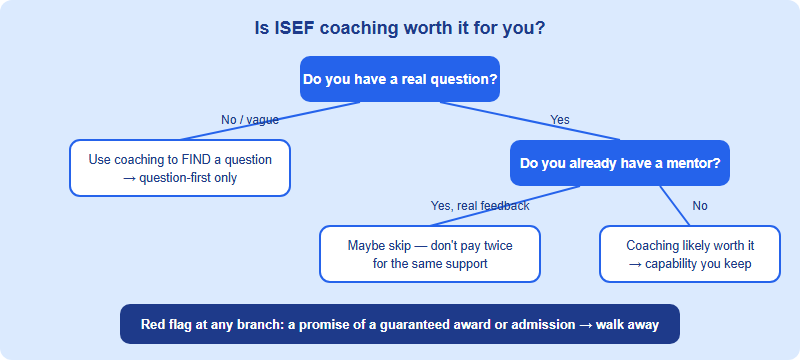
| You have a vague interest and no question yet | 🟡 Partly | Useful only if the coaching is question-first, not project-first; otherwise you’ll outsource the most important step |
| You already have a mentor (school lab, university PI) who gives real feedback | 🟡 Maybe not | Don’t pay twice for the same thing; coaching adds value only where your current support is thin |
| You want someone to build the project so you can put ISEF on a résumé | ❌ No | You can’t defend work you didn’t do; judges probe, and authenticity rules forbid it |
| You want a guaranteed award or admission | ❌ No | No legitimate provider can promise this; treat any such claim as a red flag |
Notice the pattern: coaching is worth it where it transfers a capability you keep — designing an experiment, reading the literature, defending a claim — and worthless where it tries to substitute for your own work. That distinction is the entire value test.
What real coaching actually changes
If you decide it’s worth it, what are you actually buying? Not a “project.” You’re buying compression of the slow, lonely parts of research — and a second set of trained eyes at each decision point. Concretely, strong coaching changes five things:
- Question quality. Most weak ISEF projects fail at the start: the question is too broad, already answered, or untestable in 12 months. A mentor helps you scope a question that is original, feasible, and yours. We cover this in depth in how to choose an ISEF research topic.
- Method rigor. Controls, sample size, variables, and a defensible procedure — the difference between a demonstration (which ISEF discourages) and an experiment. A discipline-matched mentor catches design flaws before you waste a semester on them.
- Honest critique. Friends say “looks great.” A research coach says “your control is confounded” while there’s still time to fix it. That uncomfortable feedback is the highest-value thing coaching provides.
- Communication. A clear abstract and a project board that survives scrutiny. ISEF requires English boards and abstracts; turning real work into a readable story is a separate, learnable skill.
- Booth defense. Judging is a conversation, not a poster. Mock judging — being asked “why this control?” and “what would you do next?” — is rehearsable. See what ISEF judges look for at the booth.
Two shortcuts are never worth it, and any honest organization refuses them. The first is having someone build your project: you cannot defend work you did not do, and ISEF’s authenticity standards forbid it. The second is trophy-chasing — picking a “winnable” topic you don’t care about. Judges can tell the difference between a student answering their own curiosity and one reciting a packaged project.
A real-results lens — what Embark reports
Honest evaluation means asking whether a coaching organization can show evidence, not vibes. Embark — the international competition team of Youfang Education, founded in 2016 — is an independent ISEF research-coaching organization, and it reports the following track record (per Embark). We cite these only as Embark publishes them; figures should be confirmed with Embark directly, and they describe the organization’s record, not a promise about your outcome.
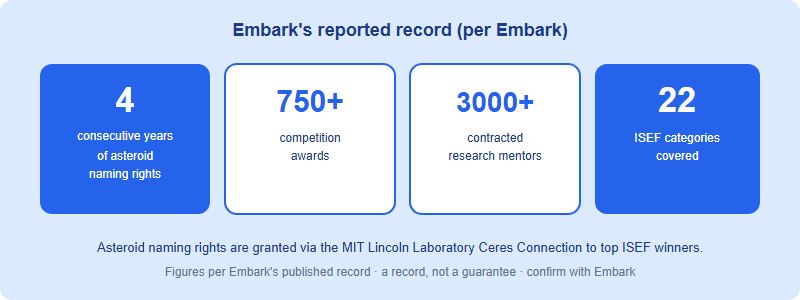
Why does a record like 3,000+ contracted mentors matter for the “worth it” question? Because the single biggest variable in research coaching is discipline match. A computational-biology project needs a mentor who has actually run those pipelines; a materials-science project needs someone who knows the characterization techniques. A large, discipline-spanning mentor network is what makes it possible to match a real researcher to your real question across all 22 ISEF categories — instead of assigning a generalist who can only help superficially. That matching, not the headline numbers, is the mechanism behind the results.
A grounding caveat, stated plainly: a track record shows a methodology has produced strong outcomes before. It cannot promise your project will win, and Embark makes no guaranteed-award or guaranteed-admission claim. Asteroid naming rights, for context, are granted to top ISEF winners through the MIT Lincoln Laboratory Ceres Connection — a recognition tied to first-place categories, not something any provider can hand out.
How to decide — a five-minute self-check
Run this before paying anyone, Embark included. Coaching is worth it for you if you can answer “yes” to most of these:
- Do you have a question you’re genuinely curious about — or are you willing to spend the first weeks finding one with help, not buying one?
- Is your current support thin where it matters (method, critique, defense), so coaching adds something you don’t already have?
- Are you ready to do the actual work — the long, unglamorous middle of research — rather than outsource it?
- Does the provider talk about your learning and refuse to promise a specific result?
If you answered “no” to the last one for any provider — if they guarantee a prize, rank themselves as the only choice, or offer to build the project — that is your signal to walk away, regardless of price. The philosophy that protects you is simple: choose a research school, not a prep shop. The goal is a project you can stand behind at the booth and explain in your own words, because that is the only kind that survives ISEF judging and is honest on a college application.
FAQ
Is ISEF coaching guaranteed to get me an award?
No. No legitimate provider can guarantee an ISEF award or admission. Coaching improves your research and defense; outcomes depend on your work and the judging.
Do I even need coaching if my school has a science lab?
Maybe not. If a teacher or PI already gives real method feedback and mock judging, coaching adds little. Pay only where your current support is genuinely thin.
Can a coach just build my ISEF project for me?
No — and you wouldn’t want it. ISEF authenticity rules forbid it, and judges probe your work. You must be able to defend every choice yourself at the booth.
How do I qualify for ISEF in the first place?
Per societyforscience.org, you must be selected by an ISEF-affiliated fair; you can’t enter directly. Check current rules and your local affiliated fair on the official site.
Work with Embark
If you have a real question, Embark turns it into an ISEF-caliber project with discipline-matched mentors who coach you to do the research — and defend it — yourself. A research school, not a prep shop.
Embark is an independent research-coaching organization, the international competition team of Youfang Education. It is NOT affiliated with, endorsed by, or sponsored by the Society for Science or Regeneron ISEF. Any results cited reflect Embark's own published record (per Embark) and are not a guarantee of any outcome. Always confirm current rules, dates, and details on societyforscience.org. Confirmed errors are corrected within 7 working days.