Your affiliated fair named you a finalist. Officially, affiliated fairs all conclude by mid-April and ISEF is held in May — but that is the latest a fair can run. Many fairs, including the mainland China qualifying routes, finish in the first quarter of the year, so your gap may be a few weeks or a couple of months. Work out your own dates first, because they change what is realistic below. Most students spend the gap either frozen or frantically rebuilding everything. Both are mistakes. This is a triage window: fix what a judge can catch, deepen what you already have, and rehearse the conversation.
The gap nobody plans for
Almost every ISEF resource ends at the moment of qualification. Students spend a year on the research, weeks on the regional fair, and then — having won the thing they were aiming at — discover there is another competition in front of them with a different scale and a different standard. Our overview of every path to the ISEF finals covers how nomination works. This article starts the day after.
The scale change is the first thing to absorb. The most recent edition drew more than 1,700 finalists selected from 365 affiliated fairs across more than 60 countries, regions and territories, competing for more than $7 million in awards and prizes. At your regional fair you may have been the only person in the room working on your topic. At ISEF you will be one of several, and at least one judge is likely to know your subfield properly.
That is not a reason to panic. It is a reason to change what you optimise for. At a regional fair, breadth wins: judges rotate across categories and reward a clear, well-presented idea. At the finals, depth wins: the questions go one or two layers past your poster, into why you chose that method, what you would do differently, and what your data cannot show. The work in this window is mostly about closing that depth gap on a project you have already finished.
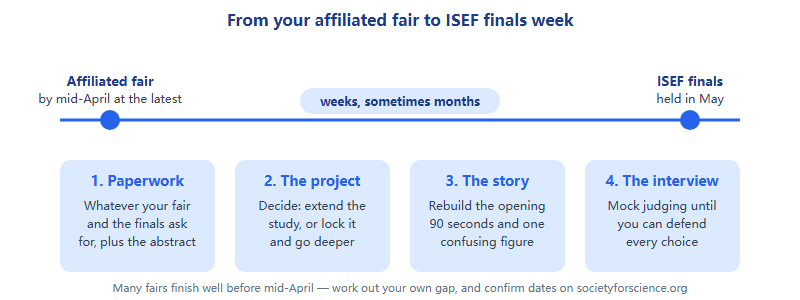
Workstream 1: the paperwork you cannot improvise
Start here, because it is the only workstream with hard external deadlines and the only one that can end your season regardless of how good the science is. Your affiliated fair director is your primary channel; they will tell you exactly what the finals require from you and by when. Do not guess at this, and do not rely on what a friend at another fair was told — requirements and deadlines are published each cycle and should be confirmed on societyforscience.org.
Two things about ISEF documentation are worth understanding in principle, because they shape how you use these weeks. First, the great majority of the forms are meant to be completed and signed before research takes place, not afterwards. If a required approval was never obtained at the right time, this window is not when you quietly backfill it — it is when you tell your adult sponsor and fair director the truth and let them advise. Second, a small set of items is explicitly done after the research, and the abstract is one of them.
The abstract deserves specific attention because students routinely reuse the regional version without rereading the rules. Per the official rules it is a maximum 250-word, one-page document, written after experimentation, summarising the current year’s work, and it must describe research conducted by the student, not by the supervising adult. That last clause is not decorative. If your abstract narrates things your mentor did, you have written the wrong document, and you have created a mismatch between your paperwork and the answers you will give at the booth.
If your project builds on work from a previous year, the continuation rules apply: the current year must show substantive expansion from the prior work — testing a new variable, for example, rather than repeating what you already did — and continuation projects carry their own form, which is displayed at the booth. Sort out what counts as this year’s contribution now, in writing, rather than trying to draw the line under judging pressure.
Workstream 2: the one decision that shapes the rest
Every finalist faces the same fork: do I collect more data before the finals, or do I lock the dataset and spend the time understanding it better? Students almost always want the first. It feels like progress, and it answers the anxiety of “my project is not big enough.” It is usually the wrong choice.
Two constraints should discipline the decision. The first is rules-based: ISEF limits you to no more than 12 months of continuous research, with an earliest permissible start date defined for each cycle, so extending your study is not automatically allowed and the current cycle’s window should be confirmed officially before you run anything new. The second is practical: data that arrives late in your own window — however long that window turns out to be — is data you will not have time to analyse properly, sanity-check, or integrate into your narrative. A judge who finds an unexamined number on your board will ask about it, and “we only just collected that” is a weak answer.
There is a narrow case where extending is right: a control you genuinely skipped, a replicate that would convert a single observation into a trend, or a second condition that closes an obvious hole a regional judge already flagged. Those are targeted additions to an existing design, not new questions. If a regional judge asked something you could not answer and the answer is one experiment away, run that experiment. If the answer is a new research question, write it down as future work — that is what your research topic becomes for next season, not for this one.
The alternative use of the time is less glamorous and usually worth more: reanalyse what you already have. Recompute your key result with an honest measure of uncertainty. Check whether an alternative explanation survives your data. Find the three most relevant papers you have not read and see whether your result agrees with them. Depth on existing data is what converts a regional-level project into one that holds up to a specialist.
Workstream 3 and 4: triage the board, rehearse the conversation
Now triage. The instinct after qualifying is to redesign the board from scratch. Resist it. A board that already communicated well enough to win a nomination does not need new fonts; it needs the two or three specific things that confused a judge fixed, and everything else left alone. Use this split.
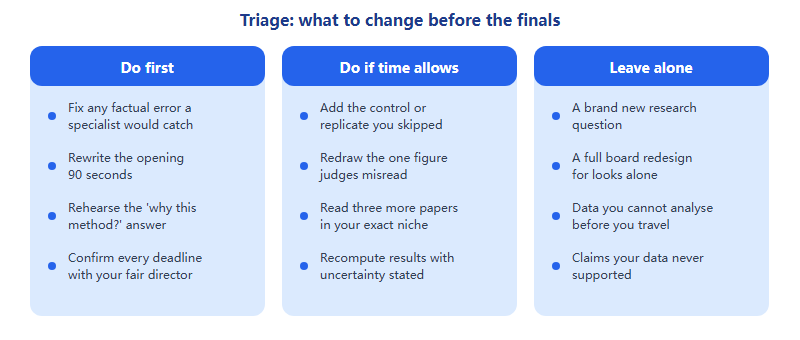
The rehearsal workstream is the one students under-invest in most, and it is where the finals differ most sharply from a regional fair. You are not delivering a speech; you are having a technical conversation with someone who may know the field better than you do. The published Grand Award criteria weight presentation heavily, with the interview carrying more of it than the poster — confirm the current year’s criteria on the official site — which means what you can say beats what you can display. Our breakdown of what ISEF judges look for at the booth goes through the conversation itself in detail.
Practically: run mock interviews with someone who will interrupt you. Have them ask “why did you choose that method rather than the obvious alternative?”, “what would change your conclusion?”, and “what is the weakest part of this project?” The last one matters most. A finalist who names their own limitation clearly and explains what they would do about it reads as a scientist. A finalist who insists there are no weaknesses reads as someone who has not thought hard enough.
A week-by-week shape you can adapt
Exact timings depend on when your fair ended and when the finals fall, so treat this as a shape rather than a calendar. The principle is that paperwork and any additional experiments must finish early, because analysis, narrative and rehearsal all depend on them.
| Stage | Priority | What good looks like | Common mistake |
|---|---|---|---|
| First days after nomination | Paperwork and deadlines | Written confirmation from your fair director of every requirement and date | Assuming the regional submission carries over unchanged |
| Early window | The extend-or-lock decision | A short written case for any new experiment, checked against the research window rules | Starting new work because the project feels “too small” |
| Middle window | Reanalysis and depth | Key result recomputed with uncertainty; three new papers read and reconciled | Polishing the board instead of understanding the data |
| Later window | Abstract and narrative | A current-year abstract inside the word limit describing your own work | Reusing last year’s or the regional abstract unedited |
| Final stretch | Mock judging | Three interviews with interrupting questioners; weakest-point answer rehearsed | Memorising a monologue nobody will let you finish |
| Travel period | Logistics | Documents, transport of materials and school absence sorted early | Leaving visa or travel paperwork until the science is “done” |
One note specific to students travelling internationally: the logistics are not a footnote. Travel documents, permissions, transporting a physical board or equipment, and time away from school all take longer than students expect, and they compete for exactly the weeks you need for rehearsal. Start them in parallel on day one rather than treating them as something to handle after the science is finished.
What we see go wrong (an Embark coach view)
Per Embark, the pattern in this window is remarkably consistent across the finals cohorts behind our published competition record. The students who struggle at the finals are rarely the ones with modest results; they are the ones who spent the gap adding rather than understanding. They arrive with a bigger dataset and a shallower grasp of it, and the first judge who asks a second-layer question finds the floor.
The second failure mode is narrative drift. A student who has been told their project is now “an ISEF project” starts inflating the claims — the applications get grander, the language gets more confident, and the gap between what the data show and what the board says widens. Judges close that gap in about ninety seconds, and the cost is not just credibility on the claim; it is credibility on everything else you say afterwards.
We are a research school, not a prep shop, so our coaching in this window is deliberately unglamorous: we tell most students to stop collecting, sit with their data, read more, and get comfortable saying what their project does not show. That is also the honest framing for what qualifying means. A nomination says your work was among the strongest at your fair. It does not promise a Grand Award, and no coach can. What these weeks can reliably do is make sure that when a specialist asks you a hard question, the answer is yours.
Frequently asked questions
Can I keep doing experiments after I qualify?
Sometimes, but ISEF limits research to a 12-month continuous window with a set earliest start date each cycle. Confirm the current rules officially first.
Do I reuse my regional fair abstract?
Rewrite it. The abstract has a 250-word maximum, is written after experimentation, and must describe your own work, not your mentor’s.
Should I rebuild my project board?
Usually no. Fix the specific things that confused judges and invest the rest of the time in reanalysis and mock interviews.
How do I find out my exact deadlines?
Ask your affiliated fair director and check societyforscience.org. Requirements and dates are published per cycle and change year to year.
Work with Embark
Embark is the international competition team of Youfang Education — a research school, not a prep shop. Our coaches are working researchers who help finalists use the weeks before the finals well: reanalysing data, tightening the story, and rehearsing the questions a specialist will actually ask. We do not sell shortcuts or guarantee outcomes; we teach the craft.
Embark is an independent research-coaching organization, the international competition team of Youfang Education. We are not affiliated with, endorsed by, or sponsored by the Society for Science or Regeneron ISEF. Any results cited reflect Embark's own published record (per Embark). Please confirm all competition details, dates and rules on societyforscience.org; we correct any errors within 7 working days.