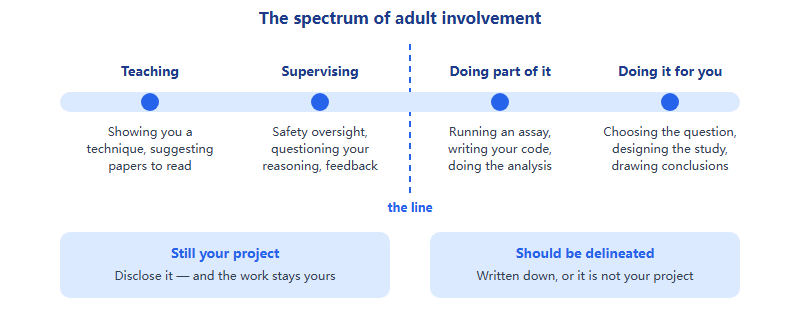
Every serious ISEF project involves adults: an adult sponsor, often a mentor, sometimes an institution. So the question is not whether you had help — it is where the line sits. ISEF answers it in two places. Your research plan should delineate which parts were done by you and which by your mentor, and your abstract must describe research conducted by the student, not by the supervising adult.
The question families ask, and the wrong answers to it
Chinese families new to ISEF ask a version of this question almost immediately: how much can we help? The two answers that circulate are both wrong. The first says any adult involvement is cheating, which would disqualify most real science — research is an apprenticeship, and working alongside someone more experienced is how it has always been learned. The second says the result is all that matters and nobody checks, which is simply false.
The accurate answer is narrower and more useful: help is expected, but authorship is not transferable. You may be taught, supervised, corrected, given access to equipment and shown how to use it. What you may not do is present work as yours when the intellectual decisions were somebody else’s. The rules do not ask you to be unhelped. They ask you to be accurate about what you did.
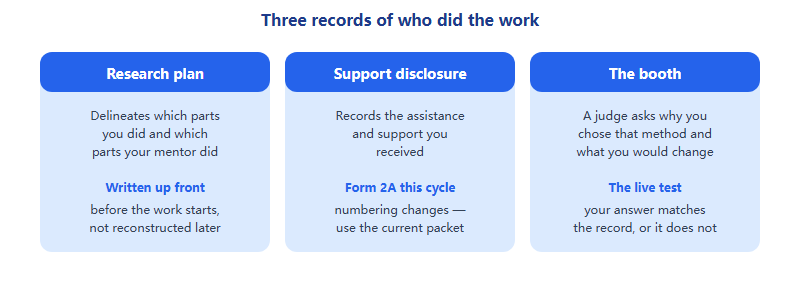
This matters practically because ISEF checks it three ways, and they cross-reference. There is what your research plan says, what your support disclosure records, and what you say at the booth when a judge asks why you chose that method. A student whose contribution is real gives three consistent answers without effort. A student presenting someone else’s project has to keep three stories aligned under pressure, and that is where it comes apart.
What the rules actually require
Three official requirements do most of the work here, and they are worth reading as design constraints on your project rather than as forms to survive.
First, the research plan. Where a mentor participated, the plan should delineate which parts of the project were done by the student and which parts by the mentor. Notice that this is written at the start of the project, not at the end. A team that cannot answer “who will do what” in advance has not really decided whose project it is — and drifting into an answer over the year is how students end up presenting work they cannot defend.
Second, the abstract. It must describe research conducted by the student, not by the supervising adult. This is a surprisingly sharp test. Sit with your abstract and mark every claim you personally executed or decided. If large parts survive only because of what a lab did around you, the abstract is describing the lab’s project with your name on it, and you have discovered the problem early enough to fix the framing.
Third, disclosure. ISEF requires a Student Support Disclosure Form — numbered 2A in the current cycle’s packet — documenting the assistance and support you received. Related forms cover work supervised by a qualified scientist and research carried out in a regulated research institution. Form numbering has shifted between cycles, so use the current year’s packet from societyforscience.org rather than an old one you found online, and note that most forms are meant to be completed and signed before research begins.
The booth is where the line gets tested
Documentation establishes what you claim. The judging interview tests it. And it does so without anyone ever asking “did you really do this?” — because the ordinary technical questions are already a perfect ownership test.
Consider what happens when a judge asks why you chose a particular concentration, sample size or model architecture. A student who made the decision remembers the alternatives they rejected and why. A student who inherited it can describe what was done but not why that rather than something else. The same is true of “what would you do differently?”: real ownership produces specific regrets, while borrowed work produces vague ones. Our breakdown of what ISEF judges look for at the booth goes through the mechanics of that conversation.
This is why over-help backfires even on its own terms. A mentor who designs the study to make it more impressive raises the technical level of the project and simultaneously lowers the student’s ability to discuss it — and the published Grand Award criteria weight the interview heavily within the presentation score. Confirm the current criteria on the official site, but the direction is clear: a sophisticated project that its presenter cannot explain performs worse than a modest project its author understands completely.
A useful private exercise: have someone ask you “why?” three times in a row about any decision in your project. Why that method? Why that parameter? Why did that matter? Ownership survives three layers. Anything less than genuine ownership usually runs out at the second.
Where parents actually fit
Parents are rarely trying to cheat. They are trying to stop their child from failing, which is a different motive with similar effects. The useful reframing is that there is a large category of support that is genuinely valuable and touches nothing a judge will ever attribute to a student.
| Area | Helpful and uncontroversial | Crosses into the student’s work |
|---|---|---|
| Logistics | Transport, travel arrangements, buying approved materials, paying documented costs | Sourcing a solution to a research problem the student has not solved |
| Time | Protecting study blocks, managing the family calendar around deadlines | Doing parts of the project so the student can revise for exams |
| Access | Introducing a family contact who might mentor, then stepping back | Negotiating what the project will be with that contact |
| Feedback | Listening to a practice talk and saying which parts were unclear | Rewriting the abstract, board text or conclusions |
| Emotion | Steadying the student through a failed experiment | Treating a null result as a crisis to be engineered away |
| Judgement | Asking “can you explain that to me?” and letting silence do the work | Supplying the answer when the explanation stalls |
The right-hand column is worth reading carefully, because the entries are not equally obvious. Paying for approved materials is ordinary and disclosable. Rewriting a child’s conclusions is not a grey area at all — conclusions are the intellectual core of the project. And the last row is the one families find hardest: when a student cannot explain their own work, the instinct is to supply the missing explanation. Letting the gap stay visible is what allows it to be fixed.
How to protect your ownership from the start
If you are working in a university lab or with a professional mentor, the ownership risk is highest and the safeguards are simplest. Agree in writing, at the start, what is yours. One paragraph naming your question, your variables, the analysis you will run and the parts the lab will handle is enough. That paragraph feeds directly into the research plan requirement, and it prevents the most common drift — a student joining an ongoing project and gradually becoming a pair of hands on somebody else’s question.
Second, keep a contemporaneous record of your own decisions, not just your results. Note what you tried, what failed, and what you chose instead. When a judge asks why, that record is the difference between reconstructing a rationale and remembering one. It also makes the disclosure form trivial to complete honestly at the end.
Third, choose the scope you can own. A more ambitious project run mostly by adults is worth less than a smaller one you designed and executed — both in judging and in what you learn. That is largely a question you settle when you pick your research topic, and it is why we push students toward questions sized to their own current ability rather than to the equipment they can borrow. Where you compete and how you qualify are separate decisions, covered in our guide to every path to the ISEF finals.
Per Embark, this is the point where our approach differs most visibly from a results-first one. We are a research school, not a prep shop: our coaches are working researchers, and their job is to teach a student to make a decision, not to make it for them. That produces slower first drafts and occasionally less impressive-sounding projects. It also produces students who can answer three “why”s in a row — which, on the floor, is worth more than a borrowed technique. Nobody can guarantee an award. What you can guarantee is that the work is defensible because it is actually yours.
Frequently asked questions
Is it cheating to have a mentor for an ISEF project?
No. Mentoring is expected. The requirement is that your research plan delineates which parts you did and which your mentor did.
Do I have to disclose the help I received?
Yes. ISEF requires a Student Support Disclosure Form documenting assistance and support. Use the current cycle’s packet from the official site.
Can my parents help with my project?
With logistics, time and honest feedback, yes. Writing your abstract, board text or conclusions is not feedback — it is authorship.
How do judges tell whose work it is?
They ask ordinary technical questions. Someone who made a decision can explain the alternatives they rejected; someone who inherited it cannot.
Work with Embark
Embark is the international competition team of Youfang Education — a research school, not a prep shop. Our coaches are working researchers who teach students to make and defend their own research decisions, and who help families draw the ownership line clearly at the start of a project. We do not sell shortcuts or guarantee outcomes; we teach the craft.
Embark is an independent research-coaching organization, the international competition team of Youfang Education. We are not affiliated with, endorsed by, or sponsored by the Society for Science or Regeneron ISEF. Any results cited reflect Embark's own published record (per Embark). Form names and numbering change between cycles — please confirm all rules and current forms on societyforscience.org; we correct any errors within 7 working days.