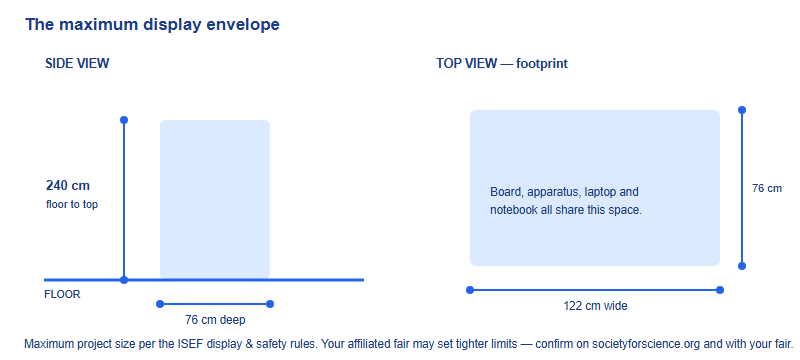
An ISEF booth has a hard size envelope — 76 cm deep, 122 cm wide, 240 cm from the floor to the top — and a surprisingly long list of things that may not sit inside it. School crests, national flags, QR codes, brochures, flash drives and medals are all named as not allowed. None of this affects your science. All of it can cost you the morning before judging.
The size envelope, and why it is measured from the floor
The display and safety rules give three maximum dimensions for a project display: depth (front to back) 76 cm, width (side to side) 122 cm, and height (floor to top) 240 cm. The third one is the one students misread. It is not the height of your board — it is everything stacked from the floor upward, so a tall board placed on a table is measured including the table.
Depth catches people too. Seventy-six centimetres front to back sounds generous until you have a board, a laptop, an apparatus and a lab notebook competing for the same footprint. Anything protruding into the aisle is outside the envelope.
The banned list, and the single idea behind it
The prohibited items look arbitrary until you notice they cluster into four intentions. The rules are trying to keep the hall a place where the research is what is judged: no promotion, no distribution, no contact harvesting, no clutter.
| What the rules bar | Examples that appear on real boards | The intention |
|---|---|---|
| Self-promotion and external endorsements | Commercial logos, institutional crests, trademarks, flags | Judge the project, not the sponsor, school or country behind it |
| Anything intended for distribution | Disks, CDs, flash drives, brochures | The booth is a conversation, not a marketing stand |
| Contact details and live connections | Postal addresses, websites, email, social media handles, QR codes; active internet or email connections | Protects a hall full of minors from contact harvesting |
| Awards and medals | Prior competition awards and medals — the stated exception is past or present ISEF medals worn by the finalist | Prestige from elsewhere should not colour this year's judging |
| Clutter and stored belongings | Personal items or packaging materials stored in or around the booth | Safety and a workable aisle for thousands of visitors |
| Loose published literature | Published research papers may only be present within a lab notebook | Keeps the display about your work, with sources kept where judges expect them |
Where students coming from outside the United States get caught
In coaching, the same five items account for nearly every late-night fix. Four of them are things that would be entirely normal — even expected — on a competition board at home.
- The school crest. International-school boards very often carry the school badge in a corner as a matter of habit. Crests fall under institutional crests and trademarks, which the rules bar unless they are integral or incidental to the project and approved in advance by the ISEF Display and Safety Committee — which a school badge on a board will not be. The useful nuance: the rules do permit certain personal information — finalist name, school, city, state and country, with age and grade also permitted. The school's name in text is allowed; the school's logo is not. Set it in plain type and move on.
- The national flag. Flags are named in the prohibited list. Students who have competed at national fairs where flags are standard are the most likely to bring one.
- The QR code. This is the most common single error we see, because a QR code linking to a dataset, a GitHub repository or a demo video feels like good scientific practice. QR codes are named alongside web, email and social-media addresses in the prohibited list. Plan to show supplementary material from your own device in conversation rather than to link to it from the board.
- Last year's medals. Bringing a regional or national medal to sit beside the board reads as evidence of a serious record. Under these rules it reads as a prohibited award display, with the stated exception for ISEF medals worn by the finalist.
- The suitcase. After a long flight, the natural instinct is to stow bags and packaging behind the board. Personal items and packaging materials stored in or around the booth are not permitted. Find out where luggage goes before you arrive with it.
A related planning point: some of these constraints trace all the way back to the project you chose. Field studies with site partners, work done inside a company lab, and research involving other people all generate branding, consent and photography issues on the board later. That is one more reason to think about downstream logistics at the point of choosing your research topic, not the week before finals.
Every image needs a source line — including the ones you generated
The image-credit rules are more specific than most students expect, and they now cover AI. The rules set three distinct paths depending on who or what made the graphic.
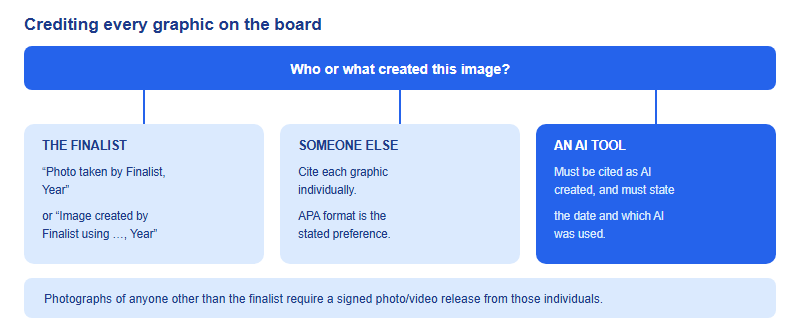
Two practical notes. First, the release-form requirement for photographs of other people is easy to forget for anyone whose method involved human participants — a photo of your test session is a photo of people. Get releases at the time of the session, not months later when the class has moved on. Second, the AI-citation rule requires more than the word “AI”: the citation must include the date and the specific tool used. Record that at the moment you generate anything, because reconstructing it in May is guesswork.
The short list you may have — with prior approval
A few items are not flatly banned but sit behind approval or conditions, and the conditions are specific.
- Drones and flight-capable apparatus: named as requiring prior approval unless the propulsion power source is removed. If your project is a UAV, the display version is generally the de-powered one.
- Lighting: decorative lighting or illumination is discouraged. Where it is used, the rules state it must be as low a voltage as possible and must be LED. A booth lit for aesthetics is a booth arguing with the rules for no scientific gain.
- Active internet or email connections: not permitted as part of the display, with exceptions only where requested by email and approved in advance. If a live demonstration is genuinely central to your result, this is a request to make early in the season, not on arrival.
Beyond the display rules themselves, remember that affiliated fairs can and do add their own constraints, and the fair is where your project is first inspected. If you are unclear which fair route you are on, we set out the qualification structure in every path to the ISEF finals.
A pre-flight check you can run in twenty minutes
Do this once at home with the board fully assembled, and once again the night before setup.
- Measure, do not estimate. Depth and width with a tape; height from the floor with the table it will stand on. Photograph the assembled result.
- Zoom to 100% and read every corner. Crests, logos, watermarks and stock-image marks hide in headers, footers and figure edges. Software templates insert them silently.
- Search your own board for a URL. Any web address, email, handle or QR code comes off. Check figure captions and reference lists as well as the main panels.
- List every image and name its source. Yours, someone else's, or AI-generated — each gets its own credit line in the required form. Note the date and tool for anything AI-generated.
- Check what must be present, not only what must not. Required documentation belongs at the booth, including the abstract and, if your project is a continuation of earlier research, Continuation/Research Progression Projects Form (7), which the rules require to be displayed at the project booth.
- Decide where the bags go. Not behind the board.
None of this earns a point. The Grand Award criteria award 35 points to presentation, of which 25 sit in the interview — and a student who spent setup morning reprinting a board arrives at that interview rattled. The display rules are best treated as a checklist you clear early so that your attention on judging day goes entirely to the conversation. What that conversation actually assesses is covered in what ISEF judges look for at the booth.
How big can an ISEF project display be?
The stated maximums are 76 cm deep, 122 cm wide and 240 cm high measured from the floor. Confirm current limits on societyforscience.org.
Can I put a QR code linking to my dataset on the board?
No. QR codes appear alongside postal, web, email and social-media addresses in the list of items not allowed at the display.
Can I show my school logo or my country's flag?
Generally no. Crests, trademarks and flags are barred unless integral or incidental to the project and approved in advance by the ISEF Display and Safety Committee, which a school badge will not be. Finalist name, school, city, state, country, age and grade are permitted as text.
Do AI-generated figures need a citation?
Yes. They must be cited as AI created, and the citation must include the date and which AI tool was used.
Work with Embark
Display compliance is the cheapest problem to solve and the most annoying one to discover on setup morning. If you are preparing a board for a fair this season, we will run it against the current rules with you — and spend the rest of the time on the interview, which is where the marks actually are.
Embark is an independent research-coaching organisation, the international competition team of Youfang Education. We are not affiliated with, endorsed by, or sponsored by the Society for Science or Regeneron ISEF. Any results cited reflect Embark's own published record (per Embark). Display dimensions, prohibited-item lists, citation requirements and approval procedures change between cycles and affiliated fairs may add their own — confirm all details on societyforscience.org and with your fair. Factual errors are corrected within 7 working days of notice.