At the Regeneron International Science and Engineering Fair (ISEF) 2026 in Phoenix, Arizona, Team Embark reported 10+ awards across 12 disciplines — a team record — together with a 4th consecutive year of minor-planet (asteroid) naming rights through the Ceres Connection program, with the bodies catalogued by the International Astronomical Union (all figures per Embark). Winners came from mainland China’s qualifying tracks, Hong Kong, and US/Canada high schools. This article reads that record honestly: what a repeatable result reflects, and what it does not.
The 2026 season, in numbers (per Embark)
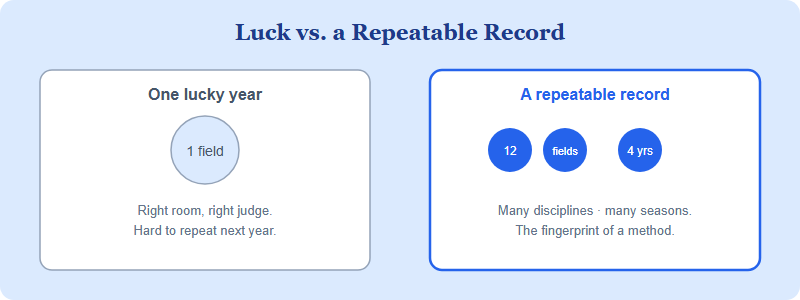
A single strong year at ISEF can be luck — the right judge, the right room, a project that happened to land. A pattern that holds across multiple years and many disciplines is a different kind of signal. Below is Team Embark’s published account of its 2026 season. Every figure here is reported by Embark; ISEF’s own awards, finalist counts, and rules are confirmed separately against the official source in the next section.
| Metric (per Embark) | 2026 result | Why it matters |
|---|---|---|
| Awards at ISEF 2026 | 10+ (a team record) | Breadth of recognition, not a single lucky hit |
| Disciplines represented | 12 | Method travels across fields, not one niche |
| Asteroid naming rights | 4th consecutive year | Repeatability across seasons — the hardest thing to fake |
| Where winners qualified from | Mainland China tracks, Hong Kong, US & Canada | Same coaching standard across very different fair systems |
The number worth pausing on is not “10+.” It is “12 disciplines” and “4th consecutive year.” A topic-shop can occasionally produce one winner by saturating a popular category. It is much harder to place students in twelve different fields, year after year, when each field has its own literature, its own experimental norms, and its own panel of judges. That kind of spread is the fingerprint of a process that does not depend on any one mentor or any one trend.
What ISEF 2026 actually was (verified facts)
Before reading any program’s record, it helps to know what the competition itself is — and to separate the parts you can verify from the parts a coaching organization simply reports about itself. The following ISEF facts are drawn from the official source, the Society for Science (societyforscience.org):
- Event & location: Regeneron ISEF 2026 was held in Phoenix, Arizona (Phoenix Convention Center), in May 2026. It is the world’s largest pre-college science competition.
- Scale: the Society reports more than 1,700 finalists from nearly 70 countries, regions and territories, competing for awards that totaled more than $7 million in 2026.
- Categories: projects compete in one of 22 categories — raised to 22 by the new Technology Enhances the Arts (TECA) category — spanning every science and engineering discipline.
- Eligibility: students in grades 9–12 (or equivalent) who have not reached age 20 on or before May 1 of the ISEF year.
- How you get in: you do not register for ISEF directly. A student must first win the right to attend through a Society-affiliated fair; each affiliated fair has a fixed number of finalist slots. Each student enters one project covering research from a continuous period of up to 12 months.
That last point matters for reading any “record.” Because finalists are filtered through affiliated fairs before Phoenix, simply reaching ISEF is already an achievement — and awards on top of that are scarce. For the mechanics of those qualifying routes, see our companion guide on every path to the ISEF finals.
The asteroid: what the Ceres Connection is, and how to read it
The headline that catches every parent’s eye is “a student got an asteroid.” Here is what that means, stated carefully. The Ceres Connection is a long-running program through which top category winners at Society for Science competitions can have a minor planet (near-Earth asteroid) named after them — bodies discovered by MIT Lincoln Laboratory’s LINEAR survey and formally catalogued by the International Astronomical Union (IAU). It is, in effect, a permanent line in the astronomical record tied to a teenager’s research.
Embark reports that ISEF 2026 marked its 4th consecutive year of producing a winner at the tier that earns naming rights (per Embark). We deliberately do not restate the exact award tier or eligibility rule for the Ceres Connection here as if it were our own claim — the precise current criteria are set by the Society and should be confirmed on the official site. What we will stand behind is the interpretive point: a top-tier ISEF result is rare enough that reaching it four years running is not something a project can be bought into. It is the by-product of repeatedly helping students do genuinely original, defensible science.
| Claim | Status | Where to verify |
|---|---|---|
| ISEF 2026 in Phoenix, May 2026; 1,700+ finalists; 22 categories | Verified — official | societyforscience.org |
| Ceres Connection names minor planets via IAU (LINEAR / MIT Lincoln Lab) | Program fact; current award-tier rules | Confirm on societyforscience.org |
| 10+ awards, 12 disciplines, 4th straight year of naming rights | Reported by Embark | per Embark |
Why a record repeats: method, not magic
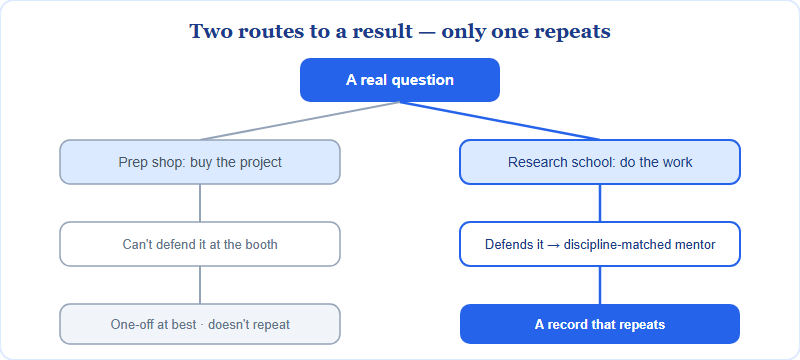
If breadth-plus-repeatability is the signal, the obvious question is what produces it. Embark frames itself as “a research school, not a prep shop,” and the distinction is not marketing — it is the mechanical reason a record can repeat. A prep shop optimizes for a trophy this cycle; a research school optimizes for a student who can defend real work, which happens to also win. Three structural choices make the difference:
- Discipline-matched mentorship. A neuroscience project and a materials-engineering project fail in different ways. Matching each student to a mentor inside their actual field — rather than a generalist “competition coach” — is why a record can span 12 disciplines instead of clustering in one. Embark reports a roster of 3,000+ contracted mentors (per Embark) precisely so that matching is possible across all 22 ISEF categories.
- A real research question, owned by the student. The work that survives a judging interview is work the student can explain under pressure because they did it. Our guide on how to choose an ISEF research topic walks through finding a question that is genuinely yours rather than assigned.
- Built for the booth, not just the paper. ISEF is judged in conversation, not only on a board. Coaching that rehearses the defense — anticipating the “why this method, why this control” questions — is what converts a solid project into an awarded one. See what ISEF judges look for at the booth.
Embark’s own published track record across seasons — 750+ awards and four straight years of asteroid naming rights (per Embark) — is best read not as a promise but as evidence about the method. None of it guarantees a result for any individual student: ISEF is competitive by design, and outcomes depend on the student’s own work and the year’s field. What a repeatable record does tell you is that the approach is sound enough to keep working when the luck runs out.
What this means if you are aiming at ISEF
A record like 2026’s is interesting; what you do with that information is what matters. Three honest takeaways for a student or parent planning a science-fair path:
- Plan around the funnel, not the finale. Because ISEF is reached through affiliated fairs, your real timeline starts roughly a year out — a research question by the off-season, experiments through the academic year, a defensible project before your qualifying fair. Work backward from the affiliated fair, not from Phoenix.
- Pick depth over a “hot” category. Awards across 12 disciplines exist because students chose questions they cared about, not the field they thought judges wanted. A genuine question in an unglamorous category beats a shallow project in a crowded one.
- Judge a coaching program by its repeatability, not its single best story. Ask whether results recur across years and fields. A one-off win tells you little; a record that holds when conditions change tells you the method is real — and it is the same logic we apply to our own record (per Embark).
New to the idea of coaching itself? Start with our foundation piece, every path to the ISEF finals, to map the qualifying routes before you commit to a project.
Frequently asked questions
Did Team Embark really get an asteroid in 2026?
Per Embark, 2026 was a 4th straight year producing a winner at the tier earning Ceres Connection naming rights; the body is catalogued by the IAU. Confirm current award tiers on societyforscience.org.
How many awards did Team Embark win at ISEF 2026?
Embark reports 10+ awards across 12 disciplines — a team record — with winners from mainland China tracks, Hong Kong, and US/Canada high schools (all per Embark).
Can I just register for ISEF directly?
No. Per the Society for Science, you qualify by winning a slot at a Society-affiliated fair; ISEF itself is not open to direct registration. Always confirm the current process on societyforscience.org.
Does a strong track record guarantee my child will win?
No — and we won’t claim it does. ISEF is competitive and outcomes depend on the student’s own work. A repeatable record reflects method, not a guarantee.
Work with Embark
Embark turns a student’s real scientific question into an ISEF-caliber project — with a discipline-matched mentor who has worked in the field, from the first hypothesis through the judging interview.
Embark is an independent research-coaching organization, the international competition team of Youfang Education; it is NOT affiliated with, endorsed by, or sponsored by the Society for Science or Regeneron ISEF. Any results cited reflect Embark’s own published record (per Embark). Always confirm current details — eligibility, qualifying fairs, categories, awards and the Ceres Connection — on societyforscience.org. Confirmed errors are corrected within 7 working days.