A discipline mentor for an ISEF project is a researcher in your field who guides the question, the method, and the rigour of work that stays yours. They help you narrow a vague idea into a testable hypothesis, pressure-test your experimental design, push you on controls and statistics, and prepare you to defend every choice at the booth — without ever designing, running, or writing the project for you. The official ISEF rules are explicit: the project should reflect “independent research done by the student(s)” and be “presented in their own words.” A good mentor raises the ceiling on that work; they never become its author.
“Researchers coaching research” — the line a real mentor never crosses
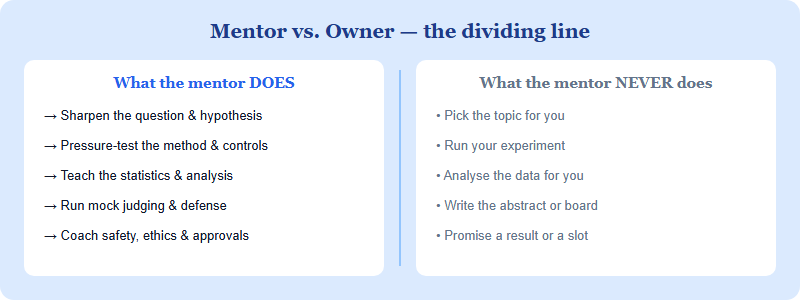
The single most useful idea to hold onto is that mentorship and ownership are different jobs. ISEF is judged on a project you own, so the mentor's entire value lives in making your decisions better — not in making them for you. Embark calls its house philosophy “a research school, not a prep shop,” and the distinction is doing real work here: a prep shop sells a finished thing; a research school builds a researcher who can produce the thing and explain it.
This is not just an ethical preference; it is written into how ISEF defines adult roles. Per the Society for Science roles and responsibilities, the student researcher is responsible for “all aspects of the research project” — enlisting supervisory adults, obtaining approvals, performing the experimentation, collecting and analysing data, and abiding by the Ethics Statement. Adults exist to support and supervise, not to substitute. A discipline mentor works inside that boundary on purpose, because the moment they cross it, the project stops being eligible and the student stops being able to defend it.
If you are still deciding whether your idea is even a project yet, the mentor relationship pays off most after you have a real question — so it is worth reading how to choose an ISEF research topic first. Coaching compounds a sharp question and largely wastes a vague one.
What “discipline-matched” actually buys you
Not all mentorship is the same, and the word that does the heavy lifting is discipline-matched. ISEF finalists compete across 22 scientific categories — from Cellular and Molecular Biology to Robotics and Intelligent Machines to Mathematics (per the Society for Science categories list). A generalist who is good at “science fairs” cannot tell you whether your microbiology controls are sufficient, whether your machine-learning baseline is fair, or whether your assay is even measuring what you think. A researcher in your actual subfield can.
This is also where the ISEF rules quietly raise the bar. For certain projects — those involving human participants, vertebrate animals, or potentially hazardous biological agents — the rules require review and approval by a local or regional Institutional Review Board (IRB) or Scientific Review Committee (SRC) before experimentation begins. The rules further define a Qualified Scientist as someone with “a doctoral/professional degree in a scientific discipline related to [the] student's area of research” or extensive equivalent expertise. A discipline-matched mentor is exactly the person who can flag, early, that your project needs that oversight at all — long before a missing form sinks an otherwise strong project at the affiliated fair.
Embark's own model leans hard on matching: per Embark, it works with a network of more than 3,000 contracted mentors spanning research disciplines, and its students have competed across all 22 ISEF categories. The point of that scale is not the number — it is that a plant-sciences student and an embedded-systems student should not be coached by the same person.
What a mentor does at each stage of the project
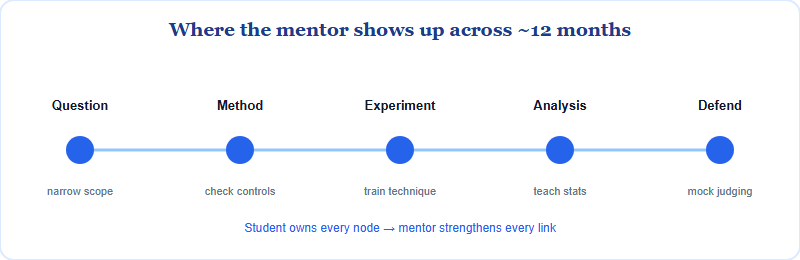
An ISEF project is roughly a year of work — the rules cap it at no more than 12 months of continuous research, beginning no earlier than January of the ISEF year. A discipline mentor shows up differently at each phase. The table below maps what the mentor contributes against what stays squarely the student's job, stage by stage.
| Stage | What the discipline mentor does | What stays the student's job |
|---|---|---|
| Question & hypothesis | Stress-tests the question for novelty and feasibility; points to the literature gap; helps narrow scope to something testable in 12 months | Chooses the topic; reads the papers; writes the hypothesis in their own words |
| Method & design | Reviews the experimental design and controls; flags confounds; advises whether IRB/SRC approval is needed before you start | Builds the protocol; obtains the required approvals; sets up the experiment |
| Experimentation | Trains technique; supervises safety; troubleshoots when results look strange | Performs every experiment and collects all the data personally |
| Analysis | Teaches the right statistics; challenges over-claims; asks “what else could explain this?” | Runs the analysis; interprets the data; decides what it means |
| Communication | Critiques the abstract, board, and narrative; runs mock judging with hard questions | Writes the abstract and board; presents and defends it at the fair |
Notice the pattern: in every row, the mentor sharpens and the student decides. That is the only configuration that survives both the eligibility rules and a real judging conversation — because a judge will ask the student, not the mentor, to defend the choice.
The booth test: why mentorship has to make you independent
The clearest proof of whether mentorship was done right comes at the affiliated fair and, for those who advance, at ISEF itself. Judging is a conversation. A judge will probe why you chose this method over that one, what your controls rule out, where your analysis could be wrong, and what you would do next. If a mentor designed your project for you, this is exactly where it falls apart — the student cannot defend choices they did not make. If a mentor coached you to make and own those choices, the defense is just you explaining your own thinking.
This is why “researchers coaching research” is not a slogan but a method: the goal of every mentor session is a student who needs the mentor less, not more. For a fuller picture of how judging actually works at the booth, see what ISEF judges look for at the booth; and for how the qualification path fits together from affiliated fair to finals, see every path to the ISEF finals.
Embark's published record — per Embark, more than 750 competition awards, and four consecutive years in which ISEF top-award projects earned asteroid-naming recognition — is offered here as evidence of what disciplined mentorship can support, not as anything anyone can promise you. No mentor, Embark included, controls an affiliated-fair panel or a Grand Award judge. What good mentorship controls is the only honest variable: the quality of the work and the independence of the person presenting it.
How to tell a real mentor from a project-for-hire
Because the difference is invisible on a glossy page, use behaviour to judge it. A genuine discipline mentor pushes work back to you; a project-for-hire takes it off your hands. Watch for these signals in any first conversation:
- They ask what you are curious about — rather than handing you a pre-built “winning” topic off a shelf.
- They match you to a subfield specialist — a mentor who has actually worked in your area, not a generalist coordinator.
- They talk about method and rigour early — controls, statistics, IRB/SRC approvals — not just trophies and titles.
- They make you explain your own choices — and run mock judging where you, not they, do the defending.
- They refuse to promise a result — anyone guaranteeing a finals slot or an award is selling something ISEF rules say no one controls.
If a conversation fails most of those tests, you are not looking at mentorship — you are looking at a prep shop, and a prep shop builds a project you cannot defend and a transcript you cannot honestly claim.
Frequently asked questions
Is using a research mentor allowed under ISEF rules?
Yes. ISEF rules expect adults to supervise and support, but the project must be the student's own independent work, in their own words, with proper citation of any mentor or facility help.
What is the difference between a mentor and an Adult Sponsor?
The Adult Sponsor is a defined ISEF role who reviews rules, forms, and safety. A discipline mentor is a subfield researcher who coaches your science. One person can sometimes fill both, but the jobs differ.
Does my mentor need a doctoral degree?
Only for certain projects. ISEF's “Qualified Scientist” role requires a doctoral/professional degree or equivalent expertise in your research area. Confirm what your specific project requires on the official site.
Can a mentor guarantee I reach the ISEF finals?
No. You must win an affiliated fair to advance, and judging is independent. A mentor can raise the quality of your work, but no one controls the outcome — always confirm current rules on societyforscience.org.
Work with Embark
Turn a real question into an ISEF-caliber project with a discipline-matched mentor who coaches your science without ever doing it for you — a research school, not a prep shop.
Embark is an independent research-coaching organization, the international competition team of Youfang Education; it is not affiliated with, endorsed by, or sponsored by the Society for Science or Regeneron ISEF. Any results cited reflect Embark's own published record (per Embark). Always confirm current details on societyforscience.org. Confirmed errors are corrected within 7 working days.