An ISEF-caliber project is built backward from one fixed point: the affiliated fair that decides whether you advance. Per societyforscience.org, a project may include no more than 12 months of continuous research, so the practical answer to “when do I start?” is roughly 9–12 months before your local affiliated fair—not before ISEF itself. Most strong international projects begin the summer or early autumn before their qualifying-fair season, leaving real time to design, run, fail, redo, and defend. Start dates and rules change yearly; always confirm the current cycle on societyforscience.org.
Why the timeline runs backward from your affiliated fair
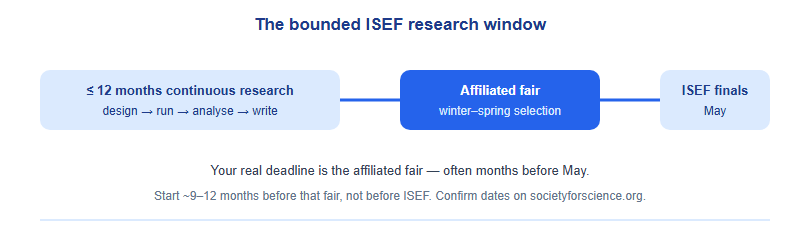
At Embark we are a research school, not a prep shop, and the first thing we do with a new student is not pick a topic—it is draw a calendar. Here is why. You do not enter the Regeneron International Science and Engineering Fair directly. Per societyforscience.org, you must be selected by an ISEF-affiliated fair first, and those fairs run on their own regional schedules, typically across the winter and spring. ISEF finals themselves fall in May. So your real deadline is not May—it is the day your affiliated fair judges your work, which can be months earlier.
That single fact reshapes planning. If your affiliated fair is in February, a project that is “ready by April” is already too late. And because ISEF caps each project at no more than 12 months of continuous research (and, for a given cycle, forbids research begun before a stated start month—January for the 2026 cycle), you cannot simply start two years early to be safe. The window is bounded on both ends. For the full structure of how regional fairs feed into finals, see our companion guide on every path to the ISEF finals.
The discipline this forces is healthy. A bounded clock stops the two failure modes we see most often: students who drift for a year with no result, and students who cram an entire investigation into the six weeks before a deadline and arrive at the booth unable to defend choices they never had time to think through.
The month-by-month roadmap (a 12-month template)
No two projects move at the same pace—a computational study and a wet-lab study spend their months very differently. But the sequence of phases is stable, and skipping or compressing a phase is what produces fragile work. Below is the template our mentors back-plan from, expressed as “months before your affiliated fair” so it works regardless of when your regional fair falls.
| Months before your fair | Phase | What you should be doing | Done when… |
|---|---|---|---|
| ~12–10 | Question & literature | Find a real question; read deeply enough to know what is already known; complete the sentence “compared to what exists, my project adds ___.” | You have one sharp, original, feasible question and can name your contribution. |
| ~10–9 | Design & approvals | Write a detailed plan; identify the right ISEF category; check which forms and reviews (e.g. SRC/IRB) your project needs before any work begins. | Your method is documented and required approvals are secured in advance. |
| ~9–5 | Run the research | Collect data, build, iterate. Keep a dated logbook from day one. Expect the first approach to fail and budget time to redo it. | You have real data—including the runs that didn't work. |
| ~5–3 | Analyse & interpret | Turn data into findings; run honest statistics; figure out what the result actually means and where its limits are. | You can state your finding in one sentence and defend its limitations. |
| ~3–1 | Communicate | Draft the ≤250-word abstract, build the board, write the paper, and rehearse the booth defense with hostile questions. | A stranger can follow your board in 60 seconds and you survive mock judging. |
| ~1–0 | Fair & iterate | Compete at your affiliated fair; collect feedback; if you advance, refine for ISEF without starting new research. | You've presented, and you know exactly what to tighten next. |
Read the right-hand column carefully. Each phase has an exit test, not just an activity. The most common planning mistake is treating “run the research” as the whole project and leaving two weeks for everything else. In our experience the back half—interpretation and communication—is where booth-ready projects are separated from impressive piles of data, because that is precisely what judges probe (see what ISEF judges look for at the booth).
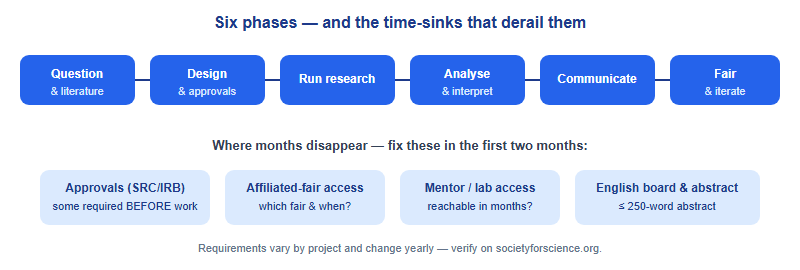
Where international students lose months (and how to protect them)
International and China-based students face timeline risks their US peers often don't, and almost all of them are predictable. Build the buffer in advance rather than discovering the problem in month four.
- Approvals you didn't know you needed. Projects involving human participants, vertebrate animals, or potentially hazardous biological agents require specific reviews and forms—and per the rules, some of these must be approved before experimentation begins. Discovering this in month five can invalidate months of work. Check requirements during the design phase, on societyforscience.org.
- Affiliated-fair access. Confirm early which fair you are eligible to enter and exactly when it judges. Your whole calendar pivots on that date, and it is not always obvious for students outside the US.
- Mentor and lab availability. If your design needs equipment, a wet lab, or a subject pool, line that up before you commit to the question—not after. Access you can't reach within months is a different project.
- The English deliverables. Project boards and abstracts must be in English. For non-native writers, budget real time to write the abstract well within 250 words and to rehearse answering fast, unscripted questions out loud.
A first-party note from our coaching: the students who finish calmly are almost never the fastest workers. They are the ones who front-loaded the boring parts—approvals, access, a dated logbook—in the first two months, so the middle of the year was free for actual science. The timeline is not bureaucracy; it is what buys you the freedom to do the work well.
“Is it too late to start this year?” — a quick decision rule
This is the question we get most. The honest test is not the calendar date—it is how much of the sequence you can still complete before your affiliated fair with integrity. Use this rule:
- 9+ months out: Comfortable. You can run a full, original investigation. Start with the question, not the technique.
- 5–8 months out: Workable if you scope tightly. Choose a question whose data you can realistically collect in the window, and protect time for analysis and the booth.
- 2–4 months out: Tight. Often the wiser move is to aim this year at a narrower, cleaner result—or to target next cycle's fair and start now. A rushed project that you can't defend helps no one.
- Under 2 months: Be honest. There is usually not enough time to produce defensible original research. Use the time to plan properly for the next cycle—that head start is worth more than a thin entry.
Choosing to wait a cycle is not failure; it is the same backward-planning discipline applied honestly. The student who starts a real project in good time almost always beats the one who forces a weak one into a closing window. If you're still deciding what to study, our guide on how to choose an ISEF research topic is the right first move—before you draw your own calendar.
Frequently asked questions
When should I start my ISEF project?
Roughly 9–12 months before your affiliated fair, not before ISEF itself. The rules cap research at 12 months, so plan backward from your regional fair. Confirm dates on societyforscience.org.
Is the deadline ISEF in May?
No—your real deadline is your affiliated fair, which selects finalists and often judges months before May. You must be selected by an affiliated fair to advance; you can't enter ISEF directly.
Can I start two years early to be safe?
No. A project may include no more than 12 months of continuous research, and each cycle has a start-month limit. Beginning too early can put work outside the allowed window. Check the current cycle on societyforscience.org.
Is it too late to start this year?
It depends how much of the sequence you can finish before your fair with integrity. Under ~2 months out, it's usually wiser to plan properly for the next cycle than to rush a project you can't defend.
Work with Embark
Embark's first session with you is a calendar, not a sales pitch. Our discipline-matched mentors back-plan a realistic timeline from your affiliated fair, so you do real research—and defend it—yourself. A research school, not a prep shop.
Embark is an independent research-coaching organization, the international competition team of Youfang Education. It is NOT affiliated with, endorsed by, or sponsored by the Society for Science or Regeneron ISEF. Any results cited reflect Embark's own published record (per Embark) and are not a guarantee of any outcome. Always confirm current rules, dates, and details on societyforscience.org. Confirmed errors are corrected within 7 working days.