ISEF runs two separate award tracks that students constantly confuse. Grand Awards are given within each of the 22 categories and judged through the Society for Science process—this is the main competition. Special Awards are given in parallel by outside organizations (companies, societies, government agencies, universities) according to their own criteria and interests. The same project can win in both tracks, neither, or just one. Specific award names, sponsors, and amounts change every year, so always confirm the current list on societyforscience.org.
Two tracks, two sets of judges, two sets of rules
At Embark we are a research school, not a prep shop, and we are careful not to let students chase trophies. But understanding the award structure is genuinely useful—not because you should optimize for prizes, but because it explains who reads your work and what they are looking for. Get that wrong and you present the same project the same way to two very different audiences.
Here is the cleanest way to hold it in your head. The Grand Awards are the headline competition: every finalist is entered into their single category, and category judges—working scientists and engineers—evaluate projects against one another within that category. This is the track most people mean when they say “won at ISEF.” The Special Awards are a separate layer run by independent sponsoring organizations. Each sponsor picks projects that fit its mission—a marine-science society, an aerospace company, a computing association, a public-health agency—using its own rubric. They review projects across categories, so a chemistry project and an environmental-engineering project might both compete for the same sponsor's award if both touch that sponsor's field.
The two tracks are independent. Winning a category Grand Award does not earn you a Special Award, and a project that places nowhere in its category can still catch a sponsor's eye for a specific strength. This is the structural fact most guides skip, and it is the one that should shape how you build your board and rehearse your booth defense (see what ISEF judges look for at the booth).
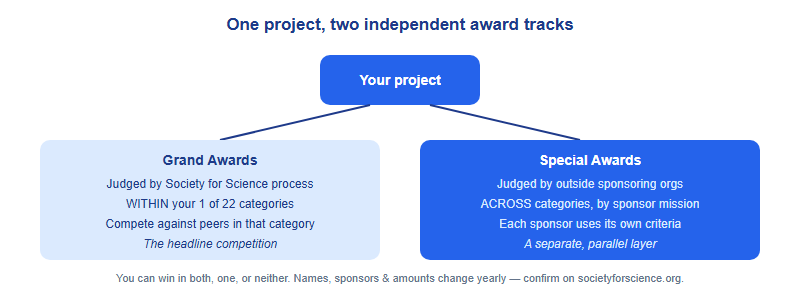
A side-by-side comparison
Because the two tracks differ on almost every dimension—who judges, what they reward, how broadly they look—it helps to see them in one view. Treat the specifics as illustrative of structure; the binding details are always the current year's official program.
| Dimension | Grand Awards | Special Awards |
|---|---|---|
| Who gives them | The Society for Science / ISEF itself | Independent sponsoring organizations (companies, societies, agencies, universities) |
| How projects are grouped | By your single ISEF category (1 of 22) | By each sponsor's field of interest, across categories |
| Judging criteria | The category judging process for scientific quality and rigor | Each sponsor's own rubric and mission priorities |
| How many you can win | Placement within your one category | Potentially several, from different sponsors |
| Predictability | You know your category in advance | Which sponsors are relevant depends on your project's themes |
| What it signals | Strength of the science within its field | Relevance/impact to a specific real-world domain |
One practical consequence: a strong, well-defined project naturally becomes eligible for more Special Awards, because a sharp contribution clearly “belongs” to one or more sponsor fields. A vague project belongs nowhere—which is yet another reason the work of scoping a precise question pays off downstream. If you haven't locked your question yet, start with how to choose an ISEF research topic.
What this means for how you present (the coaching takeaway)
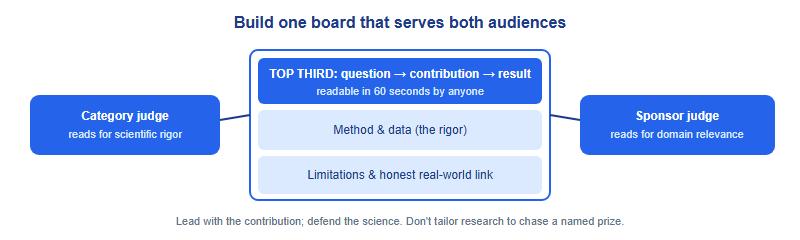
Here is where the structure becomes actionable. Because two different audiences may read your work, you have to make a single board and a single defense legible to both—without distorting the science. In our mentoring we focus students on three moves:
- Lead with the contribution, not the topic. Category judges and sponsor judges both decide quickly what your project actually adds. A board whose top third states the question, the contribution, and the result plainly serves every reader. Decoration does not.
- Make the real-world connection honest and specific. Special Award sponsors look for genuine relevance to their domain. State your application precisely—and only as far as your evidence supports it. Overclaiming impact is transparent to a working professional in that field and damages credibility with category judges too.
- Defend the science either way. No award track rewards a result you can't explain. Whether the person at your booth is a category judge or a sponsor's representative, the same thing wins: you understanding your own method, limitations, and what a “no” result would have meant.
Notice what is not on that list: tailoring your project to chase a particular sponsor. That is trophy-hunting, and it produces shallow work that judges see through. The honest sequence runs the other way—do rigorous, well-scoped research, present it clearly, and let the relevant award tracks find it. A first-party observation from Embark's coaching: the projects that pick up recognition across tracks are almost never the ones built to win a named prize. They are the ones built to answer a real question well, which happens to make them legible to many readers at once.
A note on prize money, recognition, and keeping perspective
Both tracks can carry recognition and, in some cases, monetary awards or scholarships from sponsors—but the specific amounts, named awards, and participating organizations are set by the program and its sponsors each year and change regularly. We deliberately do not publish figures here, because a number that was true one cycle can mislead the next. If award amounts matter to your planning, read them off the current year's official ISEF materials on societyforscience.org, not off a third-party summary.
More importantly: do not let the prize map distort the project. The award tracks are downstream of the science. A student who understands the structure presents more clearly and worries less—but a student who reverse-engineers their research from an awards list builds something fragile that rarely survives the booth anyway. Understand the two tracks so you can communicate well to both. Then forget them and go do the work. For how that work reaches finals in the first place, see every path to the ISEF finals.
Frequently asked questions
What's the difference between ISEF Grand Awards and Special Awards?
Grand Awards are judged within your category by the Society for Science process. Special Awards are given separately by outside sponsoring organizations using their own criteria. The tracks are independent.
Can one project win in both tracks?
Yes. The tracks are judged independently, so a project can win a category Grand Award, one or more Special Awards, both, or neither. Confirm the current award structure on societyforscience.org.
Should I design my project to win a Special Award?
No. Tailoring research to chase a named prize produces shallow work judges see through. Do rigorous, well-scoped research and present it clearly; let the relevant tracks find it.
How much prize money do ISEF awards carry?
Amounts and sponsors are set by the program each year and change regularly, so we don't publish figures. Check the current year's official materials on societyforscience.org.
Work with Embark
Embark's discipline-matched mentors help you build a project whose contribution is clear enough to read in 60 seconds—and a defense that holds up to any judge at the booth. We coach the science, not the trophy. A research school, not a prep shop.
Embark is an independent research-coaching organization, the international competition team of Youfang Education. It is NOT affiliated with, endorsed by, or sponsored by the Society for Science or Regeneron ISEF. Any results cited reflect Embark's own published record (per Embark) and are not a guarantee of any outcome. Always confirm current rules, dates, and details on societyforscience.org. Confirmed errors are corrected within 7 working days.