Some of the strongest ISEF projects never make it to the booth because of paperwork, not science. ISEF requires a documented research plan and a set of forms, and for projects involving humans, vertebrate animals, or potentially hazardous biological agents, certain reviews and approvals must happen before experimentation begins. Getting this wrong—starting work first, filing later—can invalidate months of effort. The exact forms and review bodies are defined annually; always work from the current rules and forms on societyforscience.org.
Why forms decide projects before judges ever do
At Embark we are a research school, not a prep shop, and one of the least glamorous things we do is also one of the most valuable: we make students handle compliance in the first month, before they fall in love with an experiment they may not be allowed to run as imagined. The reason is structural. ISEF's rules exist to keep pre-college research safe and ethical, and the system enforces them through a paperwork-and-review process that is checked at your affiliated fair and again at ISEF.
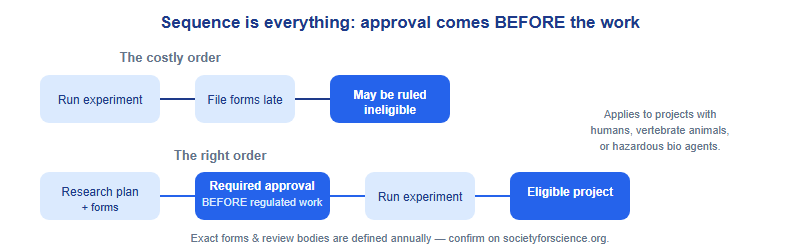
The critical point most students miss is sequence. For certain project types, the required review is not something you do at the end to document what you did—it is a prior approval you must obtain before you start the regulated work. If your project involves human participants (surveys, tests, anything with people), vertebrate animals, or potentially hazardous biological agents, the review has to come first. Run the experiment before the approval, and the work can be ruled ineligible no matter how good it is. This is the single most expensive mistake we see, and it is entirely avoidable with a month of foresight.
This is also why the research plan matters so much. A clear, detailed research plan is not bureaucratic box-ticking; it is what the review process evaluates, and writing it forces you to confront feasibility and risk before you commit a school year. It connects directly to choosing the right study in the first place—see how to choose an ISEF research topic—because a question that can't clear review in time is, for this cycle, the wrong question.
The categories of forms (in plain language)
ISEF's forms fall into a few functional groups. The exact form names, numbers, and which committee signs off are set each year, so the table below describes what each type is for rather than quoting form codes. Use it to figure out which conversations you need to have early; pull the actual current forms from societyforscience.org.
| Form type (by purpose) | When it applies | Why it exists |
|---|---|---|
| Student / project & research plan | Every project | Documents who you are, what you propose, and your detailed plan—the basis everything else reviews against. |
| Adult sponsor / supervision | Every project | Confirms a responsible adult is overseeing safety and compliance. |
| Human-participants review | Projects involving people (surveys, tests, interventions) | Protects participants; typically requires review/approval before data collection. |
| Vertebrate-animal review | Projects involving vertebrate animals | Enforces humane, ethical treatment; requires prior review. |
| Potentially hazardous biological agents | Projects with microorganisms, rDNA, tissues, etc. | Manages biosafety risk; requires prior review and a suitable setting. |
| Regulated substances / equipment | Projects using certain chemicals, devices, or hazards | Ensures safe, supervised, lawful handling. |
| Site / institution documentation | Work done in a university or professional lab | Records where regulated work happened and under whose oversight. |
The recurring word is prior. For the review-triggering categories, the approval gates the start of regulated work. Notice too that a project touching a regulated area is not forbidden—it is simply a project with a longer runway. That is fine if you planned for it, and disastrous if you didn't, which is the whole argument for handling forms during design rather than during data collection (see our every path to the ISEF finals guide for where this sits in the overall route).
Why this hits international and China-based students harder
The compliance layer is a bigger risk for students outside the US, and again the risks are predictable rather than mysterious. In our coaching these are the four that cost the most time:
- The review body may be less familiar. US students often have a school or fair that routinely handles these reviews. International students may need to identify who plays that role for them well in advance—you cannot improvise it the week before your fair.
- Lead times stack up. Securing supervision, arranging a suitable lab setting for regulated work, and getting approvals can each take weeks. Run sequentially under time pressure, they consume the months you needed for the actual experiment.
- Translation and documentation. If parts of your supervision or institutional context are not originally in English, you must produce clear English documentation—and the board and abstract themselves must be in English. Budget time for this.
- “I'll just change the question later” rarely works. Discovering in month five that your design needed prior approval usually means restarting that strand of work inside a window that no longer allows it. The cheap fix is upstream: know your form requirements before you run anything.
A first-party note from Embark's mentoring: when an international student comes to us with a project that "isn't working," the problem is frequently not the science—it is that an approval or a documentation gap is blocking otherwise-good work, discovered too late. Almost every one of these is preventable with a single early checklist pass. Compliance done early is not friction; it is the thing that keeps your real research alive.
A simple compliance discipline that protects your year
You don't need to be a rules expert; you need a small, early routine. The version we coach is four steps, all completed before any regulated experimentation:
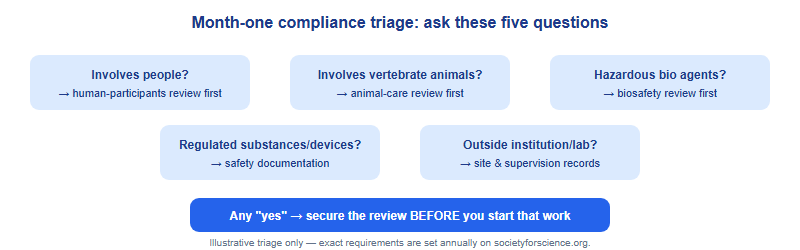
- Map your project against the review triggers. Humans, vertebrate animals, hazardous biological agents, regulated substances, outside institutions—circle every one your design touches.
- Pull the current forms and rules from the official source. Form names and committees change yearly. Read this cycle's requirements directly from societyforscience.org rather than a blog (including this one).
- Identify who reviews and supervises you—early. Confirm your adult sponsor and any required reviewers, and for international students, confirm who fills the affiliated-fair's review role.
- Get prior approvals before you run regulated work. Then keep a dated logbook so your timeline is documented and defensible at the booth.
That is the whole discipline. It is unglamorous and it is decisive. The students who clear it early spend their year on science; the ones who skip it spend their spring rebuilding work that the rules won't accept. And because none of the figures, form codes, or committee names here are guaranteed to match your cycle, treat this article as a map of the terrain—and the official site as the authoritative source for every binding detail.
Frequently asked questions
Do all ISEF projects need committee approval before starting?
Not all—but projects involving humans, vertebrate animals, or potentially hazardous biological agents typically require review and approval before experimentation begins. Confirm your project's requirements on societyforscience.org.
What happens if I run my experiment before getting approval?
For review-triggering projects, doing regulated work before the required approval can make the project ineligible, regardless of quality. Handle approvals during design, not after data collection.
Which ISEF forms do I actually need?
It depends on your project. Every project needs core plan and supervision forms; others apply only if you involve people, animals, hazards, or an outside lab. Pull the current forms from societyforscience.org.
Why is this harder for international students?
Review bodies and supervision can be less familiar and slower to arrange outside the US, and documentation may need English translation. Identify your reviewers and lead times in month one.
Work with Embark
Embark's mentors run the compliance map with you in month one—review triggers, sponsors, lead times—so paperwork never quietly kills good work. We coach you to do the research, and to keep it eligible. A research school, not a prep shop.
Embark is an independent research-coaching organization, the international competition team of Youfang Education. It is NOT affiliated with, endorsed by, or sponsored by the Society for Science or Regeneron ISEF. Any results cited reflect Embark's own published record (per Embark) and are not a guarantee of any outcome. Always confirm current rules, dates, and details on societyforscience.org. Confirmed errors are corrected within 7 working days.