At ISEF, the abstract and the project board are how a year of research introduces itself. A judge often reads your abstract before they meet you and scans your board in the seconds before the interview begins. So these are not afterthoughts to assemble the night before — they are the highest-leverage communication you will produce all year. This guide is about making both do their job: deliver the question, the method, and the finding fast, so the conversation starts from your best result.
Why the abstract and board decide your first impression
At Embark we are a research school, not a prep shop, and one thing we tell every student is that great science badly communicated still loses. The judging at ISEF runs on conversation, but the abstract and board frame that conversation before you say a word. The abstract is a short structured summary submitted with your project; the board is the physical display that stands behind you at the booth. Together they answer the judge's first silent question — what did this student actually do, and did it work? — and they set the altitude for everything that follows.
The mistake we see most often is not weak research; it is strong research that hides its own headline. Students bury the finding in paragraph three, fill the board with text nobody reads at the booth, and assume the judge will dig for the point. Judges will not dig. They are moving down a row of projects on a schedule. If your abstract's first two sentences do not tell them what you found and why it matters, you have spent your most valuable real estate explaining background instead of contribution. The fix is structural, not cosmetic — and it connects directly to choosing a question with a clear, defensible result in the first place, which is why we start with topic strategy long before board season.
Both deliverables also have official constraints — an abstract word limit and project-display size and safety rules — that are set each year. Build to a draft early, but always confirm the current limits and display rules on societyforscience.org before you finalize anything, because exceeding them is an avoidable problem at the fair.
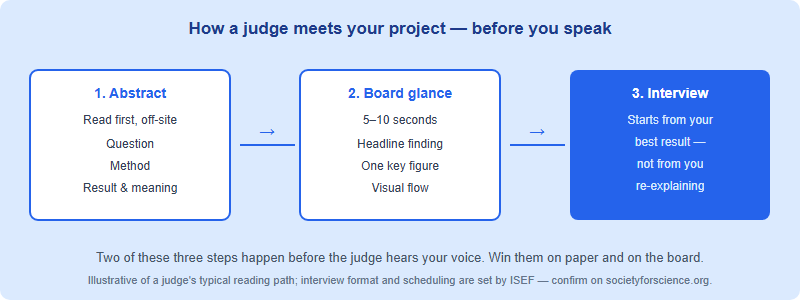
Writing an abstract that leads with the finding
An ISEF abstract is short by design, which means every sentence has to earn its place. The structure we coach is deliberately front-loaded: state the problem and your specific question, name the method in one clause, then give the result and what it means — in that order, with the result arriving early rather than at the very end. A reader who stops after two sentences should still know what you found. This is the opposite of how most school lab reports are written, where the conclusion is the reward at the bottom of the page.
A few principles travel across every discipline:
- Lead with contribution, not background. One sentence of context is usually enough. The judge needs to know what you added, not a textbook summary of the field.
- Quantify the result. “Improved performance” is invisible; a specific magnitude, effect, or comparison is memorable. Numbers are how a scanning reader anchors your finding.
- Name the method precisely but briefly. Judges infer rigor from how cleanly you can describe what you did. Vague method language reads as a vague project.
- Cut the limitations from the abstract, keep them for the interview. The abstract is for your headline; nuance and caveats belong in the conversation, where they actually score as scientific maturity.
- Respect the official word limit. The limit is set annually; write tight, then trim to fit the current rule on societyforscience.org rather than padding to fill space.
A practical test: read only your first two sentences aloud to someone outside your field. If they can repeat back your question and your finding, the abstract is doing its job. If they say “so what did you actually discover?” you have led with background and need to move the result up.
Designing a board a judge can read in ten seconds
The project board is a visual argument, not a poster of your full paper. A judge approaching the booth gives it a glance — call it five to ten seconds — and that glance should deliver the headline finding and the single most important figure before the interview even begins. The most common board failure is density: walls of text in a small font that no one reads standing up, with the one graph that proves the project shrunk into a corner.
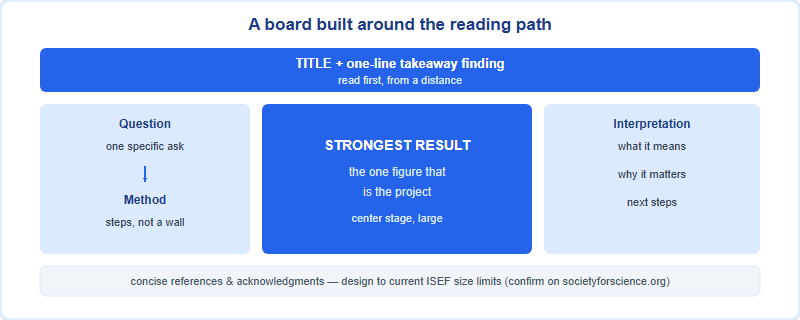
Design the board around a clear reading path. People scan top-to-bottom and left-to-right, so the title and a one-line takeaway go up top, the question and method flow down the left, and your strongest result — the figure that is the project — sits in the visual center where the eye lands. Use whitespace as a tool, not a failure to fill space; a board that breathes looks like the work of someone who knows which result matters.
| Board zone | What goes there | Common mistake to avoid |
|---|---|---|
| Top banner | Project title + one-line takeaway finding | A clever title that hides what you did |
| Upper left | The specific research question | A broad field statement with no question |
| Left column | Method, in steps a non-specialist follows | A dense paragraph of procedure |
| Center | Your single strongest figure / key result | Shrinking the proof into a corner |
| Right column | Interpretation, significance, next steps | Repeating the abstract word-for-word |
| Lower edge | Concise references / acknowledgments | Filler that crowds out the result |
Two operational notes for international students in particular. First, build the board in the language of judging and rehearse explaining each panel out loud — a board you can talk through fluently is worth more than a beautiful one you read off. Second, ISEF sets official maximum display dimensions and a list of items not allowed at the booth, and these are checked at display-and-safety inspection. Design to the current size limits from the start; rebuilding an oversized board on arrival is a stressful way to spend the day before judging. Always pull the live display rules from societyforscience.org.
Where the abstract, the board, and the interview line up
The reason coaches obsess over these two artifacts is that they are not separate from the judging — they are the on-ramp to it. A judge who arrives already understanding your finding from the abstract and board spends the interview probing your reasoning and depth, which is exactly where a well-prepared student shines. A judge who arrives confused spends the interview reconstructing what you did, and you never get to the good part. If you want to see how that conversation is actually scored, read our breakdown of what ISEF judges look for at the booth; the abstract and board are how you earn the right to have that deeper conversation.
Practically, build all three to say the same thing in increasing depth. The abstract is the 90-second version, the board is the visual version, and the interview is the full version. When a student can move between those three registers without contradicting themselves, judges read it as command of the work — and that consistency is something you rehearse, not something you improvise on the day.
Frequently asked questions
How long should an ISEF abstract be?
ISEF sets an official abstract word limit each year. Write a tight draft early, then trim to the current limit published on societyforscience.org rather than padding it.
What size can my project board be?
Maximum display dimensions are set annually and checked at display-and-safety inspection. Build to the current size and prohibited-items rules on societyforscience.org.
Should the board repeat my full paper?
No. The board is a visual argument: title, question, method, your strongest result, and meaning. Detail and caveats belong in the interview.
What is the single most common board mistake?
Density — too much text and a shrunken key figure. A judge glances for seconds, so the headline finding and main result must be readable from a distance.
Work with Embark
Embark is the international competition team of Youfang Education — a research school, not a prep shop. We coach students to communicate real research clearly: structuring the abstract, designing the board around the result, and rehearsing the interview that follows. If you want a second set of eyes on how your project introduces itself, talk to us.
Embark is an independent research-coaching organization, the international competition team of Youfang Education. It is not affiliated with, endorsed by, or sponsored by the Society for Science or Regeneron ISEF. Any results referenced reflect Embark's own published record (per Embark). Competition facts — abstract limits, display rules, eligibility, deadlines, and judging format — are set by the organizer and should be confirmed on societyforscience.org. Errors will be corrected within 7 working days.