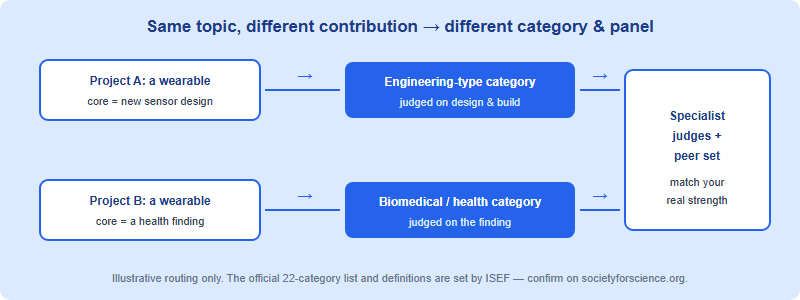
ISEF organizes its finalists into 22 scientific categories, and the one you enter decides which specialists judge you and which projects you are compared against. That makes category selection a real strategic choice, not a dropdown you fill in at the end. The rule that matters: pick the category by what your project contributes — the core scientific question and method — not by the surface topic it happens to touch. Get this right and judges evaluate you on your strongest dimension; get it wrong and your best work is judged against the wrong yardstick.
Why the category you choose changes how you're judged
At Embark we are a research school, not a prep shop, and category strategy is one of the conversations we have earliest, because it quietly shapes a whole year. ISEF's 22 categories — spanning everything from biochemistry and cellular and molecular biology to engineering, computational biology, environmental disciplines, and the social and behavioral sciences — exist so that projects are evaluated by judges with relevant expertise. When you enter a category, you are choosing your peer group and your panel. Two students with overlapping projects can land in different categories, face different judges, and be measured against different expectations.
This matters because judging is comparative and expert. A judge in a given category has a mental model of what a strong project there looks like — the kind of question, the rigor of method, the depth expected. If your project sits naturally in that model, the judge can recognize its strengths quickly. If you have placed a fundamentally biological project into an engineering category because it involved a device, you are now asking engineering judges to evaluate biology, and the parts of your work that are genuinely impressive may not register as the things that category rewards. The science did not change; the lens did.
The exact list of categories, their precise names, and their definitions are set by ISEF and can be refined year to year — a recent example being the addition of a category recognizing technology that enhances the arts. So treat the category as a decision you make against the current official list, not a fixed map you memorized once. Always confirm the live categories and their definitions on societyforscience.org before committing.
The test: what does your project actually contribute?
The decision becomes clear once you separate topic from contribution. The topic is the subject area your work touches; the contribution is the specific new thing your project establishes. A project about water can be chemistry, environmental engineering, or earth science depending on whether its core advance is a chemical mechanism, a treatment system, or a model of a natural process. The right category follows the verb of your project, not the noun.
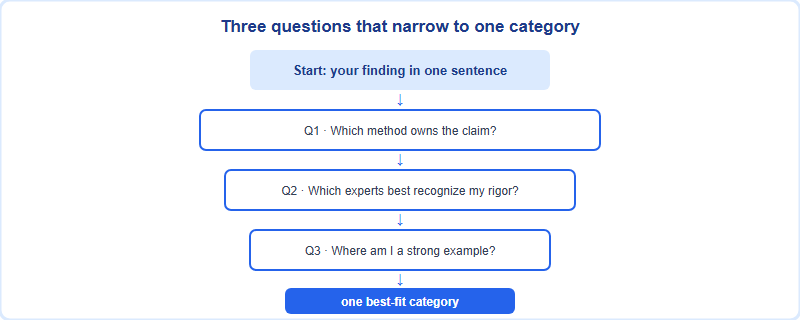
Three questions usually resolve it:
- What is the central claim of my project? Write your finding in one sentence. The discipline that owns the method behind that claim is usually your category — not the discipline of the application.
- Which experts would best recognize my rigor? Imagine the judge who would be most impressed by your method. The field they work in points to your category. If your strongest move is statistical modeling, computational categories may serve you better than the applied field you modeled.
- Where is my project a strong example rather than a weak outlier? It is better to be a clear, strong fit in one category than an ambitious misfit in a flashier one. Judges reward depth that belongs, not breadth that wanders.
This is also where category and question reinforce each other. If you scoped your study well from the start — see how to choose an ISEF research topic — the category often becomes obvious, because a sharp question already implies the discipline that should judge it. When students struggle to place a project, it is frequently a sign the question itself is doing two things at once and needs tightening.
A practical way to decide between two plausible categories
Many strong projects could honestly fit two categories. When that happens, do not guess — compare them on the dimensions that affect judging. The table below is a decision aid we use with students; it does not list ISEF's categories (those live on the official site) but gives you the criteria to choose between any two candidates.
| Decision factor | Favors a given category when… | Why it matters at judging |
|---|---|---|
| Core method | The category's judges use that method daily | Your rigor is recognized, not explained |
| Nature of the claim | The claim is the kind that category exists to evaluate | Your finding reads as a contribution, not a side effect |
| Peer comparison | You are a strong, clear fit among those projects | Being a strong example beats being an odd one |
| Depth of evidence | Your strongest evidence speaks that field's language | Judges weigh evidence they can deeply assess |
| Honesty of fit | You can defend the placement without stretching | A forced category invites skeptical questions |
One caution we give every student: do not category-shop for a perceived “easier” field. Judges in every ISEF category are experts, and an obvious mismatch — a project parked somewhere it doesn't belong to dodge competition — tends to draw harder questions, not softer ones, because it reads as either confusion or gamesmanship. The strongest position is the honest one: the category where your contribution genuinely lives. And because the official categories and their boundaries are defined annually, confirm your final choice against the current definitions on societyforscience.org rather than last year's memory.
How category fits into the whole road to the finals
Category selection does not happen in isolation — it threads through your entire path. At your affiliated fair, the category framing already shapes how local judges read you, and that framing carries forward if you advance. Understanding the full route helps you see where the category decision lands; our guide to every path to the ISEF finals walks through the qualification structure so you can plan the category choice as part of the larger journey rather than a last-minute form field.
The throughline for the whole year is consistency: a sharp question, the right category to judge it, an abstract and board that lead with the finding, and an interview that defends it. Category is the hinge in the middle — the decision that makes sure the rest of your hard work is evaluated by the people best equipped to see how good it is.
Frequently asked questions
How many ISEF categories are there?
ISEF organizes finalists into 22 scientific categories. The exact list and definitions are set annually — confirm the current categories on societyforscience.org.
Should I pick my category by topic or by method?
By contribution — the core question and method, not the surface topic. Choose the field whose specialists would best recognize your project's rigor.
Can I move to an “easier” category to avoid competition?
It rarely helps. Every category is judged by experts, and an obvious misfit tends to draw harder questions. The honest, best-fit category is the strongest play.
What if my project genuinely fits two categories?
Compare them on method, the nature of your claim, and where you are a strong example. Pick the one you can defend without stretching the science.
Work with Embark
Embark is the international competition team of Youfang Education — a research school, not a prep shop. We help students place real research in the category where its contribution is judged on its strongest dimension, and build the year around that choice. If you're weighing two categories, talk it through with us.
Embark is an independent research-coaching organization, the international competition team of Youfang Education. It is not affiliated with, endorsed by, or sponsored by the Society for Science or Regeneron ISEF. Any results referenced reflect Embark's own published record (per Embark). Competition facts — the official category list, eligibility, deadlines, and judging format — are set by the organizer and should be confirmed on societyforscience.org. Errors will be corrected within 7 working days.