A failed experiment does not end an ISEF project — but the wrong response to it can. When your hypothesis collapses, you have four legitimate moves: diagnose whether the method or the hypothesis failed, iterate the method, pivot the question, or present the negative result honestly as a finding. Judges are working scientists; they have watched their own hypotheses die many times. What they score is how rigorously you responded — and what disqualifies projects is pretending it never happened.
First, the uncomfortable truth: failure is the default
Students arriving from exam-driven systems — and this is especially familiar to students at Chinese international schools — often carry an implicit model of science as a test with a correct answer: form hypothesis, run experiment, get confirmation, collect award. Real research does not work that way. Hypotheses are guesses made at the edge of what is known, and guesses at the edge are frequently wrong. The bacteria grow anyway. The new algorithm loses to the baseline. The correlation you predicted flatlines.
This matters for ISEF strategy because your response to failure is itself part of what gets evaluated. The judging emphasis at ISEF sits on your research question, the rigor of your design and execution, and your own understanding of what happened (see current judging guidance on societyforscience.org). None of those criteria say “the hypothesis must be confirmed.” A confirmed hypothesis with sloppy method loses to a refuted hypothesis investigated rigorously — a dynamic we unpack from the judges’ side in what ISEF judges look for at the booth.
The real risk of failure is not the result. It is the two bad reactions it provokes: quiet data-massaging to rescue the hypothesis (an integrity violation that can end far more than one project), or panic-abandoning months of work when a sharper response was available.
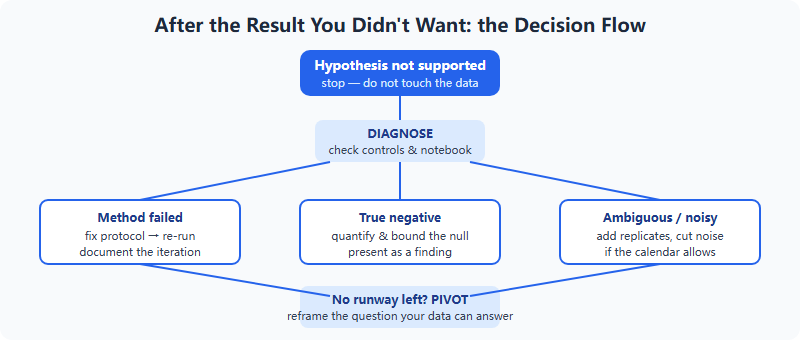
Step one: diagnose — did the method fail, or did the hypothesis?
Before deciding anything, separate three situations that feel identical at 11pm in the lab but demand different responses:
| What happened | How to recognize it | Right response | Wrong response |
|---|---|---|---|
| Method failure — the experiment never fairly tested the hypothesis | Controls misbehave; instruments drift; contamination; huge unexplained variance | Fix the method and re-run; document the fix in your notebook | Interpreting garbage data as a “result” in either direction |
| True negative — a fair test said no | Controls behaved; the experiment worked; the effect simply is not there | Treat it as a finding: quantify it, bound it, explain what it rules out | Re-running with small tweaks until something reaches significance |
| Ambiguous outcome — underpowered or noisy | Effect points the predicted way but the spread swallows it; small n | Increase replication or reduce noise, if the calendar allows | Declaring victory on a trend line judges will not accept |
The diagnostic evidence lives in your controls and your lab notebook — which is why the projects that recover well from failure are almost always the ones that documented carefully from day one. A dated record of when things broke, what you suspected, and what you changed converts a bad month into the most convincing section of your interview.
When to iterate, when to pivot, when to reframe
Iterate when the diagnosis says method failure and you have months, not weeks, before your qualifying fair. Iteration is normal science — most successful projects contain at least one protocol revision, and a documented revision arc (“version 1 failed because X, so version 2 changed Y”) is interview gold.
Pivot when the question itself has died — the effect does not exist, the organism will not cooperate, the dataset you needed never materialized — but your skills, apparatus, and literature review still point somewhere adjacent. Good pivots stay close: same system, new question. A student studying whether compound A inhibits algal growth who finds no effect might pivot to characterizing why the algae are resistant — keeping the culture setup, the assay skills, and half the bibliography. A pivot into an unrelated field in December is not a pivot; it is starting over, and the calendar rarely forgives it. If you are early enough to redesign properly, go back to first principles on how to choose a research topic that can actually win.
Reframe when the negative result is itself informative. This is the move students underuse most. “Compound A shows no inhibitory effect at concentrations up to N” is a real finding if your experiment had the power to detect one — it rules something out, which is half of what science does. A well-bounded negative result with tight error bars, honest limitations, and a clear account of what it means for the field can absolutely stand at a fair. What cannot stand is a negative result disguised as a positive one.
Timing matters in all three moves: the affiliated-fair calendar, not ISEF finals week, is your real deadline, and different qualifying routes leave different amounts of runway — map yours against every path to the ISEF finals before deciding whether you have time to iterate.
How to present negative results so judges lean in
- Lead with the question, not an apology. Your board’s story is “we asked X; the answer appears to be no, and here is how confidently we can say that” — not “unfortunately, our project did not work.”
- Show statistical power. A negative result is only meaningful if your experiment could have detected the effect. State your n, your variance, and roughly what effect size you could have seen.
- Keep the revision arc visible. A small “protocol evolution” panel — v1, what failed, v2 — turns your hardest month into visible rigor.
- Own the limitations before the judge finds them. Listing the two or three most serious limitations yourself, unprompted, is one of the strongest maturity signals available to a high-school researcher.
- Rehearse the sentence you are afraid of. “Our hypothesis was not supported” said calmly, followed by what you learned, defuses the entire topic. Judges push hardest where students flinch.
The integrity line — and why we hold it
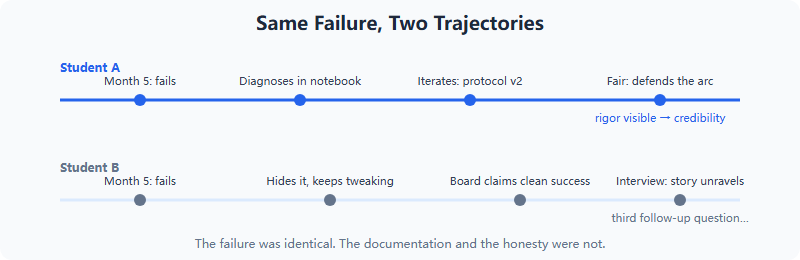
Every fair season produces stories of projects quietly “fixed” after a failed experiment: outliers dropped without criteria, trials re-run until the answer cooperated, boards that describe the experiment the student wishes they had run. Beyond the ethics, this is strategically foolish — fabricated smoothness is precisely what experienced judges are trained to probe, and integrity issues at science fairs can have consequences far beyond one competition.
This is also where Embark’s “research school, not a prep shop” philosophy is tested in practice. When a mentee’s hypothesis dies, our mentors’ job is to walk the student through the diagnosis-iterate-pivot-reframe decision honestly — including, sometimes, the disappointing advice that the calendar favors a reframe over a heroic re-run. Per Embark’s published record, its students have earned 750+ competition awards across 22 ISEF categories, and a consistent pattern inside that record is that several of the strongest projects passed through at least one dead hypothesis on the way. The failure was not the obstacle to the award. Handled rigorously, it was part of the evidence.
FAQ
Can a project with a negative result really compete at ISEF?
Yes — if the experiment was rigorous and powered enough that the “no” is meaningful. Judges evaluate method and understanding, not whether nature said yes. Confirm judging criteria on societyforscience.org.
How late is too late to pivot my project?
It depends on your qualifying fair's date, not ISEF's. A near pivot (same system, new question) needs weeks; a full restart needs a season. Count backward from your fair before deciding.
Should I mention failed attempts on my board?
Selectively, yes. A brief protocol-evolution panel showing what failed and how you responded signals rigor. Documented iteration reads as strength, not weakness.
Is removing outliers ever acceptable?
Only with a pre-stated, documented exclusion rule applied consistently. Dropping points because they hurt your hypothesis is data manipulation, and judges ask about exactly this.
Work with Embark
The weeks after a failed experiment are when a discipline mentor earns their keep — diagnosing what actually broke and choosing between iterating, pivoting, and reframing while there is still runway. If your project just hit a wall, talk to us before you decide anything.
Embark is an independent research-coaching organization and the international competition team of Youfang Education. Embark is not affiliated with, endorsed by, or sponsored by the Society for Science or Regeneron ISEF. Results cited reflect Embark’s own published record (per Embark). Competition rules and judging criteria change — always confirm details on societyforscience.org. If you spot an error in this article, we correct verified issues within 7 working days.