Finding an ISEF-worthy research gap starts with reading — but reading strategically, not exhaustively. You skim reviews to map a field, cluster the primary papers around a question, and look for what the literature has not yet answered. That unanswered question becomes your project. This guide shows international students how to read papers efficiently and turn a stack of PDFs into one testable question.
Why reading comes before your research question
The strongest ISEF projects sit at the edge of what is currently known. You cannot find that edge by brainstorming in a vacuum; you find it by mapping what researchers have already done and noticing where they stopped. A student who reads well arrives at a question that is genuinely open, feasible for a high-school timeline, and specific enough to test. A student who skips this step tends to re-run a well-known experiment and calls it a project.
This is also the cheapest phase of the whole year. Reading needs no lab, no funding, and no approvals — only time and a method. It is the smartest place for international students to invest first, because the quality of your question sets a ceiling on everything that follows. Once you have found a gap, you can shape it into a competition-ready topic; our companion piece on how to choose an ISEF research topic picks up exactly where this article ends.
The three-pass method for reading a paper
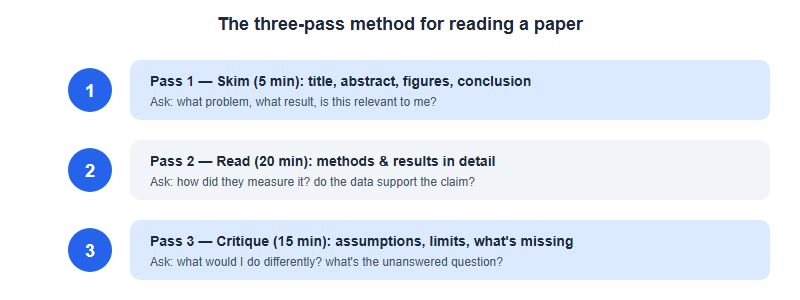
You do not read a research paper the way you read a novel. Experienced researchers make three passes, each with a different goal. Most papers you will only pass once; a handful that sit at the heart of your question earn all three.
- Pass 1 — Skim (about 5 minutes): read the title, abstract, figures, and conclusion. Decide only whether the paper is relevant to your question. Most papers stop here.
- Pass 2 — Read (about 20 minutes): for relevant papers, work through the methods and results. Ask how they measured the effect and whether the data actually support the claim.
- Pass 3 — Critique (about 15 minutes): for your core papers, interrogate assumptions and limitations. Ask what you would do differently and, crucially, what question the authors left unanswered.
Where to read — and what each source is good for
International students often waste weeks reading the wrong kind of source. A textbook is comfortable but rarely shows you an open question; a single primary paper is precise but easy to over-generalize. The trick is to move from wide to narrow: start with a review to map the field, then drill into the primary papers a review points you toward.
| Source | Use it for | Watch-out |
|---|---|---|
| Review articles | Mapping a field fast; finding the open questions authors flag as “future work” | Can be a few years old; the newest gaps may be in recent papers |
| Primary research papers | Real methods, real data, and the exact limitations of one study | One study is not proof; look for replication across papers |
| Preprints (arXiv, bioRxiv) | The most recent work, before peer review | Not yet reviewed; verify claims and treat as provisional |
| Textbooks | Background and vocabulary when a field is new to you | Settled knowledge, not open questions — a starting point only |
| Datasets & repositories | Checking whether the data you need already exist and are usable | Read the documentation; know how the data were collected |
Free tools go a long way. Google Scholar indexes almost everything and shows who cited a paper (a fast way to walk forward in time from a key study). PubMed is strong for life sciences; arXiv and bioRxiv host preprints in physics, computer science, and biology. Your school library may also provide database access — ask, because paywalled papers are often reachable through an institutional login.
Whatever you read, capture it as you go. A free reference manager such as Zotero stores papers and generates citations, but the more valuable habit is a one-line summary per paper written in your own words: the question, the method, the finding, and the limitation. Those one-liners become the rows of your literature matrix and, later, the citations in your research plan. Students who postpone note-taking almost always re-read the same papers twice; a few minutes of discipline now saves days in the spring.
Turning a stack of papers into a gap
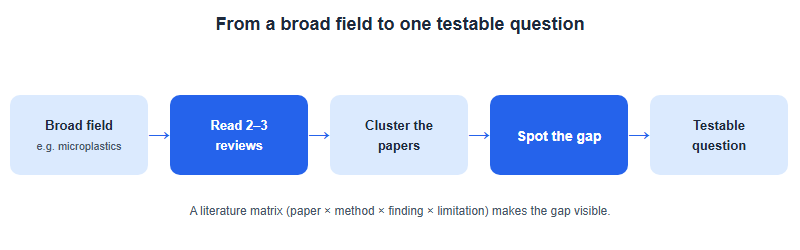
Reading is only half the job; the other half is organizing what you read so a gap becomes visible. The most reliable tool is a simple literature matrix — a table where each row is a paper and the columns are: what they studied, the method, the main finding, and the stated limitation. When you have ten to twenty rows, patterns appear.
A research gap usually shows up in one of three shapes. First, an unanswered question that several papers name as future work but nobody has tackled. Second, an untested condition or population — a method validated in one context but never tried in another (a different climate, age group, material, or dataset). Third, a contradiction between studies that your project could help resolve. Your matrix makes all three easy to spot, and it doubles as the backbone of the literature review you will later write into your research plan.
A worked example makes this concrete. Suppose your matrix holds a dozen papers on how a common food dye affects a model organism. Eight measured survival; three measured behavior; none measured both across the organism’s full life cycle, and two disagreed about low-dose effects. Reading across the rows, the gap almost writes itself: a dose-response study that tracks behavior and survival together, at the low doses where the literature contradicts itself. You did not invent that question — you assembled it from what others left undone, and that is exactly the move judges recognize as original thinking.
Writing the gap as a testable question
A gap is a hunch; a research question is a commitment. To convert one into the other, force your gap through three filters. Is it specific — does it name a variable you can measure and a condition you can change? Is it feasible — can you answer it with the time, equipment, and access you actually have this year? Is it meaningful — would the answer matter to someone beyond the fair? A question that survives all three is worth a year of your life.
- Specific: does it name a variable you can measure and a condition you can change?
- Feasible: can you answer it with the time, equipment, and access you actually have this year?
- Meaningful: would the answer matter to someone beyond the fair?
Feasibility is where international students most often need to compromise, and that is fine. If a gap demands equipment you cannot reach, narrow it until it fits your resources, or reframe it as a computational or observational study. Judges reward a sharply answered small question over a vaguely gestured-at big one; our note on what ISEF judges look for and the overview of every path to the ISEF finals both underline that originality and clear thinking travel further than expensive gear.
What we tell students who feel behind (an Embark coach view)
Reading a research literature is a skill, not a talent, and it is learnable in weeks. Per Embark, the students whose projects hold up under judging are almost always the ones who spent real, unglamorous time in the literature early — not the ones who read the most, but the ones who read with a question in mind and stopped to write down what was missing. Our coaches are working researchers, so we teach this the way a lab teaches a new graduate student: read in passes, keep a matrix, and defend your gap out loud before you commit.
If you feel behind, you probably are not — you are just at the phase that does not photograph well. A four-week reading sprint (week one: reviews and vocabulary; week two: primary papers and matrix; week three: cluster and name candidate gaps; week four: pressure-test the strongest question) puts most students in a genuinely strong position. That is the work we do first with every student, because a well-chosen question is the highest-leverage decision of the entire year.
Frequently asked questions
How many papers should I read before starting?
There is no fixed number. Read until you can explain the field's open questions in your own words — often a few reviews plus 10–20 primary papers.
Where do I find scientific papers?
Start with Google Scholar, PubMed, and preprint servers such as arXiv or bioRxiv. Use review articles first to map the field quickly.
What actually counts as a research gap?
An unanswered question, an untested condition or population, or a contradiction between studies that your project could help resolve.
Do I need to cite the literature at ISEF?
A literature review and citations are part of a strong research plan. Confirm the current requirements on societyforscience.org.
Work with Embark
Embark is the international competition team of Youfang Education — a research school, not a prep shop. Our coaches are working researchers who help students read the literature, find a real gap, and shape it into a question they can defend. We do not sell shortcuts or guarantee outcomes; we teach the craft.
Embark is an independent research-coaching organization, the international competition team of Youfang Education. We are not affiliated with, endorsed by, or sponsored by the Society for Science or Regeneron ISEF. Any results cited reflect Embark's own published record (per Embark). Please confirm all competition details on societyforscience.org; we correct any errors within 7 working days.