You do not need a university lab to build a competitive ISEF project. International students run strong research in school labs, in mentors’ labs, in the field, at home with citizen-science tools, and entirely on a computer with public data. What matters is matching your question to resources you can actually access — and following ISEF’s safety and ethics rules wherever you work. Here is how to choose.
You don’t need a university lab — but you do need a plan
One of the most damaging myths among international students is that a serious science project requires a gleaming university lab, and that without one you may as well not enter. It is not true. Every year, projects built with modest equipment, public datasets, or careful field observation advance alongside projects born in research universities. The lab is a means, not the point; the point is a well-designed study that answers a real question with defensible methods.
What actually sinks resource-limited students is not the missing lab — it is choosing a question that requires a lab they will never reach, then improvising badly. The fix is to decide your venue early and design the project around it. A question shaped to fit your resources beats an ambitious question you cannot execute. This is also why the reading phase matters so much: it is where you calibrate scope to reality before committing.
It helps to separate two things students tend to conflate: prestige and capability. A famous lab is not the same as the capability your specific question needs. A behavioral-ecology question may need a notebook, a phone camera, and patience; a materials question may need one instrument your school already owns; a public-health question may need nothing but a laptop and a well-chosen dataset. Audit what your question actually requires, then find the smallest venue that supplies it. Under-building starves a project of data; over-building burns a year chasing access you never needed.
Five places international students run ISEF research
There are more venues than most students realize. Each suits a different kind of question, carries a different cost, and comes with its own rules to check. You are not limited to one — many strong projects combine two, such as field data analyzed computationally.
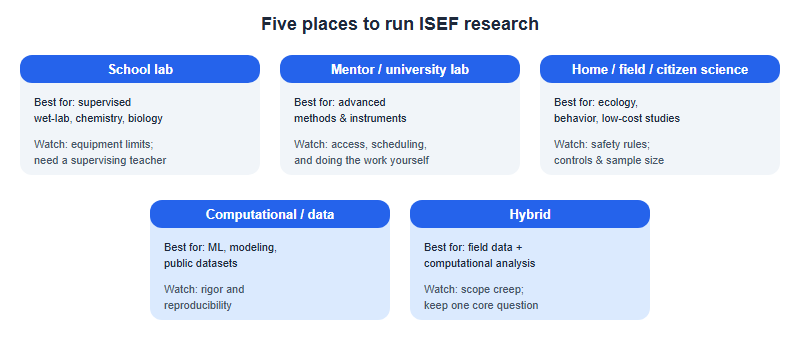
Do not over-think the choice on day one. Most students begin in the venue they can reach fastest — usually a school lab or a laptop — run a small pilot, and only then decide whether the question demands more. A pilot answers questions no amount of planning can: whether your method actually produces usable data, how long each trial really takes, and whether the idea survives contact with reality. Starting small is not a compromise; it is how careful researchers de-risk a year before they have spent it.
Comparing venues: fit, cost, and rules
Cost and effort vary widely, and so do the rules you must check before you begin. The table below is a planning aid, not a rulebook: safety and ethics requirements depend on your specific project, so always verify the current rules on the official site before you collect any data.
| Venue | Best-fit projects | Typical cost / effort | Key thing to verify |
|---|---|---|---|
| School lab | Chemistry, biology, materials with basic instruments | Low–moderate; depends on your school | Supervision and permitted procedures |
| Mentor / university lab | Advanced instrumentation, specialized techniques | Access is the cost; travel and scheduling | That the work is genuinely yours, not the lab's |
| Home / field / citizen science | Ecology, behavior, environmental sampling, surveys | Low; time-intensive data collection | Safety, ethics, and adequate controls |
| Computational / data | Machine learning, simulation, data analysis | Low; a laptop and free tools | Data source, licensing, reproducibility |
| Hybrid | Field measurement paired with modeling | Moderate; two workflows to manage | Keeping scope to one defensible question |
The computational route: strong projects with no wet lab
If lab access is your hard constraint, the computational path deserves serious consideration. Public datasets in genomics, astronomy, climate, public health, and economics are enormous and freely available; so are the tools to analyze them. A well-designed machine-learning study, a simulation of a physical system, or a careful statistical analysis of an existing dataset can be every bit as rigorous as a bench experiment — sometimes more so, because the whole pipeline can be made reproducible.
Concrete starting points are everywhere. Government portals publish climate, air-quality, and public-health data; astronomy surveys release sky catalogs; genomics consortia share sequence data; and open repositories host datasets in nearly every field. The strongest computational projects do not just download and describe such data — they pose a specific question the dataset was not originally assembled to answer, then defend every step from cleaning to conclusion. The skill on display is not coding for its own sake; it is disciplined reasoning about evidence, which is exactly what a science fair is built to reward.
The catch is that “no lab” does not mean “no rigor.” Computational projects live or die on method quality: did you split your data honestly, avoid leaking test information into training, choose a fair baseline, and report uncertainty? Judges who know the field will probe exactly these points. The freedom of the computational route comes with the obligation to be scrupulous about how you validate your results. It is a real path, not an easy one — and for many international students it is the most accessible way to do genuinely original work.
Match the venue to your question
Rather than starting from “what lab can I get into,” start from your question and let it point to a venue. A few honest questions usually settle it quickly.
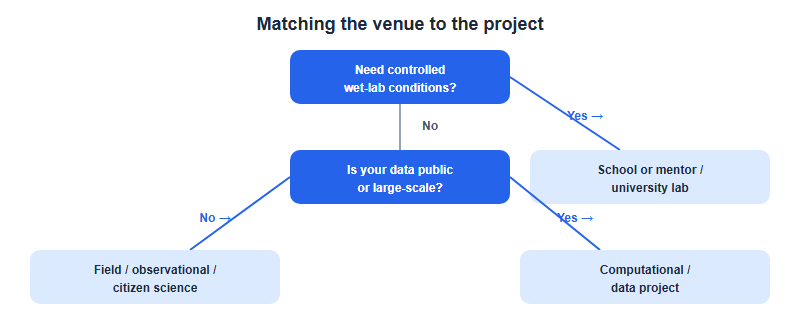
If your question genuinely needs controlled wet-lab conditions, invest energy in finding a school or mentor lab — and be ready to do the hands-on work yourself, because judges care that the research is yours. If it does not, a computational or field study may let you start this week with no gatekeepers at all. Our guide to choosing a research topic pairs naturally with this decision: the best topic is one your venue can actually support.
One more practical filter is time. A venue that is technically available but three bus rides away, bookable only on alternate Saturdays, will quietly starve your project of the repetition good data need. When two venues could both answer your question, choose the one you can return to often. Frequency of access, not grandeur of equipment, is what turns a promising idea into a finished dataset — and it is the factor students most consistently underweight when they choose where to work.
Safety, ethics, and access: what trips students up (an Embark coach view)
Two things quietly derail resource-limited projects, and neither is the absence of a lab. The first is rules: certain projects — those involving human participants, vertebrate animals, or hazardous materials — require review and approval before you begin, regardless of where you work. Students who assume a home or field project is automatically exempt sometimes collect a year of data that cannot be used. Check what applies to your project on the official rules, early, before you touch anything.
The second is ownership. When a student works in a mentor’s lab, judges want to see that the thinking, the design, and the interpretation are the student’s own — our note on what ISEF judges look for explains why they probe this so hard. A useful private test: can you explain, without notes, why you made each methodological choice? If the honest answer is “the lab told me to,” that is a gap to close before the fair, not at it. Per Embark, some of the most competitive projects we coach are built with the humblest resources — a laptop, a public dataset, a clear question — precisely because there is no ambiguity about whose work it is. We are a research school, not a prep shop: we help students design projects they can genuinely own and execute, whatever their access. For how venue choice interacts with qualification, see every path to the ISEF finals.
Frequently asked questions
Can I do an ISEF project at home?
Many students do — especially observational, behavioral, or computational work. Confirm what is permitted for home settings in the official rules.
What if I have no lab access at all?
Consider computational or data projects using public datasets, or field and observational studies that need minimal equipment.
Do home and field projects still need safety approval?
Possibly. Safety and ethics rules apply by project type, not location. Verify current requirements on societyforscience.org.
How do I find a mentor with a lab?
Reach out to nearby universities, alumni networks, and coaching programs; be specific about your question and your time commitment.
Work with Embark
Embark is the international competition team of Youfang Education — a research school, not a prep shop. Our coaches are working researchers who help students design projects they can genuinely own and execute, whether in a school lab, in the field, or entirely on a laptop. We do not sell shortcuts or guarantee outcomes; we teach the craft.
Embark is an independent research-coaching organization, the international competition team of Youfang Education. We are not affiliated with, endorsed by, or sponsored by the Society for Science or Regeneron ISEF. Any results cited reflect Embark's own published record (per Embark). Please confirm all competition details on societyforscience.org; we correct any errors within 7 working days.