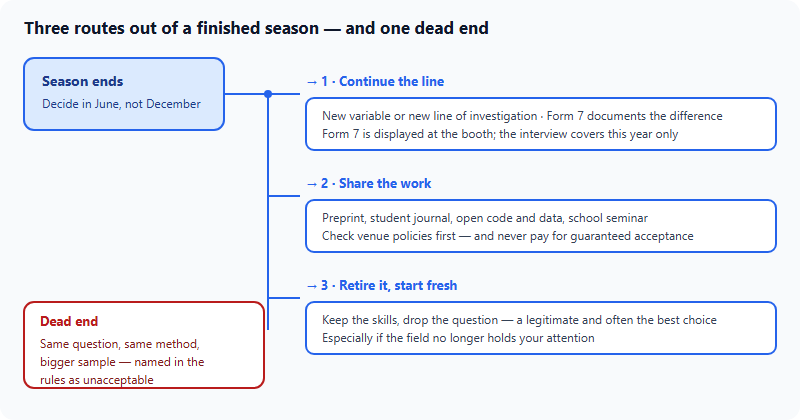
When the season ends you have three honest options: continue the research line, share the work, or retire the project and start something new. There is a fourth thing students try — running the same study again with more samples and calling it next year's project — and ISEF rules name it explicitly as an unacceptable continuation. Knowing which option you are choosing, in June rather than December, is what decides next year.
The one thing the rules will not let you do
Start here, because it is the most common wasted year we see. ISEF permits continuation and research-progression projects, but they must document that the additional research is new and different, and the rules give a direct example of what fails: repeating previous experimentation with the same methodology and research question — even with a larger sample size — is named in the rules as an unacceptable continuation.
Read that sentence twice, because it kills a very natural plan. A student finishes a study with 40 samples, hears a judge say the sample was small, and spends the summer collecting 200 more. That is a better study — and it is not a permitted continuation, because the research question and the methodology did not change. What the rules ask for is a substantive expansion: testing a new variable, or opening a new line of investigation. The mechanism is the Continuation / Research Progression Projects Form (Form 7), which documents how this year's work differs from the previous work and, per Society for Science, must be displayed at the project booth at ISEF.
There is a judging consequence too. If a project is a multi-year effort, the interview is meant to focus only on the current year's work, with judges reviewing the abstract and Form 7 to clarify what progress was completed this year. Everything you did in previous cycles becomes context, not credit. A student who plans a continuation and then discovers in April that eighty percent of their material is last year's has effectively arrived with a shorter project than everyone else.
| What you are planning for next year | Likely verdict | Why |
|---|---|---|
| Same question, same method, three times the sample size | Not acceptable | Named in the rules as an unacceptable continuation — nothing new was tested |
| Same system, new variable introduced and tested | Usually acceptable | Testing a new variable is given as an example of substantive expansion |
| Same finding, now tested in a second species / material / population | Usually acceptable | A new line of investigation, not a repetition |
| Last year's prototype, rebuilt more neatly, same design criteria | Weak | Construction improvements without new testing criteria rarely read as progression |
| Entirely new question in the same field | Acceptable | A new project; Form 7 requirements depend on how much prior work it builds on |
Route 1: continue the line properly
A good continuation starts from the question your own results raised, not from the criticism you received. Those are different things. If a judge said your sample was small, the research answer is not “more samples” — it is to ask what your data hinted at that you could not resolve. The effect appeared in one subgroup but not another: why? The material failed at one temperature: what mechanism would predict that? Those are new variables and new lines of investigation, which is exactly the language the rules use.
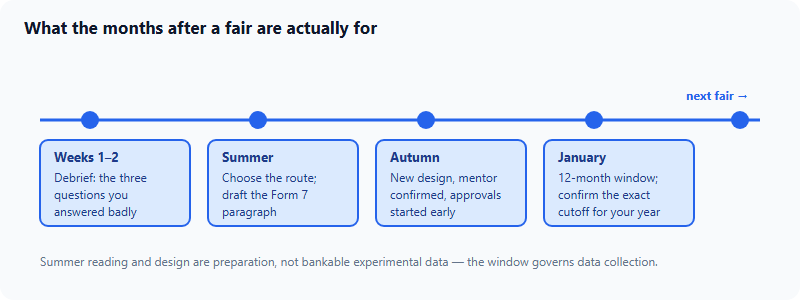
Two scheduling facts shape this. First, projects may include no more than 12 months of continuous research, and the rules state the research may not include work performed before a stated cutoff — the current rules page specifies research may not include work performed before January 2026, so check the exact cutoff for your fair year. Second, each student is only allowed to enter one project. Together these mean your continuation is a fresh twelve-month experimental cycle, not an accumulation, and the reading and design you do over the summer is preparation rather than bankable data.
Practically, the summer after a season should produce three artefacts: a one-page statement of the new question, a list of the variables you will now manipulate that you did not manipulate before, and a draft of what Form 7 will have to say. If you cannot draft that Form 7 paragraph in July, the continuation is not real yet — and it is far cheaper to discover that now than in March. If it turns out you need a genuinely new question, our guide to choosing a research topic that can actually win is the right place to restart.
Route 2: share the work — and the trap waiting for you
Sharing research is normal scientific behaviour and worth doing. Reasonable options include posting a preprint (each preprint server has its own scope, moderation and eligibility policies — read them before you submit), submitting to a journal that genuinely reviews student work, releasing your code and de-identified data with a licence and a README, giving a seminar at your school, or writing a plain-language explainer for a general audience.
Now the trap. Every year, families are approached with an offer to “publish” a high-school project quickly, for a fee, often bundled with other application services. The warning signs are consistent and easy to check:
- Acceptance is promised or implied before review. Real peer review cannot guarantee an outcome in advance.
- The fee comes first and the review is measured in days. A serious review cycle is usually weeks to months.
- You were solicited by email or agent rather than choosing the venue yourself after reading what it publishes.
- No named editorial board, no listed reviewers, no archived back issues you can read.
- The pitch is about admissions, not about readers. That is a marketing product describing itself as a journal.
The decisive point for ISEF specifically: publication is not a judging criterion. The Grand Award criteria are the research question or problem, design and methodology, execution, creativity and potential impact, and presentation. There is no line for “has been published,” and nothing in what judges actually probe at the booth is improved by a certificate. A paid publication buys nothing at the fair and carries a real cost: a paper you cannot defend is a liability in any interview where an adult asks how it was reviewed. If you do plan to publish before a future fair, ask your SRC how prior publication interacts with continuation and originality expectations, and confirm on societyforscience.org.
Route 3: retire it — the underrated choice
Retiring a project is not failure, and coaches who never recommend it are not being honest with students. Retire when the question is genuinely answered; when the equipment or access you needed has disappeared; when the field stopped interesting you; or when the only continuations you can imagine are the repetition the rules forbid. What you keep is substantial: instrument skills, statistics, a working relationship with a mentor, and the experience of running a full cycle. Students often produce their strongest work in year two precisely because they were willing to abandon year one's topic.
The two-week debrief we run at the end of every season
Embark is the international competition team of Youfang Education, and we are a research school rather than a prep shop — which shows up most clearly in June, when nothing is due. Per Embark, our coaching spans projects across ISEF's 22 categories, and the students who compound year over year almost always do the same unglamorous thing: they debrief while the season is still fresh, rather than restarting in October from memory.
The protocol is short. In week one, write down every question a judge asked and mark the three you answered badly — those are your real gaps. In week two, write the two-page “what I would do differently” memo and the one-page new-question statement, then decide your route: continue, share, retire. Book the mentor conversation before the summer disperses everyone. Archive the notebook, raw data and analysis scripts somewhere you will still find them in eight months.
What actually carries forward to an application
Be careful about the story you tell yourself here. No competition result, publication or coaching programme guarantees an admissions outcome, and anyone promising otherwise is selling something. What a second cycle can give you is a longer arc: evidence that you can identify a follow-up question, design around a constraint, and stay with a problem past the point where it stopped being fun. That is a different and more durable signal than a single ribbon, and it reads clearly whether or not you reach the finals again — the routes to which are mapped in every path to the ISEF finals.
FAQ
Can I redo my ISEF project next year with more data?
No. The rules name repetition of the same methodology and research question with a larger sample as an unacceptable continuation. You need a new variable or line of investigation.
What is Form 7?
The Continuation / Research Progression Projects Form. It documents how this year's research is new and different, and it must be displayed at the project booth at ISEF.
Does publishing my project help my ISEF score?
Publication is not among the Grand Award judging criteria. Share your work if it is ready, but never pay for guaranteed acceptance.
Is it a waste to abandon my project after one year?
No. Retiring a finished question and keeping the skills is a legitimate choice, and often produces a stronger second-year project.
Work with Embark
The most valuable hour of a research year is the one right after the fair, when nothing is due. If you are deciding between continuing, sharing and starting over, bring us your results and your judge questions — we will tell you which route your own data supports.
Embark is an independent research-coaching organisation, the international competition team of Youfang Education. We are not affiliated with, endorsed by, or sponsored by the Society for Science or Regeneron ISEF. Any results cited reflect Embark's own published record (per Embark). Rules, forms, criteria and dates change between cycles — confirm all competition details on societyforscience.org and with your affiliated fair. Factual errors are corrected within 7 working days of notice.