If any part of this year's project grew out of last year's — same area, same question line, even a lesson you simply carried forward — ISEF treats it as a continuation, and Continuation/Research Progression Projects Form (7) is required. Continuations are permitted and often respected. What is not permitted is repeating the same question with a bigger sample. That distinction decides whether year two is your strongest project or a paperwork failure.
“Continuation” is defined far more widely than students assume
Most students think a continuation means “I am literally redoing last year’s experiment.” The ISEF rules define it much more broadly. The rules for all projects state that “if the current project is in a similar area of research as any previous project of the student or any team member, it is considered a continuation. ONLY a new and different research project is allowed.”
Read that twice, because two clauses in it catch people out. First, similar area of research — not identical question, not identical method. Second, any team member. If you join a partner who worked on adjacent research last year, the project inherits continuation status through them.
The official Rules FAQ pushes the definition wider still. It notes that “most professional scientific research is a continuation of some kind,” and offers a plain test: if there is anything you learned in your last study that is helping you in this study, if a question arose from it that led you here, or if you will refer to anything from the previous study — it is considered a continuation.
The practical consequence for planning is simple. Assume you are a continuation and prepare Form 7, rather than hoping you are not. Discovering at fair registration that you needed a form you never drafted is a bad week. Concluding you needed one and then being told you did not is a shrug.
One more structural rule frames everything below: each student is only allowed to enter one project, and that project may include no more than 12 months of continuous research. There is no route where you enter last year's project and this year's project as two entries and let the judges pick.
What separates a valid continuation from a rejected one
The rules give one standard and one anti-example, and both are worth memorising. A valid continuation must document that the additional research is a substantive expansion from prior work — the rules name testing a new variable or a new line of investigation as examples. The anti-example is equally explicit: repetition of previous experimentation with the same methodology and research question, even with an increased sample size, is given as an unacceptable continuation.
“Even with an increased sample size” is the sentence that ends the most common student plan. Collecting three times the data on the same question is a perfectly reasonable scientific instinct and it does not satisfy this rule.
| Year 1 project | Year 2 as students often propose it | How it reads against the stated standard | The fix |
|---|---|---|---|
| Effect of salinity on germination rate, 30 seeds | Same protocol, 90 seeds, tighter error bars | Repetition with increased sample size — named as unacceptable | Add a genuinely new variable: temperature interaction, seed age, or a second species |
| CNN classifier for leaf disease, one dataset | Same architecture, same task, retrained longer | Same question and methodology; longer training is not a new line | New line: cross-dataset generalisation, or a failure-mode analysis of what the model gets wrong |
| Adsorption of a dye onto a biochar | Same biochar, three new dyes, same protocol | Arguably a new variable; the fair's SRC decides, not you | Document explicitly what is new, and what year-one result motivated it |
| Survey of study habits, 120 respondents | Same instrument, new school, larger n | Same research question with more participants | New line: change the question to a mechanism or intervention, not a bigger sample |
Notice the pattern in the fixes. In every case the repair is not “do more,” it is “ask a question year one could not answer.” That is also, not coincidentally, what makes year two a better project. The rule is pushing you toward good science, not merely toward compliance.
Form 7: what it is, when you write it, where it goes
Continuation/Research Progression Projects Form (7) is the document that carries the argument. Its job is to document that the additional research is new and different. Three logistics facts matter, and students routinely get all three wrong.
- It is written after experimentation, not before. Form 7 sits in the same timing bucket as the abstract — it describes what you actually did. This is the opposite of the approval forms (adult sponsor, risk assessment, human participants, vertebrate animals), which must be signed before experimentation begins.
- It must be displayed at the project booth. The display rules require that if a study is a continuation, Form 7 must be completed and vertically displayed at the booth at ISEF. It is not a file you email and forget.
- It is read as an argument, not a formality. The rules describe a valid continuation as “a sound scientific endeavor” that “demonstrates the student’s commitment to the field.” Written well, it converts a compliance obligation into evidence of depth.
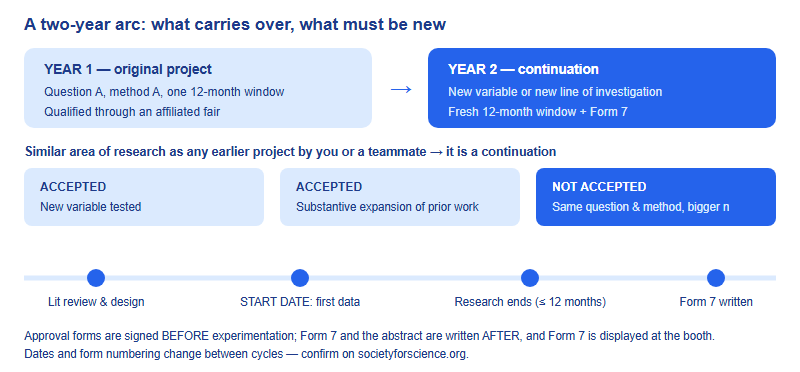
The 12-month clock resets. Your literature does not.
A common misreading is that a continuation somehow inherits the previous year's research window. It does not. Each entry gets its own window, and the definition of when that window opens is precise: the Rules FAQ states that “the start date of your project is when you begin to collect data for your experiment. The literature review and the design of your study will occur prior to your start date.”
That sentence is a gift to continuation students, and most of them fail to cash it. Everything you did in year one that was reading, designing, and learning the technique can inform year two without consuming a single day of the new window. Only data collection is on the clock. A second-year student should therefore arrive at their start date faster and better prepared than any first-timer — the literature is already in their head.
Two further timing facts to plan around, both from the official rules:
- The project may include no more than 12 months of continuous research, and the rules specify an earliest permitted start date each cycle. That cutoff moves every year — check the current Rules and Guidelines for your fair year rather than reusing last season's number.
- You may keep working between your regional competition and ISEF, provided the active research period is no longer than 12 months within an 18-month period and any additional data uses the same methodology already approved by the affiliated fair. Changing methods after fair approval is a different matter entirely.
Also worth stating plainly: a continuation does not grant standing at the finals. You re-qualify through an affiliated fair every single year, on the same terms as everyone else. If you are unclear how that funnel works from outside the United States, we have mapped it in every path to the ISEF finals.
When year two is the stronger play — and when to start fresh
The rules tell you what is permitted. They do not tell you what is wise. In coaching, the deciding factor is rarely the topic; it is whether year one produced a question or merely a result. A project that ended with “and therefore we now need to know X” is built to continue. A project that ended with a clean, closed answer is often better left closed.
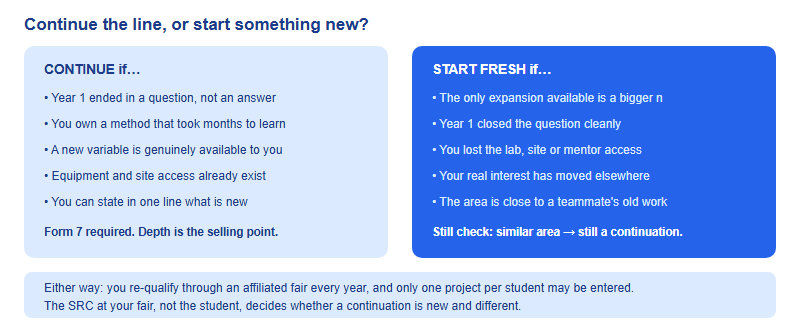
One thing continuation students consistently underrate: judges are assessing this year's work. The Grand Award criteria allocate 10 points to the research question, 15 to design and methodology, 20 to execution, 20 to creativity and potential impact, and 35 to presentation, of which 25 sits in the interview. Nothing in that scoring pays you for last year. What year one buys you is a better answer to “why this question” and a much steadier interview — which is exactly where the marks are. We break down that interview in what ISEF judges look for at the booth.
Building year two so it is legal on day one
The continuation students who have the calmest seasons do five things before they collect any data.
- Write the one-sentence delta first. “Last year I established X; this year I test whether Y changes X.” If you cannot write that sentence, you do not yet have a continuation — you have a repeat. This sentence later becomes the spine of Form 7.
- Audit your teammates' history, not just your own. The rule reaches through any team member. Ask each prospective partner what they researched previously, before you commit to a question.
- Re-run the approval forms as if you were new. Continuation status does not carry approvals forward. Adult sponsor review, risk assessment, and any human-participant or vertebrate-animal approval must be dated before experimentation begins for this project, this year.
- Separate the notebooks. Keep year two's lab notebook physically distinct from year one's. When an SRC or a judge asks what is new, a notebook that starts at this year's start date answers the question by existing.
- Choose the new variable for scientific reasons, then check compliance. The order matters. Students who pick a variable to satisfy Form 7 produce thin projects; students who pick the variable their year-one data demanded pass Form 7 as a side effect. Our guide to choosing an ISEF research topic applies to a second year as much as a first.
One honest gap worth flagging: the rules pages we checked set the standard for what a continuation must show, but we did not find a stated maximum number of years a line of research may continue, nor an explicit rule on displaying prior-year data at the booth. Both are questions for your affiliated fair's SRC and for the current Rules and Guidelines — confirm on societyforscience.org rather than assuming either way.
Is a second project on the same topic automatically a continuation?
Yes. If it is in a similar area of research as any earlier project by you or a teammate, ISEF treats it as a continuation and Form 7 is required.
Can I just increase my sample size and enter again?
No. Repeating the same research question and methodology with a larger sample is given in the rules as an example of an unacceptable continuation.
When do I write Form 7?
After experimentation, like the abstract. At ISEF it must be displayed at the project booth. Confirm requirements on societyforscience.org.
My teammates graduated — can I continue alone?
Per the ISEF Rules FAQ, yes: you may switch to an individual project or add new members, but it remains a continuation requiring Form 7.
Work with Embark
If you competed last season and are deciding between continuing and starting over, the useful conversation is about what your year-one data actually asked next — and whether that question is reachable with the access you have. We will say plainly when a fresh start is the better project.
Embark is an independent research-coaching organisation, the international competition team of Youfang Education. We are not affiliated with, endorsed by, or sponsored by the Society for Science or Regeneron ISEF. Any results cited reflect Embark's own published record (per Embark). Continuation rules, form numbering, research-window dates and judging criteria change between cycles — confirm all details on societyforscience.org and with your affiliated fair. Factual errors are corrected within 7 working days of notice.