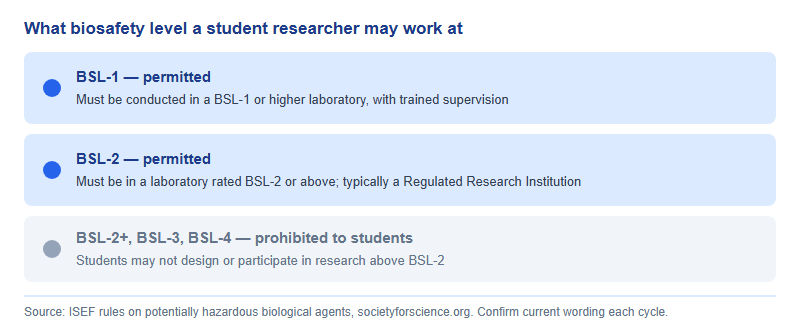
ISEF permits student research at biosafety levels 1 and 2 only, and prohibits students from designing or participating in research above BSL-2 — including BSL-2+, BSL-3 and BSL-4. For microbiology projects, that single cap plus one rule about sealed petri dishes decides more about your project than your research question does. Both are worth knowing before you swab anything.
The ceiling, and why it is a design constraint rather than a formality
The Society for Science rules on potentially hazardous biological agents state the limit plainly: “Students are prohibited from designing or participating in any research involving biosafety levels above BSL-2. (This includes BSL-2+, BSL-3 and BSL-4.)” Note the verb — designing. The prohibition attaches at the planning stage, not at the bench. A project that would require BSL-3 containment is not a project you may write a research plan for and then scale down; it is out of scope from the first sentence.
The second structural fact is that microbiology sits inside a pre-approval regime. The rules require that “prior review and approval is required for the use of potentially hazardous microorganisms (including bacteria, viruses, viroids, rickettsia, fungi, cyanobacteria, and parasites) and recombinant DNA (rDNA) technologies.” Approval comes from an affiliated fair Scientific Review Committee (SRC), an Institutional Biosafety Committee (IBC), or an IACUC, and it must be in place before experimentation begins.
Read together, these two rules produce the sentence that surprises most students: in microbiology, you cannot start work and seek approval afterwards. Approval is a gate, not a receipt. A summer of data collected before a committee saw the plan is not a strong project with a paperwork problem; under the rules it is data that should not have been collected.
The sealed-plate rule, and the single most expensive lid in high-school science
The most common student microbiology project on earth is some version of “swab a surface, culture what grows, compare.” School door handles, phone screens, canteen trays, river water. It is popular because it is cheap and visual, and it is exactly where the rules get specific.
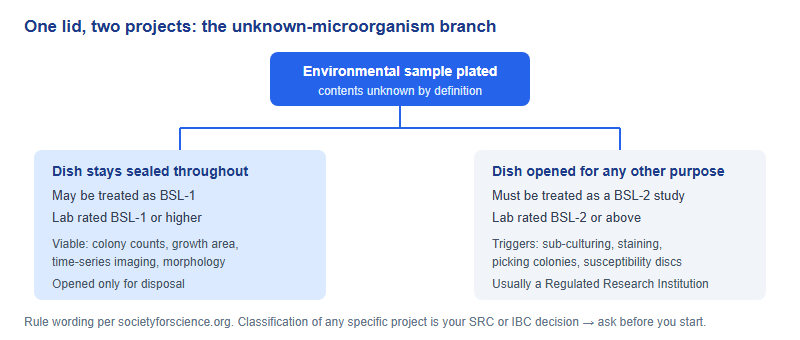
Environmental samples grow unknown microorganisms, and unknowns cannot be risk-assessed by name. The rules handle this with a conditional: unknown microbes may be treated as BSL-1 only if “the petri dish remains sealed throughout the experiment.” If the dish is opened for any purpose other than disposal, “it must be treated as a BSL-2 study and involve BSL-2 laboratory precautions.”
That is a very large consequence hanging on a very small action. Sub-culturing, Gram staining, picking a colony, running a sensitivity disc, sniffing a plate, opening it to measure a zone with callipers — each of these opens the dish, and each converts a project that could run in a school BSL-1 lab into one requiring a facility rated BSL-2 or above.
The practical decision, therefore, comes before the swab: do you want a counting study or an identification study? Colony counts, growth-area measurement, time-series photography and morphology description can all be done through a sealed lid. Identifying what grew, testing its susceptibility, or isolating it cannot. Students routinely design the first and then drift into the second because it feels like the natural next question — and by then the plate is open.
Where the work has to physically happen
Biosafety level is not only a hazard label; it is a statement about the room. The rules tie each level to a facility: BSL-1 research “must be conducted in a BSL-1 or higher laboratory” under trained supervision, and BSL-2 research “must be conducted in a laboratory rated BSL-2 or above,” which in practice means a Regulated Research Institution rather than a school prep room or a kitchen.
This is the point at which many otherwise sensible plans fail for students at international schools in China. The question is not “is my school science lab good enough” in a general sense — it is whether the lab carries a rating, and whether someone can say so in writing. A well-equipped IB chemistry lab with a fume hood is not automatically a rated microbiology facility.
Two consequences follow. First, resolve the venue question before the research question hardens, because venue determines which half of the branch above is available to you. Second, if you are negotiating access to a university lab, ask specifically about the rating and about who will supervise, not just about bench time. Access and supervision are separate goods, and ISEF requires both.
What actually gets approved, and in what order
ISEF’s general rule is that projects involving human participants, vertebrate animals, potentially hazardous biological agents or tissue must be reviewed and approved by a local or regional IRB or SRC prior to the start of experimentation. For biological-agent work, the documentation set typically includes the standard checklist forms every project files, a Potentially Hazardous Biological Agents form, a Risk Assessment form where applicable, and a Qualified Scientist form — because BSL-2 research must be supervised by a Qualified Scientist, while BSL-1 research may be supervised by a trained Direct Supervisor or a Qualified Scientist.
One honest caveat on paperwork: form numbers are renumbered between cycles, and the Society publishes a Rules Wizard specifically so students stop guessing. Use it rather than copying a form list from a blog post or a senior’s old folder, this one included. What is stable is the logic: sponsor and student jointly determine which forms apply, most forms are signed before research begins, and only a small set — the institutional setting form, the animal form used at regulated sites, the continuation form and the abstract — are completed afterwards.
| If your project involves… | What the rules require | The question to settle first |
|---|---|---|
| Culturing unknown microbes from the environment | BSL-1 treatment only while the dish stays sealed; BSL-2 treatment and precautions once it is opened for anything but disposal | Is my research question answerable through a sealed lid? |
| Named bacteria, viruses, viroids, rickettsia, fungi, cyanobacteria or parasites | Prior review and approval before use; classification and level are decided by the reviewing committee | Who is my SRC or IBC, and what is their submission deadline? |
| Recombinant DNA (rDNA) techniques | Prior review and approval required, same as for potentially hazardous microorganisms | Does any facility I can access support this at a permitted level? |
| Anything requiring containment above BSL-2 | Prohibited — students may not design or participate in such research | Can the question be reframed at a permitted level, or should it be dropped? |
Designing a microbiology project that survives the constraint
The constraint is real, but it is not a ban on doing interesting biology. It is a filter that rewards a particular kind of question — one where the measurement, not the identification, carries the finding.
- Move the novelty into the variable, not the organism. A sealed-plate growth study becomes original through what you manipulate: a light regime, a surfactant gradient, a temperature cycle, a realistic cleaning protocol tested at intervals that match how cleaning actually happens.
- Prefer quantities you can measure without opening anything. Colony counts over time, area coverage from calibrated photographs, and lag-phase timing are all real dependent variables, and imaging gives you a reproducible record a judge can inspect.
- Consider non-PHBA model systems. Some questions about growth, competition or inhibition can be asked in systems that do not invoke the PHBA rules at all. Ask your sponsor whether an alternative organism answers the same question at a lower regulatory cost — and confirm the classification rather than assuming it.
- If you genuinely need BSL-2, start the access conversation months early. An institution has to agree, a Qualified Scientist has to approve the plan before experimentation, and a committee has to review it. None of that compresses well, and all of it sits ahead of your first data point.
- Write the disposal protocol into the plan. Autoclaving or approved decontamination is not a footnote in microbiology; reviewers read it as a proxy for whether the student has been trained by someone who has actually run a lab.
The topic-selection logic underneath all of this — choosing a question that is both interesting and executable in your actual circumstances — is covered in how to choose an ISEF research topic that can actually win. And it is worth remembering that judges will ask you to justify the containment choices themselves; the reasoning judges probe at the booth is unpacked in what ISEF judges look for at the booth.
Across the projects Embark has coached — per Embark, more than 750 competition awards overall, with coaching spanning the 22 ISEF categories — the microbiology pattern is consistent and slightly unromantic. The projects that reach a fair are rarely the ones that identified something exotic. They are the ones that picked a question answerable within the level they could legitimately access, secured approval before the incubator was switched on, and spent the saved months on replication instead of on renegotiating lab access in March. A research school treats the biosafety rules as part of the experimental design, because that is precisely what they are.
Can ISEF students do BSL-3 research?
No. Students are prohibited from designing or participating in research above BSL-2, including BSL-2+, BSL-3 and BSL-4.
Can I culture bacteria from a swab at school?
Possibly at BSL-1 if the dish stays sealed throughout. Opening it for anything but disposal makes it a BSL-2 study.
Do microbiology projects need approval before starting?
Yes. Prior review and approval is required for potentially hazardous microorganisms and rDNA, before experimentation begins.
Where must BSL-2 work be done?
In a laboratory rated BSL-2 or above, which typically means a Regulated Research Institution rather than a school lab.
Work with Embark
Most microbiology projects are decided by a venue and an approval deadline, not by a hypothesis. If you have a question but do not yet know which biosafety level it lives at, that is the right moment to work it through with someone who has done it before.
Embark is an independent research-coaching organisation, the international competition team of Youfang Education. We are not affiliated with, endorsed by, or sponsored by the Society for Science or Regeneron ISEF. Any results cited reflect Embark's own published record (per Embark). Biosafety rules, form numbering, approval routes and committee requirements change between cycles and may be applied more strictly by individual affiliated fairs — confirm all details on societyforscience.org and with your affiliated fair before beginning any work. Factual errors are corrected within 7 working days of notice.