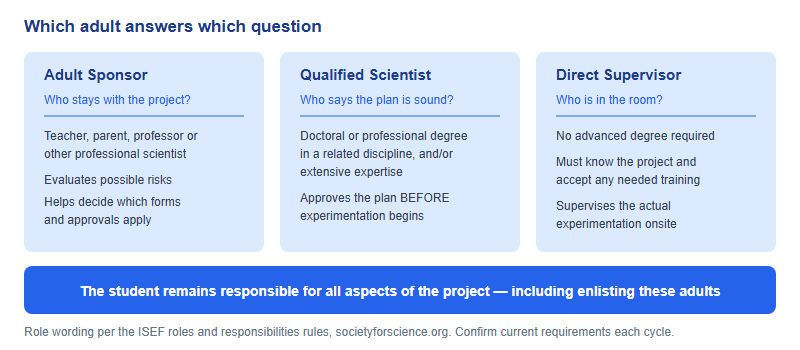
ISEF projects run on three named adult roles. The Adult Sponsor oversees the project and helps decide which rules apply; the Qualified Scientist approves the research plan before experimentation and is required for certain project types; the Direct Supervisor provides onsite supervision and needs no advanced degree. Most students discover these roles while filling in forms — which is roughly six months too late.
Three roles, one accountability question
The roles look bureaucratic until you notice they answer three different questions. Who is with the student across the whole project? That is the Adult Sponsor. Who has the expertise to say this plan is scientifically and legally sound before it starts? That is the Qualified Scientist. Who is physically present when the risky part happens? That is the Direct Supervisor.
They can overlap. The rules note that a Qualified Scientist “can also serve as the Adult Sponsor if that person meets both sets of qualifications” — and for many school-based projects a single well-chosen teacher covers everything required. But they are distinct functions, and a project that has one adult performing a function they are not qualified for is a project with a hole in it, whatever the signature page shows.
The rule that frames all three is the one about the student. Per the published responsibilities, the student researcher is “responsible for all aspects of the research project,” and that list explicitly includes “enlisting the aid of any required supervisory adults.” Recruiting your adults is not something done to you by your school. It is listed as part of your job.
The Adult Sponsor: the role you probably already have, filled by the wrong person
The qualification bar here is deliberately wide. An Adult Sponsor “may be a teacher, parent, professor, and/or other professional scientist” who is knowledgeable in the area of the student's research. What the rules emphasise instead of credentials is familiarity and proximity: the sponsor should know the regulations that apply to the project's procedures and materials — particularly for human participants, vertebrate animals, potentially hazardous biological agents, and hazardous chemicals, devices or activities — and “should have close contact with the student throughout the timeline of the project.”
Two failure modes recur, and neither is about competence.
The first is the prestigious absentee. A student recruits the most senior science teacher in the school, who agrees warmly and is then unreachable for four months. Close contact throughout the timeline is an explicit expectation of the role; a sponsor who signs in September and reappears in February cannot perform the risk-evaluation function the rules assign them.
The second is the mismatched subject. A student doing a computational ecology project asks their physics teacher because that is who they like. The sponsor is supposed to be knowledgeable in the area of the research and familiar with the applicable regulations. A physics teacher is a fine human being and the wrong person to spot that a project has quietly become human-participant research.
The useful reframe: choose your Adult Sponsor for availability plus regulatory literacy, not seniority. If the best-informed person is not the most available, that is an argument for splitting the roles, not for pretending one person covers both.
The Qualified Scientist: when you genuinely need one
The Qualified Scientist has a real credential bar: “earned a doctoral/professional degree in a scientific discipline related to student's area of research AND/OR individual with extensive experience and expertise” in the student's area, and thorough familiarity with the applicable local and national regulations.
Their responsibilities are more specific than “advising.” Per the published rules, the Qualified Scientist reviews the ISEF rules relevant to the project and approves the student's research plan or engineering design prior to the start of experimentation; provides direct supervision throughout the project timeline, or coordinates with a Direct Supervisor to serve in that capacity; ensures proper training of the student researcher and/or Direct Supervisor; and completes the required documentation.
Not every project needs one. The rules identify project types where a Qualified Scientist's approval is required before experimentation begins — including many vertebrate animal studies and, among biological-agent projects, BSL-2 work. Whether your specific project triggers the requirement is exactly what the Society's Rules Wizard exists to answer, and it is a better source than any summary, including this one.
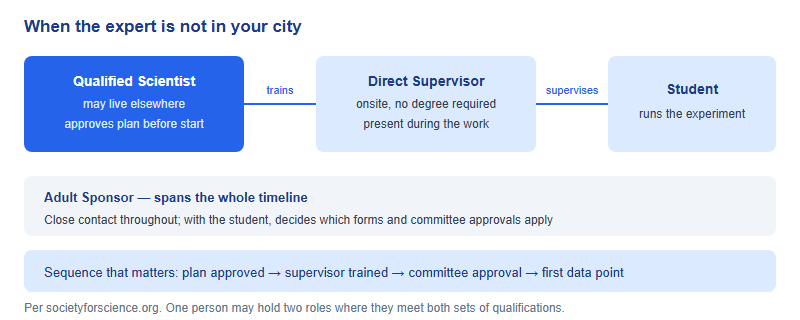
What matters strategically is the timing verb: approves…prior to the start of experimentation. A Qualified Scientist recruited in March cannot retroactively approve a plan executed in January. If your project type needs one, the recruitment deadline is not the fair deadline; it is your own start date, and the start date is when data collection begins. That interacts directly with topic choice, which is why feasibility belongs in the question-selection stage — see how to choose an ISEF research topic that can actually win.
The Direct Supervisor: the role that unlocks a remote expert
This is the least understood of the three and the most useful to students in China, because it solves a specific problem: the person with the right expertise is often not in your city.
The rules address this directly. A Qualified Scientist “may live elsewhere and not be local to the student, in which case, a Direct Supervisor has been appointed and trained to serve as the onsite supervision as necessary for the specific student project.” The Direct Supervisor “does not need an advanced degree” but “must be familiar with the student's project and agree to any training necessary.”
That structure is worth reading twice. It means expertise and presence can legitimately be held by two different people. A professor abroad who knows the field can approve the plan and train the supervisor; a lab technician, school lab manager or graduate student on site can hold the supervision function during experimentation. What the structure does not permit is a remote expert with nobody present when the work happens.
How to actually recruit these adults from an international school
The rules tell you who is acceptable. They do not tell you how to get a busy person to say yes. That part is a skill, and it is learnable.
| Role | Realistic sources for a student in China | What to put in the ask | Common reason for a no |
|---|---|---|---|
| Adult Sponsor | Subject teacher, IB/AP science coordinator, lab manager, or a parent who is a professional scientist in a related field | Project one-liner, expected months of work, what you need from them each month, and the fair deadline | Vague time commitment — adults decline open-ended requests, not defined ones |
| Qualified Scientist | University faculty, hospital or industry researchers, alumni networks, a teacher holding a relevant doctorate | A one-page draft research plan, not an idea; the specific rule that requires their approval; the date you need it by | Being asked to “supervise a student project” with no plan attached and no defined end point |
| Direct Supervisor | School lab technician, university graduate student, staff at the site where the work happens | The exact procedures they would oversee, the training the Qualified Scientist will give them, and the schedule | Nobody explained that no advanced degree is needed, so likely candidates rule themselves out |
Three practical notes from the pattern we see repeatedly. Ask with a document, not a question. A one-page plan converts far better than a request for a meeting, because it lets the adult judge the workload in ninety seconds. Name the end point. “Through to the regional fair in March, roughly two hours a month, plus one review before I start collecting data” is answerable; “would you supervise my research?” is not. Ask before you need the signature. The approval architecture assumes adults are in place before experimentation, so recruitment belongs in the same weeks as literature review and design — the part of the season that costs nothing.
One more thing worth saying plainly to students from schools without a research culture: a no is usually about capacity, not about you. Per Embark, our coaching draws on a network of more than 3,000 contracted research mentors from leading universities, and even inside that network the binding constraint is availability rather than willingness. Ask more people, earlier, with a clearer ask.
What none of these adults can do for you
The roles are supervisory, not substitutive. The student is responsible for performing the project, for following the rules and guidelines, and for understanding and abiding by the Ethics Statement. Adults evaluate risk, approve plans, train, supervise and sign. They do not design your study for you, and at the booth nobody will be standing next to you.
This has a practical consequence that judges test constantly. If a student cannot explain why a control was chosen, or what a supervisor actually did versus what the student did, the interview turns from a discussion of results into an audit of authorship. The questioning pattern is unpacked in what ISEF judges look for at the booth, and the wider structure of fair-level review and advancement sits in every path to the ISEF finals.
The cleanest test of whether your adult structure is right is a question you can ask yourself in August. For each of the three functions — continuity, plan approval, onsite supervision — can you name a person, and does that person know they are named? If any answer is “probably my chemistry teacher, I should ask,” that is this week's task, and it is a far better use of the pre-start weeks than reading one more paper. A research school builds the supervision structure before the experiment, because the rules were written on the assumption that somebody already did.
Who can be an ISEF Adult Sponsor?
A teacher, parent, professor or other professional scientist who is knowledgeable in the research area and in close contact throughout.
Does every ISEF project need a Qualified Scientist?
No. Certain project types require one, including many vertebrate animal studies and BSL-2 biological agent research. Confirm with the Rules Wizard.
Can my Qualified Scientist be in another country?
Yes. They may be non-local if a Direct Supervisor is appointed and trained to provide onsite supervision.
Does a Direct Supervisor need a PhD?
No. They need no advanced degree, but must know the project and accept any training the Qualified Scientist provides.
Work with Embark
Finding the right supervising adults is the step most students underestimate and the one that decides whether a project can legally start on time. If you know what you want to research but not who needs to sign off on it, that is a good conversation to have now rather than in March.
Embark is an independent research-coaching organisation, the international competition team of Youfang Education. We are not affiliated with, endorsed by, or sponsored by the Society for Science or Regeneron ISEF. Any results cited reflect Embark's own published record (per Embark). Role definitions, terminology, form numbering and approval requirements change between cycles and may be applied more strictly by individual affiliated fairs — confirm all details on societyforscience.org and with your affiliated fair. Factual errors are corrected within 7 working days of notice.