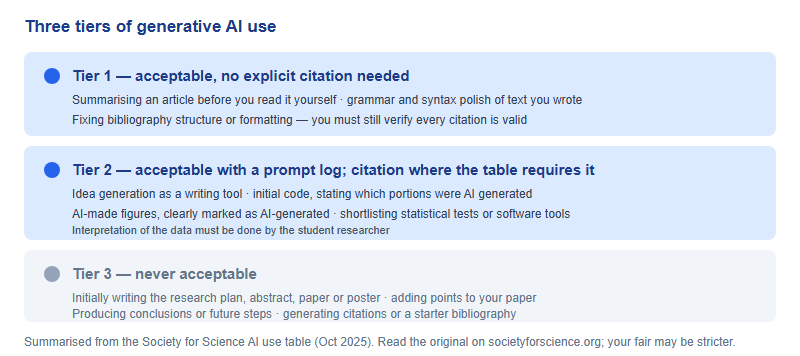
The Society for Science and the Regeneron ISEF Scientific Review Committee publish a table setting out when generative AI may be used in a research project and how that use must be cited. The short version: AI may help you read, tidy language, draft code and shortlist statistical tools — but writing your research plan, abstract, paper, poster, conclusions or bibliography with it is never acceptable. The dividing line is authorship, and the enforcement mechanism is a prompt log.
What the guidance actually is, and why its status matters
The guidance takes the form of a task-by-task table, dated October 2025, produced by the Society for Science together with the Regeneron ISEF Scientific Review Committee, and adapted from work by an American Historical Association committee on AI in history education. It is published alongside the international rules on societyforscience.org, and you should read the original rather than any summary — including this one.
Two features of its status are easy to miss and consequential.
First, the document describes itself as “a preliminary model” and states that affiliated fairs “may adopt their own, more strict, policies.” That means the Society's table is a floor, not a ceiling. A practice that is acceptable at ISEF level may be prohibited at your regional fair, and your regional fair is the gate you pass through first. Checking your own fair's policy is a separate task from reading the ISEF table — the structure of fair-level review is set out in every path to the ISEF finals.
Second, it is written as guidance on citation, not a prohibition on tools. That framing is more demanding than a ban would be. A ban you either comply with or violate. A citation regime asks you to track, disclose and justify — which requires you to have kept records from the beginning of the project, not to have reconstructed them in April.
The principle underneath the table: engagement and authorship
Read the rows together and a single logic appears. Every prohibition falls into one of two categories.
Prohibitions about engagement. The table permits asking AI to summarise key points in an article before you read it, as a starting point for a literature review. It prohibits reproducing an AI summary of a book or article in your literature review without reading the source at all — explicitly because “there has been no engagement with the book or source itself.” Same tool, same output, opposite verdicts. What changed is whether you actually read the paper.
That is a rule about reading, not about typing. It also happens to describe how a competent researcher uses these tools anyway: triage first, then read the ones that matter. Where that triage should point you is the substance of how to choose an ISEF research topic that can actually win.
Prohibitions about authorship. Using generative AI to initially write the research plan, abstract, paper or poster is never acceptable; the table states this “must be the independent work of the student.” Asking AI to write an abstract or a section and submitting it as your own is never acceptable. Nor is asking AI to add points to a paper you wrote, or to produce your conclusions and future steps.
Note the word initially. The table draws a sequence rather than a wall: the first version of a document must be yours, after which guidance or refinement is permitted with explicit citation and a log. The order is doing real work here. Draft, then improve with disclosure — not generate, then edit into deniability.
The two traps that catch honest students
Most integrity problems we see are not cheating. They are two specific misreadings by students who believed they were complying.
Trap one: the bibliography. The table treats citations with unusual severity. Asking generative AI to produce a starter bibliography is never acceptable. Using AI to supply citations that back up your claims is never acceptable. But asking AI to fix the structure or formatting of a bibliography you assembled is acceptable without explicit citation — with the condition that “you must review and verify all citations as valid.”
The distinction is between finding sources and formatting sources. Students blur it because both feel like reference management. The reason for the severity is well known: these systems fabricate plausible references. A judge who spot-checks three citations and finds one that does not exist has learned something about the whole project, and a fabricated reference is unusually easy to check.
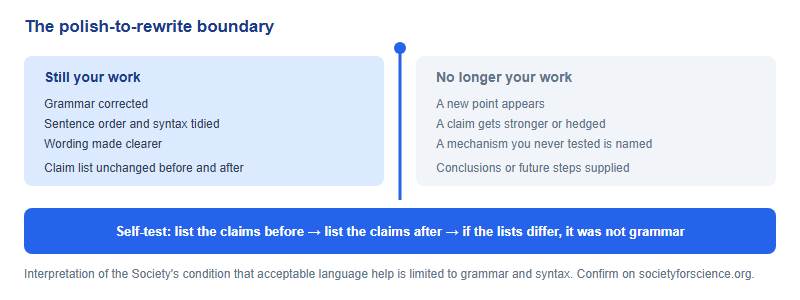
Trap two: polish that becomes rewriting. The table permits writing your own abstract and asking AI to sharpen the language — but the permission is conditional, applying “only if changes suggested by AI are limited to grammar and syntax” and the tool does not modify, add to, or replace the main points.
That is a narrow lane, and it is easy to drift out of it without noticing, because a model asked to “improve” a paragraph will happily strengthen a claim, add a caveat, or supply a mechanism you never tested. The practical safeguard is mechanical: compare the claim list before and after. If the paragraph now says something it did not say before, that is not grammar.
The prompt log: the mechanism almost nobody sets up
Across several of the permitted uses, one requirement keeps reappearing: keep a record of your prompts as part of your research notebook. The table attaches this to using a chatbot to generate and develop ideas, to AI-written initial code, and to using AI to help identify appropriate statistical tests or software tools.
This is the most actionable thing in the whole document, and it is almost always discovered too late. A prompt log cannot be reconstructed honestly at the end of a season. Either you kept it or you did not.
| If you used AI to… | What the guidance attaches to it | What to write down, the same day |
|---|---|---|
| Generate or develop ideas | May require explicit citation depending on circumstances; maintain a logbook of prompts in your research notebook | Date, the prompt, what you took from the answer, and what you rejected |
| Write initial code | Explicit citation stating which portions of the code were AI generated, plus a prompt log | A comment header in the file naming AI-generated blocks, and what you changed afterwards |
| Produce a flowchart, graphic or image | Image clearly marked as AI-generated, with explicit citation of how it was created | A caption label on the board or in the paper, plus the tool and prompt used |
| Identify statistical tests or software tools | Permitted with a prompt log; interpretation of the data must be done by the student researcher | Why you chose that test over the alternatives, in your own words |
| Polish language you wrote | Acceptable without explicit citation only where changes are limited to grammar and syntax | Keep the pre-polish version, so the substance comparison is possible later |
What this means if English is your second language
This deserves saying directly, because students at international schools in China often assume the rules are aimed at them and over-correct into paralysis.
The guidance does not prohibit language help. Writing your own abstract and having a tool correct grammar and syntax without touching the main points sits in the acceptable tier, and does not require explicit citation. A student who writes their own thinking in imperfect English and then cleans up the grammar is complying with the rules, not skirting them.
What the rules do refuse is having the tool do the thinking in English for you — supplying the argument, the conclusions, the framing, the sources. That is the same standard applied to native speakers; it is simply more tempting when the language barrier is real.
There is also a practical incentive that has nothing to do with rules. At the booth you will answer questions out loud, in English, without a tool. A student whose written materials were generated at a level well above their spoken command of the material is walking into an interview where that gap becomes visible in about ninety seconds — a dynamic explored in what ISEF judges look for at the booth. Writing in your own voice is, among other things, rehearsal.
A ten-minute setup that keeps you compliant all season
- Open a prompt log today, in the same file or notebook as your research records, with columns for date, tool, prompt, what you used, and what you discarded. Retrofitting it is not possible.
- Read your own fair's AI policy and keep a copy. The Society's table is explicitly a preliminary model that fairs may tighten.
- Write first drafts unaided, always, for the research plan, abstract, paper and poster. Refinement afterwards is a different activity with different disclosure rules.
- Build your bibliography by hand from sources you actually opened. Use tools for formatting only, and verify every entry resolves to a real paper.
- Label AI-generated figures on the board itself, not just in a footnote you hope nobody reads.
- Keep pre-polish versions of every document, so you can demonstrate that language help stayed language help.
Per Embark, we ask coached students to keep the prompt log alongside the lab notebook from week one, because the two documents answer the same question in different registers: can you show how this project came to exist? A research school treats AI disclosure the way it treats a methods section — not as a confession, but as part of describing what you actually did. Tools will keep changing; the requirement to be the author of your own reasoning will not.
Can I use ChatGPT for my ISEF project?
For some tasks, yes, subject to citation and prompt logs. Writing your research plan, abstract, paper or poster with it is never acceptable.
Can AI write my ISEF abstract?
No. It must be your independent work. You may ask AI to sharpen language only where changes stay limited to grammar and syntax.
Can I use AI to find sources or citations?
No. Starter bibliographies and AI-supplied citations are never acceptable. Formatting a bibliography you built yourself is permitted.
Do I have to keep a record of my AI prompts?
Yes, for several permitted uses the guidance requires a logbook of prompts kept as part of your research notebook.
Work with Embark
The AI questions students actually worry about are practical ones: how much language help is allowed, what to log, and how to describe tool use without sounding defensive. If you would rather settle that at the start of a project than the week before a fair, let's talk.
Embark is an independent research-coaching organisation, the international competition team of Youfang Education. We are not affiliated with, endorsed by, or sponsored by the Society for Science or Regeneron ISEF. Any results cited reflect Embark's own published record (per Embark). This article summarises and interprets published guidance; the Society for Science AI use table is described in that document as a preliminary model, and affiliated fairs may adopt their own stricter policies. Guidance on generative AI is changing quickly — confirm all current rules on societyforscience.org and with your affiliated fair before relying on them. Factual errors are corrected within 7 working days of notice.