If your project idea involves fish, mice, birds, frogs — or an octopus — the Regeneron ISEF vertebrate animal rules decide what you may run before you run it. Two facts matter more than the rest: school-based work is limited to non-invasive observational, behavioural, agricultural or supplemental-nutrition studies, and every vertebrate study must be reviewed and approved before experimentation begins.
What ISEF counts as a vertebrate animal — including four cases that surprise people
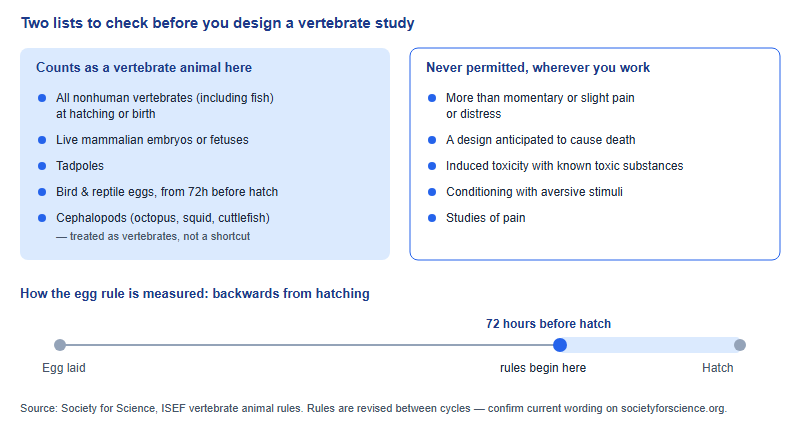
The definition is broader than “mammals and birds.” The official vertebrate animal rules cover “all nonhuman vertebrates (including fish) at hatching or birth,” and then pull in several categories that students routinely assume sit outside the rule set:
- Live nonhuman vertebrate mammalian embryos or fetuses. Embryonic material is not a loophole.
- Tadpoles. Named explicitly, so amphibian larval stages are in.
- Bird and reptile eggs starting three days (72 hours) prior to hatching. The clock is measured backwards from hatching, not forwards from laying.
- Cephalopods. The rules state that “cephalopods are to be treated as vertebrate animals” — so octopus, squid and cuttlefish work is governed by these rules even though the animals are biologically invertebrates.
That last one catches out students who reach for an invertebrate model specifically to avoid this paperwork. If you are looking for a simpler organism, cephalopods are not the shortcut. Where a case genuinely sits on the boundary — early-stage chick embryos, for instance — treat it as a question for your Scientific Review Committee (SRC) rather than a judgement call you make alone. Asking costs an email. Guessing wrong costs a season.
Five prohibitions students hit most often — and why the published list is longer
These prohibitions apply wherever the work happens — a university animal facility does not unlock them. Per the official rules, students may not conduct:
- “research projects which cause more than momentary or slight pain or distress to any vertebrate animals”
- studies “anticipated to cause vertebrate animal death”
- “induced toxicity studies with known toxic substances”
- “behavioral experiments using conditioning with aversive stimuli”
- “studies of pain”
Read the second one closely: the test covers what your design is designed or anticipated to do, and separately no vertebrate animal deaths due to the experimental procedures are permitted in any group or subgroup. A protocol whose endpoint is mortality is out at the design stage, which is why an SRC can reject a research plan before a single animal is involved. The fourth prohibition rules out a whole family of otherwise standard behavioural paradigms — anything using shock, air puffs or similar aversive stimuli to condition a response.
Two lanes: home, school and field, or a Regulated Research Institution
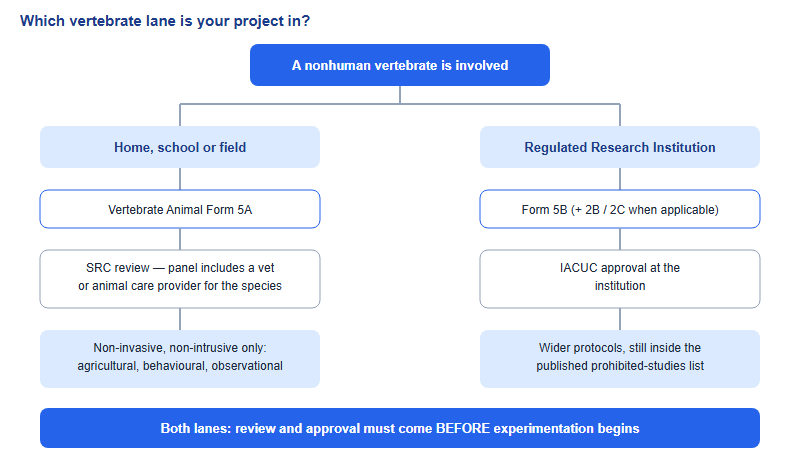
Everything else about a vertebrate project follows from where the work happens. At home, school or in the field, permitted work is limited to “agricultural, behavioral, observational or supplemental nutritional studies on animals” using “only non-invasive and non-intrusive methods that do not negatively affect an animal's health or well-being.” Anything more invasive belongs in a Regulated Research Institution (RRI).
| Home, school or field | Regulated Research Institution | |
|---|---|---|
| Vertebrate form | Vertebrate Animal Form 5A | Vertebrate Animal Form 5B |
| Who approves | The local or affiliated fair SRC, which must include “a veterinarian or an animal care provider with training and/or experience in the species being studied” | IACUC approval must be obtained at the institution |
| What you may study | Agricultural, behavioural, observational or supplemental nutritional studies | A wider range, including “nutritional deficiency or research involving substances or drugs of unknown effect … permitted to the point that any clinical sign of distress is noted” |
| Method limit | Non-invasive and non-intrusive only | Institutional protocol governs, within the published prohibited-studies list |
| Extra forms often triggered | Veterinary consultation for supplemental nutrition, prescription drugs, or activities “that would not be ordinarily encountered in the animal's daily life” | Qualified Scientist Form (2B) and Regulated Research Institution Form (2C), when applicable |
Two field-work details are worth memorising, because they are easy to breach without meaning to. “Studies of animals in their natural environment” and “studies of animals in zoological parks” are named as permitted study types — observation is a real lane, not a consolation prize. But “animals may not be captured from or released into the wild without approval of authorized wildlife or other regulatory officials.” A pond-sampling project can be entirely legitimate in its science and still fail on that single sentence.
Approval comes before experimentation, not before the fair
The sequencing rule is the one that ends the most seasons: “All vertebrate animal studies must be reviewed and approved before experimentation begins.” Retroactive approval is not a category. Data collected before your SRC signed off does not become admissible because the study turned out to be gentle.
Practically, that makes SRC review a calendar item, not a formality — and the calendar belongs to your affiliated fair, not to ISEF. Fairs set their own review deadlines and submission windows, so the date you actually need is your fair's, which you can trace through the official Find a Fair directory. If you are not yet sure which fair serves your school, settle that first, because it determines both your SRC and your route to the finals; we walk through that in every path to the ISEF finals.
A note on layered approval: for school-based work the vet or animal-care-provider requirement sits inside the SRC's composition, and separate veterinary consultation is specified for supplemental nutrition, prescription drugs, and activities outside the animal's ordinary daily life. If your design touches any of those, budget weeks rather than days. For students in China this is usually the binding constraint — not the science, but the availability of a qualified reviewer who knows the species you want to study.
When the rules kill your design, change the question — not the paperwork
Most students meet these rules in the wrong order. They arrive with a mouse-model idea borrowed from a paper, discover that the interesting endpoint is prohibited, and start hunting for a laboratory that will let them run it anyway. That search rarely ends well, and it produces the projects that stall in review while the season runs out.
Embark's academic director's reading, from years of coaching finalists, is that finding a good question matters more than chasing frontier technology — once the question is genuinely right, almost any competent execution reads as original. The vertebrate rules are where that principle earns its keep, because a blocked design usually has three honest exits:
- Change the dependent variable. If the informative outcome is invasive, ask what is measurable non-invasively — feeding rate, activity, growth, habitat selection, social behaviour. Observational designs are named permitted study types, not consolation prizes.
- Change the organism. Invertebrates, plants, microbial systems and cell culture each carry their own rule sets, often lighter ones. Just remember that cephalopods do not work as the easy substitute.
- Change the data source. Existing datasets, field observation and computational modelling can address the same biological question without a live-animal protocol at all.
There is a second, quieter payoff. A design your SRC can approve is usually also a design you can defend, because you had to state your methods, your controls and your welfare reasoning in writing before you started. That written reasoning is exactly the material judges probe at the booth — see what ISEF judges look for. And a question that grew out of your own reading and interests, rather than one retrofitted to whichever lab had space, holds up better under questioning; that is the argument we make in how to choose an ISEF research topic.
For context on the range of categories where this plays out: Embark reports finalists across 13 categories at the 2026 final, including cell and molecular biology, biomedical and health sciences and translational medicine, and 24 awards that season (per Embark — our own record, not an official ISEF statistic; results vary, and nothing here predicts an individual outcome).
Questions students ask
Are fish covered by the ISEF vertebrate animal rules?
Yes. The rules cover all nonhuman vertebrates “including fish” at hatching or birth, and zebrafish are named from 7 days post-fertilization, so fish studies need the vertebrate paperwork and pre-approval — confirm the current thresholds on societyforscience.org.
Can I keep animals at home for an ISEF project?
Only for agricultural, behavioural, observational or supplemental nutritional studies, using non-invasive and non-intrusive methods, on Form 5A with SRC approval first.
Is an octopus project easier than a mouse project?
No. The rules state cephalopods are to be treated as vertebrate animals, so octopus and squid work carries the same review requirements.
What if I already collected data before SRC review?
Approval must precede experimentation. Talk to your adult sponsor and fair SRC immediately — do not assume earlier data can be submitted.
Work with Embark
The cheapest time to test a vertebrate design against the rules is the week you sketch it, not the week your fair's SRC deadline lands. If you are weighing an animal-based question and want to know whether it can actually be run — and what the stronger version of it looks like — let's talk it through.
Embark is an independent research-coaching organisation, the international competition team of Youfang Education. We are not affiliated with, endorsed by, or sponsored by the Society for Science or Regeneron ISEF. Any results cited reflect Embark's own published record (per Embark) and are not official ISEF statistics; results vary and nothing here predicts an individual outcome. Rule quotations summarise published guidance that is revised between cycles, and affiliated fairs may apply stricter requirements — confirm all current rules, forms and deadlines on societyforscience.org and with your affiliated fair before relying on them. Factual errors are corrected within 7 working days of notice.