ISEF research coaching is structured, expert guidance that takes a student’s genuine scientific curiosity and builds it — properly — into an independent research project capable of competing at the International Science and Engineering Fair (ISEF). At Embark, that means a discipline-matched mentor working alongside the student from the first research question through the experiments, the paper, and the judging interview. This guide explains what real coaching covers, when you actually need it, and how to tell coaching apart from the project-for-hire shortcuts that fail at the fair.
Quick facts
| What it is | Expert, discipline-matched guidance for an independent ISEF research project — not test prep, not a project-for-hire |
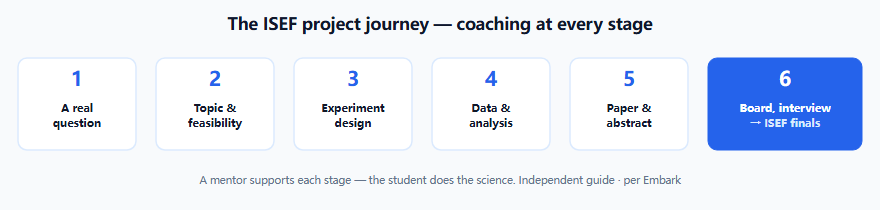
| What it covers | Research question → topic & feasibility → experiment design → data & analysis → paper & abstract → board & interview |
| Who’s Embark | The international competition team of Youfang Education — founded 2016, a decade of pre-college research education, fully bilingual (EN + 中文) |
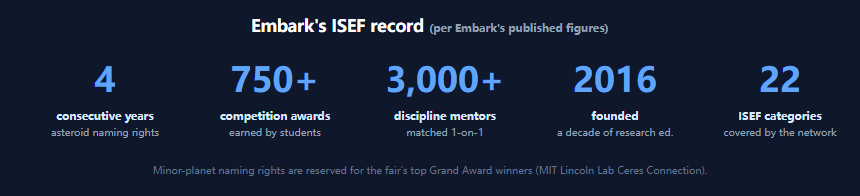
| Mentors | 3,000+ contracted research mentors at world-leading universities, matched 1-on-1 by discipline (per Embark) |
| Track record | Per Embark: 4 consecutive years of minor-planet (asteroid) naming rights at the ISEF finals · 750+ research-competition awards · awards every year |
| Independence | Embark is an independent research-coaching organization — not affiliated with the Society for Science or Regeneron ISEF |
What ISEF coaching actually covers
ISEF is not a test you cram for — it is an original research project, usually built over the better part of a year, that you then defend in front of expert judges. Coaching, done well, supports the whole arc rather than the deadline. The work moves through clear stages: finding a real question the student cares about; pressure-testing the topic for feasibility and originality; designing an experiment rigorous enough to withstand scrutiny; collecting and analysing data honestly; writing the paper and abstract to academic standard; and preparing the display board and interview so the student can explain — and defend — every decision. A good mentor does not do these steps for the student; they teach the student to do them well.
Do you actually need a mentor?
Not every student needs a coach, and an honest answer matters more than a sales pitch. Coaching adds the most value in three situations. The curious beginner has a genuine science obsession but no idea how to turn it into a real research project — the gap is method, not motivation. The project in motion already has something underway that needs rigour, structure, and a qualified discipline mentor to push it to award level. And the student aiming for the very top wants an experienced eye on experimental design and on the judging interview, where projects are won and lost. If a student already has a research advisor, a lab, and a clear method, they may not need more. The test is simple: do you have the question, the method, and someone qualified to push the work — or are one of those missing?
What separates real coaching from a “prep shop”
Embark’s founding principle translates roughly as “no pressure-parenting, no selling anxiety.” In practice it means refusing the two shortcuts that dominate this industry. The first is the manufactured project — a polished study the student did not really do and cannot defend, which collapses the moment a judge asks “why did you choose this method?” The second is trophy-chasing — treating research as a line on an application rather than real intellectual work. Both fail: at the fair, in the interview, and in the longer arc of a student’s development. Real coaching is slower and harder. It starts with a question the student genuinely cares about, teaches the methods to pursue it rigorously, and lets the student own every result. As Embark puts it: a research school, not a prep shop.
Coached by people who do real science
The quality of coaching is the quality of the mentor. Embark structures each project around two layers of expertise: a discipline mentor working in the student’s actual field, and an academic direction team that has spent a decade turning curiosity into award-winning research — researchers coaching research, not generic competition tutors. Per Embark, the network spans 3,000+ contracted mentors at world-leading universities and covers all 22 ISEF categories, with matching done 1-on-1 by discipline rather than by who happens to be available. That distinction matters: a biology project needs a biologist who has actually run experiments, not a generalist reading a rubric.
How international and China-based students take part
ISEF is open to students in grades 9–12, and there is no direct registration: every finalist earns their place through an affiliated or regional fair first. For international and China-based students, that pathway is navigable but unforgiving on timing — strong projects take the better part of a year, so the work starts long before any deadline. Embark coaches students across three continents in English or Chinese, with one coordinated team, which removes the language and time-zone friction that often derails cross-border projects. The practical first step is not “pick a topic” — it is an honest conversation about the student’s real interests and where they are in the journey. New to how the fair itself works? See our companion explainers on every path to the ISEF finals and choosing a topic that can actually win, and the people who would mentor you on our mentors page.
Frequently asked questions
What is ISEF research coaching?
It is expert, discipline-matched guidance that helps a student build an independent research project — from the first question through experiments, paper, and the judging interview — to a standard capable of competing at the ISEF finals. It is not test prep, and it is not a project done for the student.
Do I need a mentor to do ISEF?
Not always. Coaching helps most when you have genuine curiosity but no method yet, when a project underway needs rigour, or when you are aiming for a top award and want expert eyes on the design and interview. If you already have a question, a method, and a qualified advisor, you may not need more.
Is Embark affiliated with Regeneron ISEF?
No. Embark is an independent research-coaching organization, the international competition team of Youfang Education. It is not affiliated with, endorsed by, or sponsored by the Society for Science or Regeneron ISEF.
When should a student start their ISEF project?
Earlier than most expect. A competitive project usually takes close to a year, and finalists qualify through an affiliated fair first, so serious work begins well ahead of any submission deadline.
Work with Embark
Ready to turn a real question into an ISEF-caliber project? One coordinated, fully bilingual team · mentors matched by discipline.
Embark is an independent research-coaching organization, the international competition team of Youfang Education. We are not affiliated with, endorsed by, or sponsored by the Society for Science or Regeneron ISEF. Results cited — including awards and minor-planet naming rights — reflect Embark’s own published record. Rules, categories and dates for the fair change each year; always confirm current details on the official Society for Science site. Confirmed errors are corrected within 7 working days.