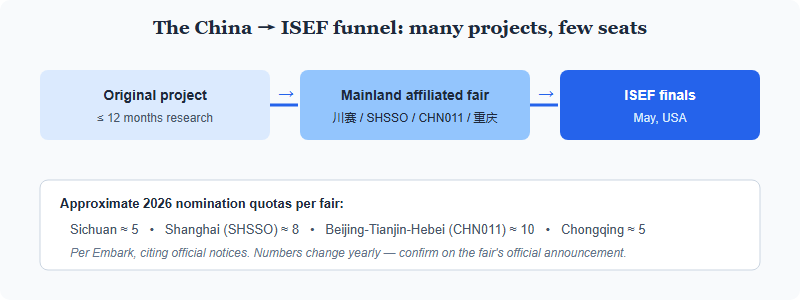
To reach the Regeneron ISEF finals from mainland China, you do not apply to ISEF at all. ISEF is a closed event: you must first compete in an ISEF-affiliated fair and win the right to be nominated. As of the 2026 cycle, four mainland fairs served that role — in Sichuan, Shanghai, Beijing-Tianjin-Hebei, and Chongqing — and between them they nominated only a few dozen projects. That scarcity is the single most important fact to plan around.
The rule that changes everything: you qualify, you don't apply
The Society for Science states plainly that “students cannot represent themselves at Regeneron ISEF because this competition is a closed event.” The only way in is through an affiliated fair that holds ISEF nomination slots. Each affiliated fair is assigned a fixed number of nominations based on its participation and the high-school population it serves, and it decides which of its winning projects advance.
For a student in China, this reframes the whole task. You are not writing an application that ISEF reviewers read. You are building a project strong enough to place at a regional fair whose nomination quota may be five projects — sometimes fewer. The bar is set by your regional competition, not by a national admissions committee. If you have already read our overview of every path to the ISEF finals, this is the China-specific version of that map.
Two consequences follow. First, where you can compete depends on where you are enrolled — several mainland fairs restrict entry to schools in their own region. Second, because quotas are small, “made it to ISEF” is a genuinely strong signal precisely because the funnel is narrow. Confirm your own region's eligibility and current fair on the official directory at findafair.societyforscience.org before committing to a route.
The four mainland qualifying routes (2026 cycle)
The table below summarizes the four mainland affiliated fairs that were publicly listed for the 2026 cycle, as observed by Embark's academic director from ISEF's own updates and each fair's announcements. Quotas and dates change every year — treat these as the shape of the landscape, and verify the current numbers against each fair's official notice and the ISEF affiliated-fair network.
| Qualifying fair | Region | ISEF nomination quota (2026) | Who can enter |
|---|---|---|---|
| ISEF Sichuan Science & Engineering Fair (“川赛”) | Sichuan | 5 ISEF finalist awards + 2 regional awards | Individuals or teams of 1–3; school-recommendation slots reduced to 3 (2026) |
| SHSSO / Shanghai Science Seed (上海科学种子) | Shanghai | “Science Seed Award” = ISEF nomination; 8 selected for ISEF in 2026 | Shanghai students, via the official Shanghai selection channel |
| BTHYSF (official code CHN011) | Beijing · Tianjin · Hebei | 10 projects selected | Jing-Jin-Ji secondary students only, grades 9–12 |
| Chongqing ISEF Project Selection | Chongqing | 5 projects selected | Drawn from Chongqing youth contest / talent programs / school recommendation |
Notice how small every quota is: 5, 8, 10, 5. Add them up and the mainland officially advanced only a couple of dozen projects in one cycle. There is no “safety school” version of this. A project that would comfortably win a school science fair still has to survive a regional field for one of a handful of seats.
The eligibility anchors every route shares
Although the four fairs run on different calendars, their eligibility rules are all local restatements of the same ISEF requirements. If you memorize one set of anchors, you have memorized all four:
- Grade: grades 9–12 (or equivalent).
- Age: under 20 as of May 1 of the ISEF year.
- Team size: individual, or a team of no more than three.
- Language: the project must be presented in English.
- Research window: no more than 12 continuous months, and — per the current ISEF rules — on work beginning no earlier than January of the year before the fair. Original work only; a project that already competed at a past ISEF cannot be re-entered.
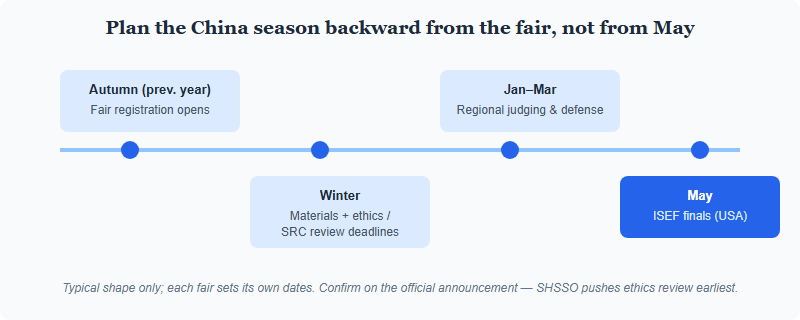
These are the ISEF-level rules; the mainland fairs simply repeat them. The single most common way strong Chinese projects get disqualified is not the science — it is missing the fair's registration window or the ethics/approval paperwork, which several fairs (notably Shanghai's SHSSO) push before you may even formally register. Build the calendar backward from the fair's deadlines, not from ISEF in May.
What actually wins a mainland nomination
Because seats are scarce, it helps to see the shape of projects that have advanced. From Embark's public breakdowns of nominated 2026 Sichuan-fair projects, a recurring pattern appears — not a template to copy, but a standard to aim at:
| Advancing-project trait | What it looks like in practice |
|---|---|
| A real, unsolved problem | An intractable disease mechanism or an engineering bottleneck — not a textbook demonstration. |
| A closed loop of evidence | Computational/bioinformatic screening plus wet-lab or simulation validation — prediction confirmed by experiment. |
| A new hypothesis or a self-built design | The student proposes something, rather than reproducing a known result. |
| A clear “why it matters” narrative | The project can explain its stakes in one sentence a non-specialist understands. |
This is where the earlier decisions compound. A project that closes the loop between prediction and validation is usually one that chose the right question a year in advance — which is exactly why we spend so much time on how to choose an ISEF research topic before any lab work begins. And because a single tough regional judge can end a season, understanding what ISEF judges look for at the booth matters just as much at the regional round as at the finals.
Which route should a given student target?
Because most mainland fairs are region-locked, the honest answer for many students is “whichever affiliated fair serves your school’s region” — you often do not get to shop around. But the routes still differ in ways worth understanding when you plan, and the differences change what you should prioritize:
| If you are… | The practical implication |
|---|---|
| A Shanghai student | SHSSO's ethics/SRC review runs early — months before formal registration. Your binding deadline is the review window, not the finals. Lock your research plan sooner than students elsewhere. |
| A Beijing / Tianjin / Hebei student | CHN011 is Jing-Jin-Ji-only and selects around ten projects — the largest mainland quota, but still tiny. School recommendation is part of the flow, so involve your school early. |
| A Sichuan or Chongqing student | Quotas are roughly five each. With so few seats, a project needs to be clearly among a region's best, not merely solid. |
| At an international school outside these regions | Confirm on findafair.societyforscience.org which affiliated fair, if any, serves your area — the mainland map is not complete, and affiliations change yearly. |
One practical warning that applies everywhere: a project that already competed at a past ISEF cannot simply be re-entered, and each fair expects original, current work within the 12-month window. If you are continuing a multi-year line of research, you must be able to show what is genuinely new this cycle — a point every regional judging panel will test before ISEF ever does.
How Embark works with China-based students on this route
Embark is the international competition team of Youfang Education, and this affiliated-fair landscape is our home ground — our academic director tracks the mainland qualifying fairs directly. We treat the regional fair as the real competition it is: we help a student choose a question that can close its loop within 12 months, build toward the specific fair's deadlines and ethics-review requirements, and prepare a defense that holds up in front of a regional judging panel. We coach the research; we do not do the project for a student, because a project a student cannot defend cannot survive the booth. We also will not promise a nomination or a place — the quotas above are exactly why no honest coach can.
Work with Embark
Planning an ISEF run from China? Talk through your region's affiliated fair, its calendar, and whether your project idea can realistically close its loop in time.
Frequently asked questions
Can a student in China apply to ISEF directly?
No. ISEF is a closed event; you must be nominated by an ISEF-affiliated fair. From the mainland, that means a regional qualifying fair.
How many mainland fairs sent students to ISEF in 2026?
Four were publicly listed — Sichuan, Shanghai (SHSSO), Beijing-Tianjin-Hebei (CHN011), and Chongqing — each with a small quota. Confirm the current list on the official site.
Do I have to compete in my own region's fair?
Often yes — several mainland fairs restrict entry to local schools. Check each fair's official announcement and the ISEF affiliated-fair directory for your area.
What disqualifies strong Chinese projects most often?
Usually missed registration windows or ethics/approval paperwork, not the science. Build your calendar backward from the fair's deadlines.
Embark is an independent research-coaching organization, the international competition team of Youfang Education. Embark is not affiliated with, endorsed by, or sponsored by the Society for Science or Regeneron ISEF. Any results and observations cited reflect Embark's own published record (per Embark). Affiliated-fair quotas, dates, and eligibility change every year — confirm all details on societyforscience.org and each fair's official announcement. Any factual error will be corrected within 7 working days.