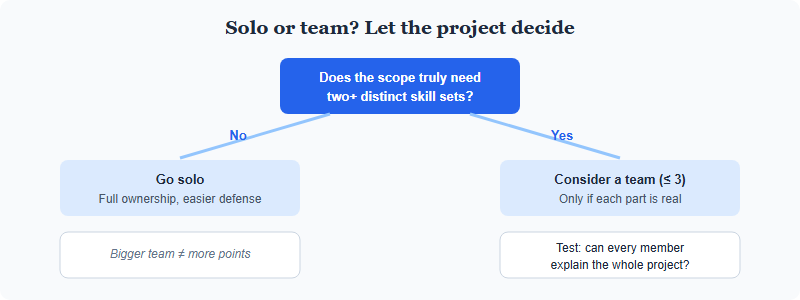
At ISEF, a project may be entered by an individual or by a team of no more than three students — and per the official rules, “each student is only allowed to enter one project.” Team and solo projects compete on the same 100-point rubric, so a team wins nothing for being bigger. It wins only if three people produce something one person could not, and only if every member can defend the whole project at the booth. Choosing a team is a strategy decision, not a convenience.
What the official rules actually say about teams
Before deciding, pin down the rules that are non-negotiable. These come from the Society for Science's Rules for All Projects; the exact wording is worth memorizing because it is where teams most often go wrong:
| Rule | Official wording / requirement | Why teams trip on it |
|---|---|---|
| Maximum size | “Teams must have no more than three members.” | You cannot add a fourth author late to share the workload. |
| One project per student | “Each student is only allowed to enter one project.” | A student cannot hedge with a solo project and a team project. |
| Team continuity | Teams at ISEF must be the “original members who competed at the ISEF-affiliated fair” and all must meet ISEF eligibility. | You cannot swap in a stronger presenter after the affiliated fair. |
| Member eligibility | Every member must meet ISEF eligibility (grades 9–12; under 20 by May 1 of the ISEF year). | One ineligible member can jeopardize the whole entry. |
| Research window | ≤ 12 continuous months, on work beginning no earlier than January of the prior year (per current rules). | Team scope has to fit the same 12 months as a solo project. |
The two rules people underestimate are team continuity and one project per student. Continuity means the team that shows up at the finals must be the same team that won the nomination — there is no roster change between rounds. One-project-per-student means forming a team is a genuine commitment: each member spends their single ISEF entry on it. Read those two together and the message is clear: choose your team and your project carefully, because both are locked early.
When a team is genuinely the stronger call
Judges score every project — solo or team — on the same criteria, where presentation (poster plus interview) carries the largest weight and execution of the work is heavily rewarded. Nothing on the rubric credits headcount. So the honest question is: does the project's scope require more than one person's hands and expertise? A team tends to help when:
- The method spans two real disciplines. For example, a project that needs both wet-lab molecular work and non-trivial computational modeling — genuinely two skill sets, not one student plus a helper.
- The build and the test are both substantial. An engineering project where designing/fabricating a device and rigorously testing it are each a full workload.
- The data collection is genuinely large. Field or behavioral studies where scale is the point and a solo timeline cannot reach significance in 12 months.
A team is the weaker call when one strong student could do the whole thing, or when a “team” is really one lead plus passengers. In that case you have quietly created the worst outcome: three students each spending their one ISEF entry on a project only one of them can defend. If you are still deciding your project's shape, our guide to choosing an ISEF research topic is the place to test whether the scope is really a two- or three-person problem.
Dividing the work so every member can defend it
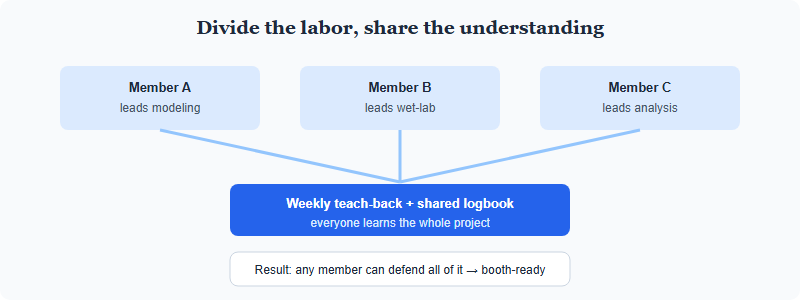
Here is the trap unique to teams. At the booth, judges interview the team, and they will probe whether every member understands the whole project — not just their slice. A team where one member can only explain “their part” reads as one real researcher and two names. The way to avoid that is to split ownership of work without splitting understanding.
| Do | Don't |
|---|---|
| Assign each member a lead area (e.g., modeling, wet-lab, analysis) they own end-to-end. | Silo members so each knows only their fragment. |
| Hold a weekly “teach-back” where each member explains their part to the others. | Meet only to hand off files. |
| Rotate who explains the full project in mock defenses. | Designate one “spokesperson” and let the others go quiet. |
| Keep one shared logbook so the whole story is visible to all. | Let three private notebooks drift apart. |
This is also why booth preparation for a team is harder, not easier, than for a solo student. Everyone has to be interview-ready on everything. Our breakdown of what ISEF judges look for at the booth applies to each member individually — a team is only as convincing as its least-prepared presenter.
The authorship and credit conversation to have first
Because each student spends their only ISEF entry on the team project, credit matters. Two conversations are worth having before the affiliated fair, not after:
- Contribution honesty. The paperwork and interview assume the listed members did the work. Padding a team with a name that did little is both an integrity risk and a defense risk — that member will be asked questions at the booth.
- Downstream use. A team project is a shared asset. If members later want to cite it in college applications, each should describe their genuine role rather than implying sole authorship. Honest, specific role descriptions read as more credible anyway.
None of this is a reason to avoid teams — strong team projects win at ISEF every year. It is a reason to enter a team on purpose, with the scope, the division of labor, and the credit all settled early.
Teams and the qualification path from a fair
One reason team continuity matters so much is the route into ISEF itself. Because ISEF is a closed event, a team — like a solo student — reaches the finals only by first competing at an ISEF-affiliated fair and being nominated. Whatever team wins that nomination is the team that competes at ISEF; the “original members” rule locks the roster at the affiliated-fair stage. If you are still mapping how you get to the finals in the first place, our overview of every path to the ISEF finals is the qualification context that sits underneath the team rules.
This has a scheduling implication people miss: a team must be formed, and its project scoped, before the affiliated fair — not in the run-up to ISEF. There is no window to recruit a stronger third member after nomination. So the practical order is: decide the project is genuinely a multi-person problem, assemble the right team, compete at the affiliated fair together, and only then, if nominated, carry that exact team to the finals.
| Stage | What is locked in for a team |
|---|---|
| Before the affiliated fair | Team composition (≤ 3), the shared project, each member's single-entry commitment. |
| At the affiliated fair | The team competes and, if strong enough, is nominated as-is. |
| Between fair and ISEF | Nothing changes — same original members, same project, refined presentation only. |
| At ISEF | All members present; each may be interviewed on the whole project. |
How Embark coaches team projects
Embark is the international competition team of Youfang Education, and we coach both solo and team projects. With teams, our first job is often to stress-test whether a team is genuinely warranted — sometimes the honest answer is that one student should go solo. When a team is right, we help set up the ownership map, run the teach-back rhythm so every member can defend the whole project, and prepare each student individually for the interview. We coach the researchers; we do not do the research, and we will not promise a placement — the rubric rewards the work, not the roster.
Work with Embark
Not sure whether your idea is a solo or a team project? Talk it through with a coach who has seen both work — and both go wrong.
Frequently asked questions
How many students can be on an ISEF team?
No more than three, per the official rules. A student may enter only one project, whether solo or on a team.
Are team projects judged more leniently than solo ones?
No. Teams and individuals are scored on the same criteria; there is no bonus for team size. Confirm the current rubric on societyforscience.org.
Can we change team members between the affiliated fair and ISEF?
No. The team at ISEF must be the original members who competed at the affiliated fair, and all must meet eligibility.
Does every team member have to answer judges' questions?
Judges interview the team and may probe each member's understanding of the whole project, so every member should be interview-ready. Confirm interview format on the official site.
Embark is an independent research-coaching organization, the international competition team of Youfang Education. Embark is not affiliated with, endorsed by, or sponsored by the Society for Science or Regeneron ISEF. Any results cited reflect Embark's own published record (per Embark). ISEF rules on team size, eligibility, and judging change every year — confirm all details on societyforscience.org. Any factual error will be corrected within 7 working days.