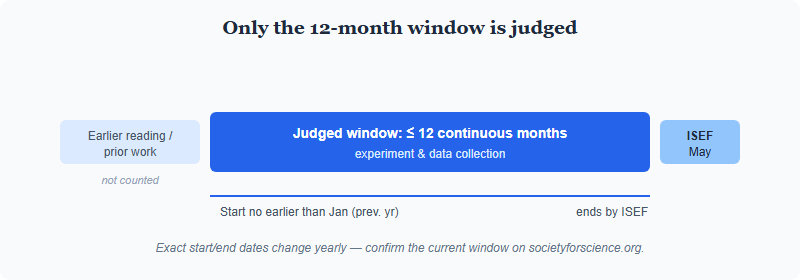
ISEF has one rule that silently rules out more strong projects than any other: you may enter a project with no more than 12 months of continuous research, and you are “judged only on laboratory experiment / data collection performed over 12 continuous months.” Your board and abstract must reflect the current year's work only. This single constraint decides which questions you can realistically attempt — and it is why multi-year science needs a continuation form, not a bigger poster.
What the window rule actually says
The exact wording from the Society for Science's Rules for All Projects matters here, because students routinely misread “12 months” as “however long I've been interested in this.” It is much stricter:
| Rule | Official wording | What it means for you |
|---|---|---|
| Duration cap | “No more than 12 months of continuous research” per project. | Your judged work has to fit inside a one-year experimental window. |
| Start boundary | Research “may not include research performed before January” of the prior year (per the current cycle). | Work done earlier can't count toward this year's judged results. |
| Judging scope | Students are “judged only on” the 12 continuous months of experiment/data collection. | Background reading you did years ago is context, not credited work. |
| Display scope | “The display board and abstract must reflect the current year's work only.” | You cannot fill a board with three years of accumulated results. |
Read together, these say something liberating and something constraining at once. Constraining: you cannot win by accumulating results over many years and presenting them all. Liberating: a first-year student with a sharp 12-month plan competes on the same window as everyone else. The clock is the same length for all projects. What varies is how well you scope the question to fit it.
How the window shapes which projects are possible
Once you accept a one-year experimental clock, some project shapes become far more achievable than others. This is not about ambition — it is about whether the loop between question and answer can close inside 12 months:
| Project shape | Fits the window well? | Why |
|---|---|---|
| A focused question with a defined method | Yes | Design, run, analyze, and interpret all fit inside a year. |
| Computational screening + a targeted validation | Often | The screen narrows the work so the wet-lab or test step is bounded. |
| An open-ended “explore everything about X” idea | Rarely | No natural stopping point; the clock runs out before results converge. |
| Long-horizon studies (multi-season, slow organisms) | Only as a continuation | The biology outlasts one window — needs the continuation route below. |
This is the deepest reason topic selection and window management are the same decision. A brilliant question that cannot produce interpretable data in 12 months is, for ISEF purposes, the wrong question this year. That is exactly the test we apply in our guide to choosing an ISEF research topic: not “is it impressive?” but “can it close its loop inside the window?”
Multi-year science: the continuation-project route
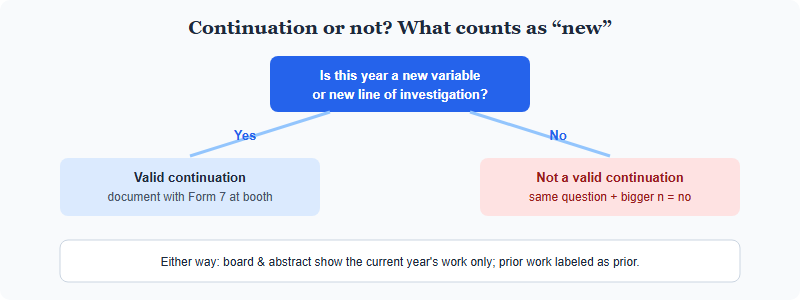
So what about genuinely long research — the student who has worked on a system for two or three years? ISEF does not forbid this; it channels it. You may present a continuation project, but you must document that this year's work is new using the Continuation / Research Progression Projects Form (7), which must be displayed at your booth. The rules are explicit about what counts:
- Allowed: the additional research is a “substantive expansion from prior work — e.g., testing a new variable or a new line of investigation.”
- Not allowed: “repetition of previous experimentation with the same methodology and research question, even with an increased sample size.” A bigger n on the same question is not a new project.
- Display: the board and abstract reflect the current year's work only; prior materials may appear but must be clearly labeled as prior.
In plain terms: each ISEF year, a continuing project must answer a genuinely new question or add a genuinely new variable. This is why judges probe multi-year projects hard at the booth — they are checking that this year is real, not a re-run. If you are running a continuation, rehearsing that distinction is part of interview prep; our breakdown of what ISEF judges look for at the booth applies with extra force, because “what is new this year?” is a question you will be asked directly.
Practical scoping: fit the question to the clock
Putting the window to work comes down to a few habits, whether you are on year one or running a continuation:
- Define the stopping condition first. Before you start, write the sentence “this project is done when I have measured ___.” If you cannot write it, the scope is too open for one window.
- Back-plan from data, not from the deadline. Data has to be collected, cleaned, analyzed, and interpreted inside the window — leave real time after the last measurement.
- For continuations, name the new variable on day one. Decide what makes this year distinct before you touch the bench, so Form 7 writes itself and the booth answer is ready.
- Keep the current-year story clean. Because the board shows this year only, don't let three years of figures blur what you actually did in the judged window.
These scoping habits are, in effect, an eligibility strategy: they keep your project inside the rule that decides whether it can be judged at all.
Why the window and the qualification path interact
The 12-month rule is not only an ISEF-finals rule — it applies at the affiliated fair you must win first. ISEF is a closed event, so you reach the finals by being nominated at an ISEF-affiliated fair, and that regional round expects the same original, current-year work. In practice this compresses the calendar more than students expect: your judged window has to be far enough along to present at the affiliated fair, which typically happens months before ISEF in May. If you are still working out how nomination works, our guide to every path to the ISEF finals explains the qualification step that the window sits inside.
The takeaway is a tighter clock than “12 months to May.” For many students, meaningful results need to exist by the affiliated fair's judging date, not by ISEF. Back-planning from that earlier milestone — and, for continuations, deciding the new variable before the bench work starts — is what keeps a project both inside the rule and ready to defend twice: once regionally, once at the finals.
| Milestone | What the window demands by then |
|---|---|
| Project start | A defined question and stopping condition that fit one research year. |
| Affiliated fair | Enough completed, current-year work to present and defend regionally. |
| ISEF finals (May) | The full 12-month story, current year only on the board; continuations show Form 7. |
How Embark coaches around the window
Embark is the international competition team of Youfang Education, and one of the first things we do with a new student is pressure-test scope against the 12-month window — because the most common early mistake we see is a question too big for one year. For students continuing multi-year work, we help draw the line that makes this year genuinely new, so Form 7 is honest and the booth answer is solid. We coach the researcher through scoping and defense; we do not do the research, and we never promise a result — the window is the same length for everyone, and the work still has to be yours.
Work with Embark
Not sure your project idea fits in one research year — or whether your multi-year work counts as a continuation? Talk it through before you start at the bench.
Frequently asked questions
Does the 12-month rule mean I can't use earlier work?
You're judged only on 12 continuous months of experiment/data collection, and the board shows the current year only. Earlier reading is background, not credited results.
Can I present a multi-year project at ISEF?
Yes, as a continuation — if this year adds a new variable or line of investigation, documented on Continuation Form (7), displayed at your booth.
Is a bigger sample size on last year's experiment a new project?
No. The rules say repeating the same methodology and question with a larger sample is not an acceptable continuation.
When exactly does the research window start and end?
It's a fixed 12-continuous-month window ending around ISEF; exact dates change each cycle, so confirm the current window on societyforscience.org.
Embark is an independent research-coaching organization, the international competition team of Youfang Education. Embark is not affiliated with, endorsed by, or sponsored by the Society for Science or Regeneron ISEF. Any results cited reflect Embark's own published record (per Embark). The ISEF research-window and continuation rules change every year — confirm all details, including exact dates, on societyforscience.org. Any factual error will be corrected within 7 working days.