The research plan you write before experimenting and the lab notebook you keep during it are the two documents that let ISEF judges verify your project is real, student-driven science. The board is a summary; these are the evidence. A thin or retro-fitted plan and a suspiciously clean notebook are among the fastest ways to lose a judge’s trust — and a rigorous pair is one of the cheapest ways to earn it.
Why two “boring” documents carry so much weight
Most students preparing for the Regeneron International Science and Engineering Fair pour their energy into the visible artifacts: the abstract, the board, the interview answers. That is understandable — those are what get scored on the day. But judges are experienced researchers, and experienced researchers know that a polished summary can be produced in a week, while a genuine research process cannot. So they probe for the process.
Two documents encode that process. The research plan is the written protocol you produce before experimentation begins — your question, your rationale, your methods, your safety analysis, your intended data analysis. Under current ISEF rules, a research plan travels with your paperwork, and projects involving human participants, vertebrate animals, or potentially hazardous agents generally require review before any experimentation starts (the exact review requirements depend on your project type — confirm the current rules and templates on societyforscience.org). The lab notebook (also called a data book or log book) is the dated, running record of what you actually did. Many affiliated fairs expect to see one at your booth, and even where it is not formally inspected, the habits it builds show up in every interview answer you give.
Put simply: the board says what you found. The plan and notebook say whether to believe you. If you are still choosing your project, start with how to choose an ISEF research topic that can actually win — a good plan is much easier to write when the question underneath it is sound.
What a strong research plan actually contains
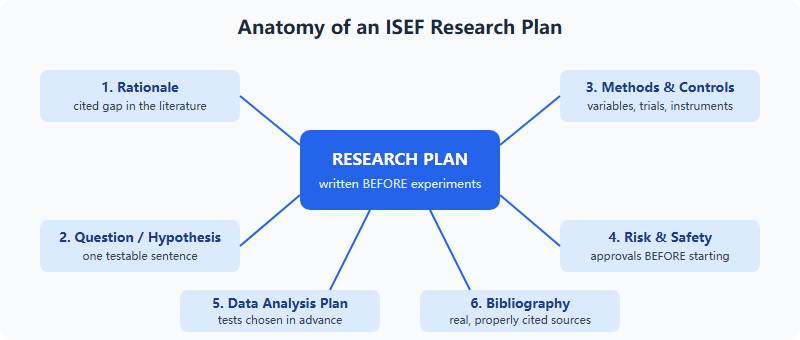
A research plan is not an essay about why you love science. It is a protocol another researcher could pick up and evaluate. The core components look like this (check the current official template for the exact required headings):
- Rationale. A short, cited justification: what is known, what gap you are addressing, why it matters. Two or three paragraphs anchored in real literature beat two pages of enthusiasm.
- Research question, hypothesis, or engineering goal. One testable sentence. If you cannot state it in one sentence, the project is not ready to plan.
- Methods and procedures. Specific enough that a reader can judge feasibility: variables, controls, materials, measurement instruments, number of trials.
- Risk and safety analysis. What could harm you or others, and how you mitigate it. Projects touching regulated areas need the appropriate pre-approval — skipping this step is one of the classic paperwork failures.
- Data analysis plan. How you will analyze results before you have them: which comparisons, which statistical tests, what would count as support for the hypothesis.
- Bibliography. The sources behind your rationale, properly cited.
The data analysis section deserves special emphasis. Committing to your analysis in advance is what separates hypothesis testing from cherry-picking — and judges ask about exactly this in interviews. Our companion piece on what ISEF judges look for goes deeper on how those questions get asked at the booth.
The lab notebook: what judges are really checking
A lab notebook is not a diary and not a fair-week prop. It is the primary record of your experiment, and its credibility comes from exactly the features that make it look imperfect:
- Dated, sequential entries. Real research happens over weeks and months. A notebook whose entries cluster into two weekends tells its own story.
- Raw data, recorded at the time. Original readings, not cleaned-up averages transcribed later. If you re-measure, both numbers stay on the page with a note explaining why.
- Failures and changes, documented. The contaminated culture, the sensor that drifted, the protocol you revised in week five — recorded with dates and reasons. This is evidence of real work, not embarrassment to be hidden.
- Decisions with reasons. “Switched to 3 replicates per condition because variance in pilot was larger than expected” is a sentence a judge will love.
- No torn-out pages, no bulk rewriting. Cross out errors with a single line. A pristine, recopied notebook reads as reconstructed — which is worse than messy.
For computational and engineering projects, the same principle applies in different form: version-controlled code with a meaningful commit history, dated design iterations, and benchmark logs serve as the notebook. What matters is a contemporaneous, tamper-evident trail from question to conclusion.
Plan vs notebook vs abstract vs board: who reads what, when
| Document | When it is written | Primary reader | What it must prove |
|---|---|---|---|
| Research plan | Before experimentation begins | Review committees (and later, judges who probe process) | The project is safe, ethical, feasible, and designed — not improvised |
| Lab notebook | Continuously, during the work | Judges and fair officials who check authenticity | The work actually happened, in sequence, done by you |
| Abstract | After results, before the fair | Judges triaging many projects quickly | The finding, compressed to its essentials (word limits apply — check current rules) |
| Project board | Last, from the documents above | Judges at the booth, in minutes | The story is clear enough to anchor an interview |
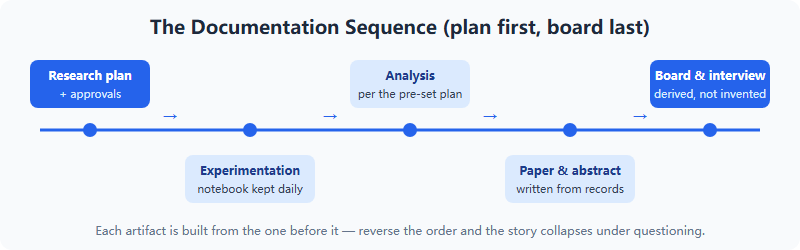
Notice the direction of flow: the board is derived from the paper and notebook, which are derived from the plan. Students who work in the opposite direction — design a board, then reverse-engineer the documentation — produce work that unravels under a judge’s third follow-up question.
The five documentation mistakes we see most often
Across the students Embark coaches from Chinese international schools, the same documentation failures recur:
- Writing the plan after the experiments. Reviewers can usually tell, and for regulated project types, experimenting before required approval can cost you eligibility entirely — see the rules for your project type on societyforscience.org.
- A rationale pasted from abstracts of papers never read. One interview question about your third citation exposes this.
- No pre-committed analysis. If your statistical test was chosen after seeing the data, expect a judge to ask why.
- The “weekend notebook.” Months of claimed work with entries on four dates.
- Perfect data. No outliers, no failed runs, no revisions. Real datasets have texture; judges know what real looks like.
Every one of these is avoidable with structure set up in the first month of the project — which is precisely when most students are focused on everything else, such as which of the routes described in every path to the ISEF finals they are aiming for.
How Embark coaches documentation without doing it for you
Embark describes itself as a research school, not a prep shop, and documentation is where that distinction is most concrete. A mentor’s job here is structural: helping you set up a notebook system in week one, pressure-testing your research plan the way a review committee would, and asking the “why did you choose this test” questions months before a judge does. What a mentor will not do is write the plan for you or reconstruct a notebook in April — because a student who cannot defend their own documentation cannot defend their project. Per Embark’s published record, its students have earned 750+ competition awards, and the consistent internal lesson from that record is unglamorous: the projects that survive deep questioning are the ones whose paper trail was real from day one.
FAQ
Do I have to write the research plan before starting experiments?
Yes — the plan is meant to be written first, and some project types require formal review before any experimentation. Check the rules for your project type on societyforscience.org.
Does my lab notebook have to be handwritten?
Not necessarily; what matters is a dated, contemporaneous, tamper-evident record. For computational projects, a version-controlled repository can play this role. Confirm any format expectations with your fair.
What if my notebook shows failed experiments?
Good — documented failure and revision is evidence of authentic work. Judges are far more suspicious of a flawless record than of an honest, messy one.
Can my mentor or teacher write parts of the plan?
No. Mentors can critique structure and feasibility, but the plan must be your own work — and you will be questioned on every part of it as if you wrote it, because you should have.
Work with Embark
Setting up a research plan and notebook system is a week-one task, not an April rescue. If you want a discipline mentor to pressure-test your plan before a review committee does, talk to us early in your project.
Embark is an independent research-coaching organization and the international competition team of Youfang Education. Embark is not affiliated with, endorsed by, or sponsored by the Society for Science or Regeneron ISEF. Results cited reflect Embark’s own published record (per Embark). Competition rules, forms, and deadlines change — always confirm details on societyforscience.org. If you spot an error in this article, we correct verified issues within 7 working days.