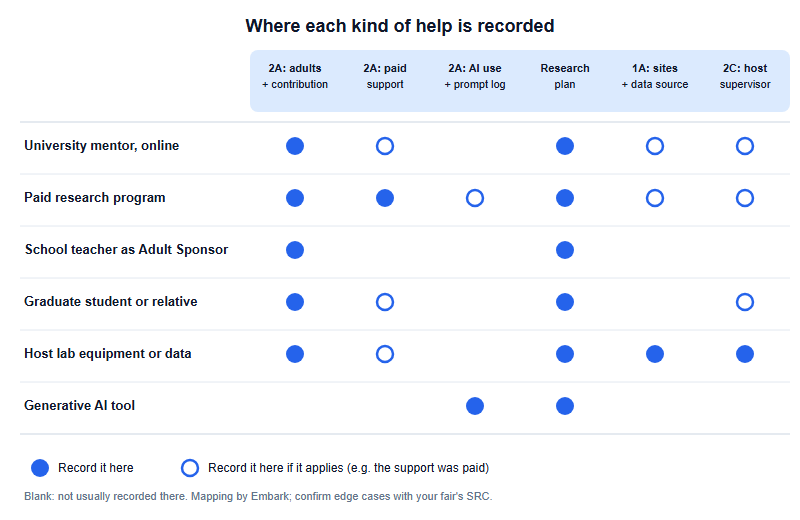
Form 2A — the Student Support Disclosure Form — is new for the 2026–27 ISEF cycle and required for every project. It asks you to name each adult who supported the work, what they contributed and for how long; whether you or your parents paid for any support; and whether you used generative AI, with a prompt log. Paying for mentoring is allowed. Leaving it off the form is where the risk sits.
What Form 2A asks for, section by section
The Companion Guide published alongside the 2026–27 International Rules describes the form’s purpose as disclosing the full support a student received: every adult who played a supervising or advisory role, any paid support, and any use of artificial intelligence. It may be completed before or after experimentation, a team completes one form for the project, and extra pages can be attached when the boxes run out.
Here is what each part asks, and the difference between an answer that invites follow-up questions and one that closes them.
| Part of Form 2A | What it asks for | An answer that invites questions | An answer that closes them |
|---|---|---|---|
| 1–3. Adult Sponsor, Direct Supervisor, Qualified Scientist | Name, organisation, contact details, relationship to you, expertise, contribution to the project and duration of support. Someone who holds several roles is listed in full once, then by name. | “Mentor. Gave guidance. 2026.” | “Trained me on the plate reader in two sessions; reviewed my analysis plan monthly; did not collect or analyse data. April–December 2026.” |
| 4. Additional supporting adults | Anyone else who helped. The form itself names graduate students, relatives and external experts as examples. | Left blank because “they were not official.” | “Graduate student in the host lab; answered protocol questions by email on three occasions, October 2026.” |
| Paid support disclosure | Whether you or your parents paid for any support. If yes: fees, tuition or payments to any adult listed, or to a program that provided support such as lab space, mentorship or documentation preparation. | “No” — because the money went to a program rather than to a person. | “Yes. Tuition to a research-coaching program for weekly one-to-one mentoring, May–December 2026.” |
| AI usage disclosure | Whether generative AI was used; an attachment naming the tools and the parts of the project involved; the prompt log with personal information removed, or a summary if you no longer have access to it. | “Yes, a little, for English.” | “Yes. Used to debug plotting code (log attached) and to check grammar in the research paper after I had written it. Not used for the research plan, abstract or poster.” |
| Student attestation | Your signed statement that you have given the full truth about the support you received, without omitting pertinent information. | Signed from memory the night before the deadline. | Signed after checking each line against your notebook, research plan and the adults’ own forms. |
Two details in that table are the easiest to get wrong. The paid-support question covers programs, not only individuals, so “we paid an organisation, not a person” is still a yes. And the AI section asks for the log itself, not a description of your intentions — which is only possible if you started keeping one before you needed it.
Paying for help is allowed; hiding it is the problem
This is the part families worry about most, so it is worth being precise. The 2026–27 Companion Guide states that no rule prohibits a student from working closely with a mentor — a relative, a family friend or an expert found for the purpose — and that a student may take part in a paid or unpaid research program and receive private lessons, tutoring or mentoring. What it requires is full disclosure of the relationship, of what the mentoring involved, and of the support received.
The risk runs in the other direction. On Form 2A specifically, the guide warns: “Omission of support that was received can be perceived as ethical misconduct.” The ethics statement in the rules takes misconduct seriously — it includes presenting another researcher’s work as your own, and a violation can lead to disqualification from ISEF and its affiliated fairs and the loss of any awards already received.
Will ticking “yes” on paid support count against you with judges? Nothing in the published Grand Award criteria scores whether support was paid. What the interview section does assess, among its listed items, is how independently you carried out the project. The criteria page also tells judges to find out whether a finalist who worked at home or in a school laboratory had mentoring or professional guidance, and to establish independence for work done at a research or industrial facility. So judges will ask about help either way. A disclosure that matches what you can explain at the booth works in your favour; a gap between the two is the real problem. Our breakdown of what ISEF judges look for at the booth covers how that conversation tends to run.
One more thing the Society says plainly, and a coaching organisation should repeat it: the guide states that Society for Science does not endorse any research program and does not believe a student must join one to succeed.
One story across six documents — and three forms now ask “for how long?”
Form 2A is the newest piece of a paper trail that already asked about support from several directions, and reviewers read the pieces together.
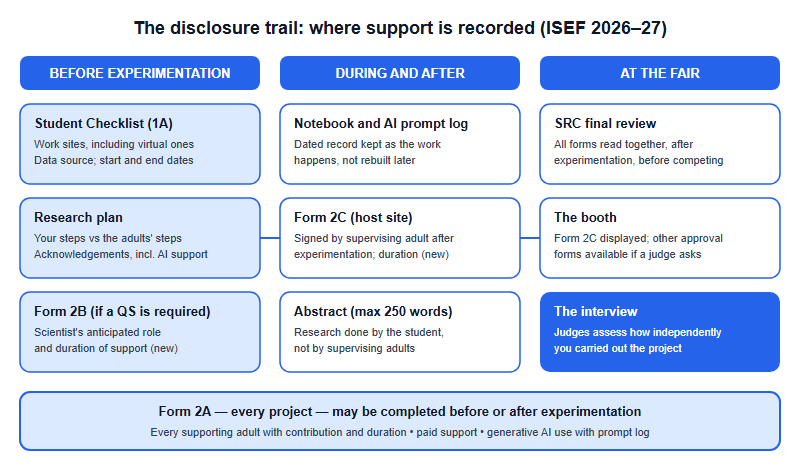
- Student Checklist (1A) asks where you will carry out the work, lists every site other than home or school whether you worked there virtually or in person, records your actual start and end dates, and asks whether your data were self-collected, collected by a mentor or publicly available.
- The research plan must distinguish your steps from any supervising adult’s, and its acknowledgements list everyone who supported the project and what they contributed, with AI support documented through a prompt log or an explanation.
- Qualified Scientist Form (2B), when one is required, adds a question this cycle about the scientist’s anticipated role and how long they will support the project.
- Regulated Research Institutional/Industrial Setting Form (2C) applies when work was conducted or mentored, virtually or on site, at a regulated research institution, an industrial setting or any site other than home, school or field. The supervising adult completes it after experimentation, describing your independent and creative work, what you did as opposed to what you watched, whether they supplied data, whether other high-school students were present and, new this cycle, how long they supported you. It is displayed at the booth, and the display rules say the supervisor’s answers may be referenced to confirm that what is on the board is your own work. Some official pages still use its former number, 1C.
- The abstract must describe research carried out by you, not by the adults who supervised it.
The practical consequence is easy to miss. Three forms — 2A, 2B and 2C — now ask how long someone supported you, and 1A records your research dates. If your 2A says a mentor helped from May to December and their 2C says June to August, you have created a question nobody needed to ask. That cross-reading happens at your affiliated fair’s scientific review, after experimentation and before you compete; if that step is unfamiliar, every path to the ISEF finals explains where it sits.
Writing “contribution” and “duration” so they survive a second reader
Two boxes carry most of the weight on Form 2A, and both reward plain, specific language. The habits below are far easier to keep from the first week of a project than to reconstruct from memory in March.
- Put each action with the right person. Adults taught, demonstrated, reviewed, suggested, supervised or supplied. You designed, ran, measured, coded, analysed and wrote. If a sentence only works with “we”, split it into two.
- Separate teaching from doing. Form 2C asks your host supervisor to distinguish what you observed from what you actually did. Draw the same boundary, in the same terms, on your own form.
- Give date ranges, not years. If help came in bursts, say so: “two training sessions in April; monthly reviews September to December.” Then check the ranges against 1A and against what the adults will write.
- Include the help that feels too small to mention. The teacher who read your research plan, the relative who drove you to a field site, the tutor who explained one statistical test — the section for additional supporting adults exists for exactly these people. Under-reporting is the error with consequences, and full disclosure is exactly what the form asks for.
- Ask mentors for permission early. The Companion Guide advises obtaining a mentor’s permission before entering a fair with the research, ideally agreed at the start, before intellectual-property or confidentiality concerns can arise.
The easiest disclosure to write belongs to a project whose question started with you: the boxes then describe help around your idea, not an idea handed to you — the argument we make in how to choose an ISEF research topic.
Privacy is not secrecy — and what that means if you work with Embark
One distinction deserves its own paragraph. Keeping a student’s name off a marketing page is privacy. Asking a student not to tell a fair about the help they received is secrecy — and the Companion Guide says research programs should not ask students for secrecy, describes it as inappropriate behaviour when working with minors, and reminds families that disclosure of additional support is required.
At Embark, our coaching agreements protect student identities in what we publish, and our published Academic Integrity Policy (last updated June 2026) commits us to disclosing assistance beyond the student’s own work on ISEF forms exactly as the rules require. In practice, if you work with us: your discipline mentor is listed with their real contribution and dates; the paid-support question is answered yes, with the program named; any AI use goes in the AI section with the log; and where an adult completes a form of their own, their account should match yours line for line. The same policy states that a request which would breach it ends the engagement.
The Companion Guide also gives families a short checklist for weighing any research program. Hold every provider to it — us included — and where something is not on a public page, ask for it in writing before you commit:
- the names and credentials of staff and mentors, shown on the program’s website;
- transparent pricing, shared on the website;
- no promised results — the guide is explicit that no program should guarantee competition success;
- no request, spoken or written, that the student keep the support quiet.
The guide also asks anyone aware of a fraudulent or suspicious research program to report it to isef@societyforscience.org.
Frequently asked questions
Is it against ISEF rules to pay for a research mentor or program?
No. The 2026–27 Companion Guide says paid or unpaid programs and mentoring are allowed. What matters is full disclosure on Form 2A.
When do I have to complete Form 2A?
It may be completed before or after experimentation. Starting early lets you record each adult's contribution and dates as they happen.
Do relatives and graduate students go on Form 2A?
Yes. Its section for additional supporting adults names graduate students, relatives and external experts as examples of who belongs there.
What if I no longer have my generative AI prompt log?
Form 2A asks for the prompt log. If you cannot access it, the form asks for a summary of the prompts and responses used in your project.
Work with Embark
Embark is the international competition team of Youfang Education — a research school, not a prep shop. If you work with us, our support appears on your Form 2A in plain words: who your mentor is, what they did, for how long, and that it was paid. Per Embark, our students have reached finalist places across 13 categories; results vary by student and season, and no outcome is guaranteed.
Embark is an independent research-coaching organisation, the international competition team of Youfang Education. We are not affiliated with, endorsed by, or sponsored by the Society for Science or Regeneron ISEF. Results cited reflect Embark’s own published record (per Embark) and are not official ISEF statistics; individual results vary and no outcome is guaranteed. Form names, numbers and requirements change between cycles — confirm all details on societyforscience.org and with your affiliated fair. Errors of fact are corrected within 7 working days of notification.