A field project — sampling a river, a school pond, park soil or city air — is one of the cheapest routes to genuine ISEF data, but it is not a rules-free route. Under the 2026–27 rules, students may not collect water during a harmful algal bloom, culturing what you collect brings in the biosafety rules, and the Society’s June 2026 Field Work Safety Plan asks you to document sites, permits, transport, disposal and emergency access before the first sample.
The rules follow what you do with a sample, not where you stand
Students often assume that working outdoors, away from a laboratory, puts a project outside the rules. The official FAQ points to what actually matters: water and soil can contain potentially pathogenic organisms, but studies involving them are treated as potentially hazardous biological agent studies only when the sample is cultured. The same bucket of pond water can be a simple chemistry project or a regulated microbiology project, depending on what you do next. Here is how the common field activities sort out.
| Field activity | What the 2026–27 rules say | What it means for planning |
|---|---|---|
| Studying water or soil microbes without concentrating them in growth media | Exempt from prior SRC review, but a Risk Assessment (Form 3) is required | Write the risk assessment before you sample; plan safe handling and disposal |
| Sealed colour-change coliform test kits | Exempt from prior SRC review if the kits stay sealed and are properly disposed of; Form 3 required | Opening a kit takes it out of the exemption — decide before you start |
| Culturing microbes from your samples | Biosafety rules apply, with review and approval before experimentation; culturing at home is prohibited; an opened plate of unknown organisms is treated as BSL-2 | Line up a suitable laboratory and supervisor first; specimens may be collected at home only if taken straight to that laboratory |
| Culturing human or animal waste, including sewage sludge | Considered a BSL-2 study | BSL-2 laboratory and a Qualified Scientist, or a different design |
| Collecting plants | Introducing or disposing of non-native, genetically altered or invasive species into the environment is prohibited | Identify what you collect, and plan transport and disposal under local law |
| Naturally occurring plant pathogens | May be studied, not cultured, at home; may not be introduced into a home or garden | Observation yes; growing the pathogen at home no |
| Water during a harmful algal bloom | Students may not collect it; qualified personnel may collect samples for them; testing must be done in a BSL-2 laboratory | Build bloom checks into every sampling day (see below) |
| Drones and deployed devices | Drone projects must follow all applicable laws; the safety plan asks how long a device is deployed and its environmental impact | Check local aviation and site rules before you fly or install anything |
The Field Work Safety Plan, section by section
The Field Work Safety Plan is a short guide published by Society for Science in June 2026 and linked from the International Rules page. It says it is meant to help students and teachers develop a safe, environmentally responsible project, that it should be reviewed alongside the research plan before experimentation, and that it is based on US Environmental Protection Agency requirements for scientists collecting air, water or soil samples. It is a guide rather than a numbered form, so ask your affiliated fair whether it expects to see it; either way, it is a thorough checklist for field logistics.
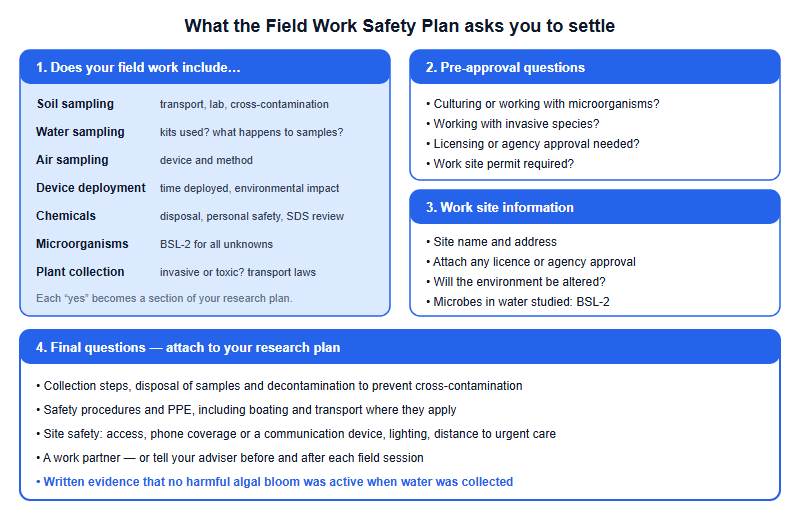
Two lines in the plan deserve particular attention. First, it flags BSL-2 protocols in the field and the laboratory if microorganisms in water samples will be studied, because the organisms are unknown. The rulebook separately allows unknown organisms to be treated as BSL-1 while a plate stays sealed. If your design involves microbes at all, ask your fair’s scientific review committee which reading applies before you collect anything. Second, the safety questions are practical rather than bureaucratic: who is with you, who knows where you are, how far the nearest urgent care is. Water edges and remote sites are where field work carries real physical risk.
Algal blooms: the one rule that can cancel a sampling day
The 2026–27 rulebook prohibits students from collecting water samples during a harmful algal bloom. Qualified personnel may collect samples during a bloom and pass them to the student for testing, and that testing must happen in a BSL-2 laboratory under BSL-2 conditions. The Field Work Safety Plan goes a step further for every water project: it asks for evidence that no bloom was active at the time of collection, such as a screenshot of a website, an email from an appropriate agency or other written documentation.
The plan’s terminology section adds the reason you cannot judge this by eye: blooms can occur in fresh, salt or brackish water, not all of them produce toxins, and the toxins that are produced can harm people, aquatic life and pets. Its examples of who tracks blooms are US state and local health departments. If you sample outside the United States, ask your SRC in advance what documentation it will accept for your location, then capture that evidence on the day of each collection rather than reconstructing it later.
The practical consequence is scheduling. A water project needs backup sampling dates, a same-day record of the bloom check, and a design that survives losing a visit. Water projects are well represented at the finals: our own keyword search of the Society’s public abstracts archive — our count, not a Society statistic — finds 36 projects from 2026 that mention microplastics, most of them in Environmental Engineering or Earth and Environmental Sciences, and seven that mention algal blooms.
Designing field data a judge will trust
Field data has a credibility problem that laboratory data does not: nature does not repeat itself on request. The science criteria still ask for systematic data collection, reproducibility and enough data to support the conclusions, and the design section asks for variables and controls that are defined, appropriate and complete. In the field, those words translate into a handful of concrete decisions you make before the first trip.
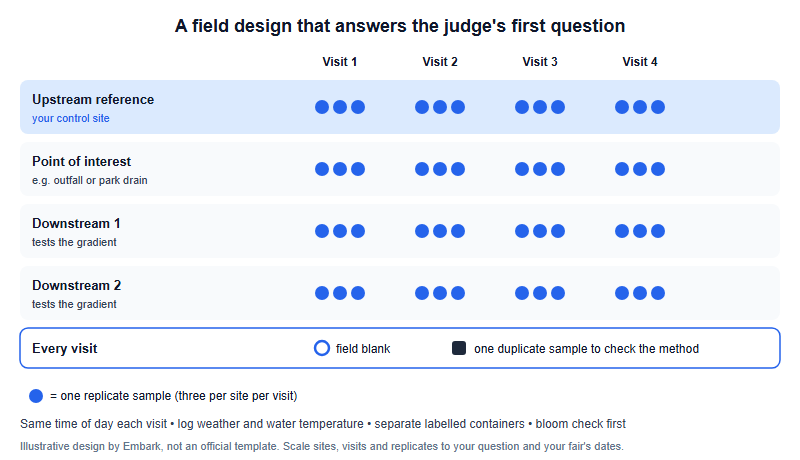
- Run a pilot visit before you commit. One trip tells you whether the site is safe and reachable, whether your kits or sensors can detect the differences you care about, and how long each sample really takes — which decides how many replicates are realistic.
- A reference site is your control. Without an upstream or unaffected comparison, a high reading at your site of interest has no meaning. Choose it for similarity, not convenience.
- Replicate at every site and visit. One sample per site tells you about that bottle, not about the river.
- Blanks and duplicates test your method. A field blank catches contamination from containers and handling; a duplicate tells you how much of your variation is measurement noise.
- Record the conditions that could fool you. Rainfall in the previous days, time of day and temperature change many environmental measurements. If you do not log them, a judge’s question about them will be one you cannot answer.
- Keep a chain of custody. The safety plan asks for separate, secured containers when samples may be contaminated. Label them with site, date and time, and note how long they waited before analysis.
This is also where the interview is decided. The criteria ask how well you understand the limitations of your results, and field projects carry more uncontrolled variables than most. A student who can say exactly which confounds the design controls, and which it does not, reads as a researcher; our note on what ISEF judges look for explains why that matters so much at the booth.
Wildlife, people, permits and the booth
Field projects wander into other rule sets more often than students expect, usually through a small design choice.
- Watching animals. Behavioural observation of animals is exempt from prior SRC review only if you do not interact with them, do not alter their environment in any way, and comply with wildlife, fish and game laws. Animals may not be captured from or released into the wild without approval from authorised wildlife officials.
- Fish. Wild fish may be used only if released unharmed, with the proper licence and in line with fishing laws. Students may not fish with barbed hooks or live bait, or carry out electrofishing, which only a trained supervisor may do. Fish count as vertebrates from hatching, as do tadpoles.
- Pollution effects on animals. Induced toxicity studies with known toxic substances that could cause pain, distress or death — the rules name alcohol, acid rain, pesticides and heavy metals — are prohibited. Measuring pollutants in the environment is a different project from testing them on fish or tadpoles.
- Watching people. Observing people becomes human-participant research, needing IRB approval before it starts, if you interact with them, modify the environment (posting a sign or placing an object counts), observe in a non-public or restricted setting, or record identifiable information. A litter study that puts up a sign is an IRB study.
- Permits and local law. The rules require projects conducted outside the United States to follow the laws of the country and jurisdiction where the work happens, and the safety plan asks you to attach any licence, agency approval or work-site permit. Protected areas, private land and reservoirs often need written permission.
- The booth. The display rules exclude living organisms including plants, all chemicals including water, and soil, sand, rock, cement and waste samples. Plan to show photographs, maps and data instead.
One piece of paperwork usually does not apply. Form 2C is required for work at sites other than home, school or field, so a field site alone does not trigger it — but if a university laboratory runs analyses for you or mentors the work, the rule’s wording brings Form 2C in, so confirm with your SRC. The approvals themselves run through your affiliated fair’s review committee; if you are unsure which fair that is, every path to the ISEF finals maps the route. And the best field questions tend to come from a place the student actually knows, which is the argument we make in how to choose an ISEF research topic.
Frequently asked questions
Do I need SRC approval before testing river or lake water for ISEF?
Not for studying water microbes left unconcentrated in growth media, but you need a risk assessment. Culturing samples changes that.
Can I collect water during an algal bloom for my project?
No. Students may not collect water during a harmful algal bloom. Qualified personnel may, and the testing must happen in a BSL-2 laboratory.
Can I bring my soil or water samples to my ISEF booth?
No. The display rules exclude soil, sand, rock and waste samples, all chemicals including water, and living organisms such as plants.
Is watching birds or fish in a park a vertebrate animal study?
Yes, but it can be exempt from prior SRC review if you do not interact with the animals, do not alter their environment and follow wildlife laws.
Work with Embark
Embark is the international competition team of Youfang Education — a research school, not a prep shop. A field project rewards the planning done before the first sample: the question, the reference site, the replicates and the rules. Per Embark, our students have reached finalist places across 13 categories; results vary by student and season, and no outcome is guaranteed.
Embark is an independent research-coaching organisation, the international competition team of Youfang Education. We are not affiliated with, endorsed by, or sponsored by the Society for Science or Regeneron ISEF. Results cited reflect Embark’s own published record (per Embark) and are not official ISEF statistics; individual results vary and no outcome is guaranteed. Archive counts are our own keyword searches of the public abstracts database. Rules and guidance documents change between cycles — confirm all details on societyforscience.org and with your affiliated fair, and follow local law where you sample. Errors of fact are corrected within 7 working days of notification.