Prospective students often search for an “ISEF research programme” expecting a standardized curriculum offered by the Society for Science. However, ISEF does not offer a central research programme. Instead, it is a competition where students submit original projects developed through their own initiative, school resources, or independent mentorship. Understanding this distinction is critical for planning your path to the finals.
The journey to Regeneron ISEF typically begins at the regional level. For example, students in Hong Kong must pass the local selection organized by the Hong Kong New Generation Cultural Association to qualify for the global stage. There is no direct individual registration for ISEF; advancement depends entirely on winning or placing highly in recognized affiliated competitions. Therefore, your “programme” is actually the strategy you build around your project development.
Comparing Preparation Pathways
Students generally fall into three categories when preparing their projects. Each offers different levels of lab access, mentoring, and control over the final output.
| Pathway | Lab Access | Mentoring Source | Student Ownership |
|---|---|---|---|
| School-Based | Limited to school facilities; may require teacher approval for specialized equipment. | Science teachers or club advisors; availability varies by school workload. | High, but constrained by curriculum timelines and school policies. |
| University/External Lab | Access to advanced equipment if accepted into a summer program or internship. | Graduate students or professors; often less time for detailed feedback. | Medium; project scope may be dictated by the lab’s ongoing research goals. |
| Independent Coaching | Virtual or partner-lab access arranged by coaches; flexible scheduling. | Dedicated mentors with specific expertise; structured weekly reviews. | High; tailored to student interests while ensuring compliance with ISEF rules. |
Lab Access and Resource Realities
A common misconception is that winning ISEF requires expensive laboratory equipment. In reality, judges evaluate scientific rigor, not budget size. Many finalists use simple materials or public datasets. If you pursue an external lab route, ensure you have clear agreements on data usage and intellectual property. For those using school labs, early communication with supervisors is vital to secure space during peak academic periods. Remember that safety protocols, such as those outlined in ISEF Form 3 risk assessments, apply regardless of where the work is conducted.
Mentoring and Student Ownership
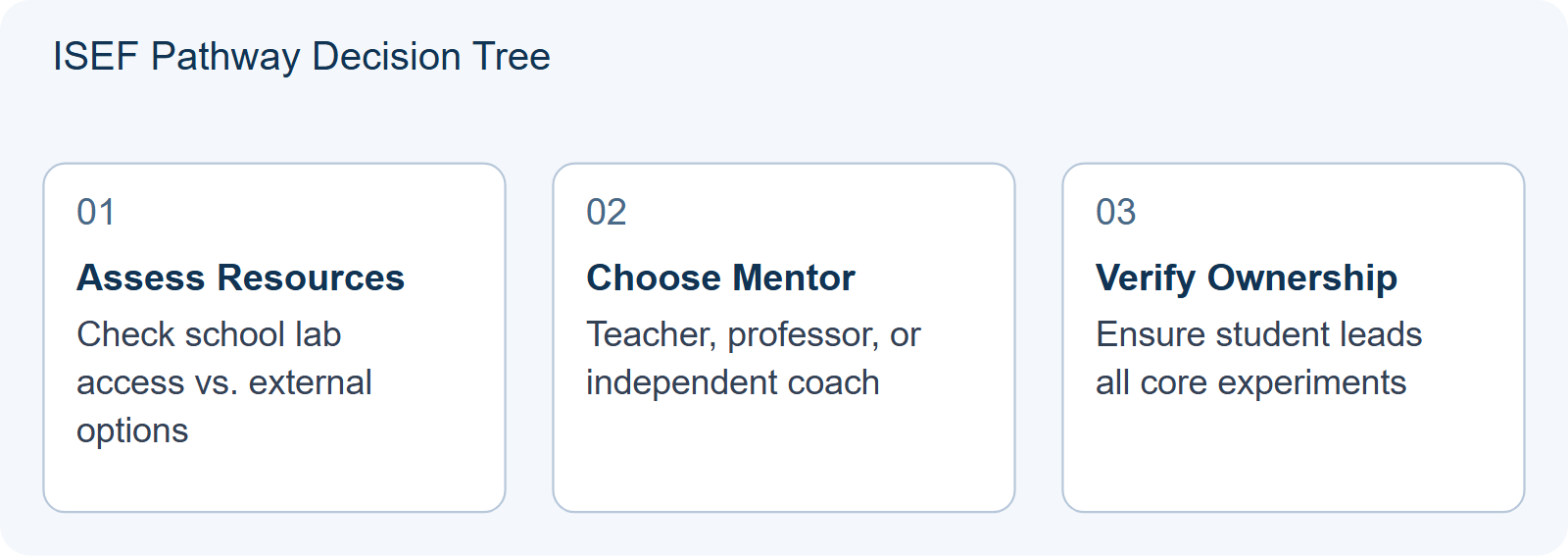
ISEF strictly prohibits ghostwriting or having others perform the core experimental work. The concept of “student ownership” means you must be able to defend every aspect of your project during the interview. Independent coaching services can help structure this learning process, ensuring you understand the methodology deeply rather than just executing steps provided by a mentor. Transparency is key: if you receive paid assistance, it must be disclosed accurately in Form 2A.
Effective mentoring focuses on guiding questions rather than providing answers. Whether working with a teacher or a private coach, ask them to challenge your hypothesis design and statistical analysis methods. This prepares you for the rigorous judging criteria used in regional qualifiers and the finals.
Strategic Planning for Regional Selections
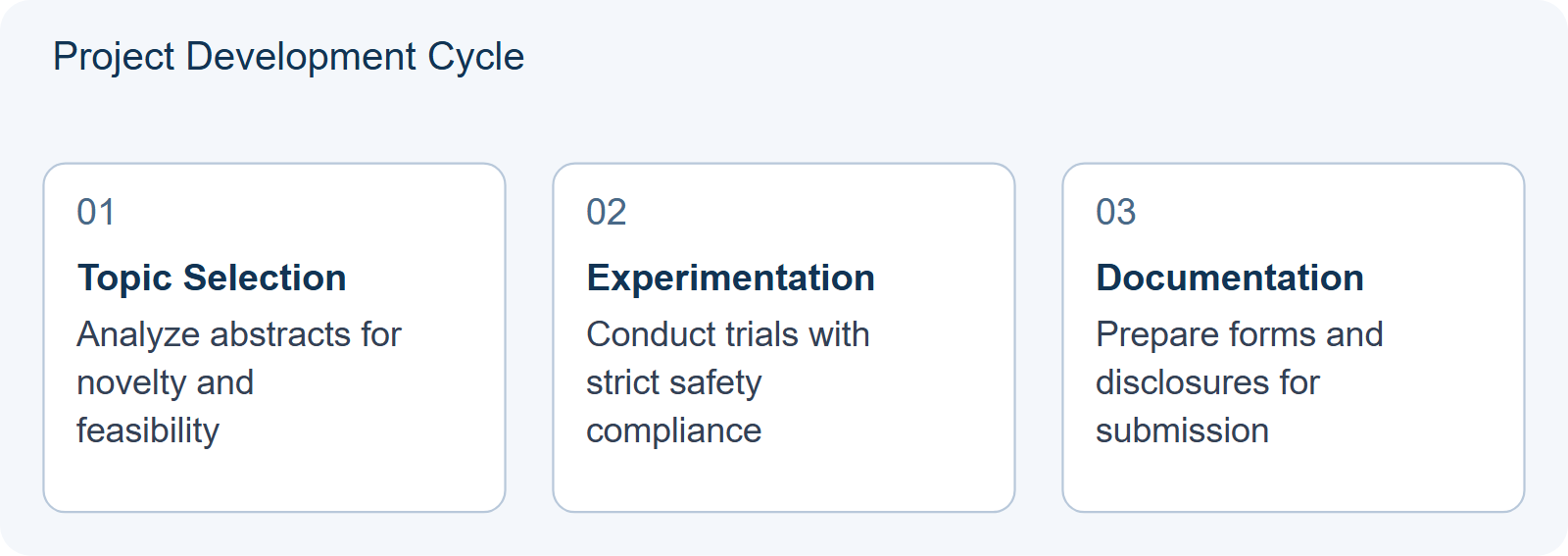
Since ISEF advancement relies on regional wins, align your project timeline with local deadlines. For instance, the Hong Kong selection cycle involves specific registration windows and submission dates. Start your research early enough to allow for multiple iterations of your experiment. Use resources like the ISEF Abstract Archive to analyze past winners and identify gaps in current research trends. This proactive approach helps you select a topic that is both feasible and novel.
Ultimately, there is no one-size-fits-all “ISEF research programme.” Success comes from choosing the right support structure—whether school-based, university-linked, or independently coached—that maximizes your learning and ensures full student ownership of the final product.
HYPOTHETICAL/ILLUSTRATIVE: The “Data-First” vs. “Lab-First” Decision
To apply the concepts of lab access, mentoring, and student ownership, consider a hypothetical scenario involving two students, Alex and Jordan, who both wish to investigate the impact of urban noise pollution on local bird behavior. Both have similar academic standing but different resource constraints. This example illustrates how specific preparation choices affect project viability and ownership.
Alex chooses a Lab-First approach. He secures a summer internship at a university ecology lab with advanced acoustic recording equipment. His mentor is a busy graduate student who provides pre-set data collection protocols. Alex spends his time operating the machinery exactly as instructed. While he gains access to high-quality hardware, his role becomes largely operational. When asked during a mock interview why he chose specific microphone placements or sampling intervals, Alex struggles to justify these decisions because they were dictated by the lab’s existing research goals, not his own scientific inquiry. His “student ownership” is low because he cannot defend the methodological nuances without referencing his mentor’s instructions.
Jordan chooses a Data-First approach. Lacking access to specialized hardware, she uses free public datasets from city environmental agencies and open-source audio libraries. She recruits a science teacher as a mentor, meeting bi-weekly for 30 minutes. Instead of asking for answers, Jordan presents her proposed statistical models for correlation analysis. Her teacher challenges her assumptions about confounding variables, such as weather patterns. Jordan iterates her code and analysis plan independently. Although her tools are simpler, she fully understands every step of her methodology. During practice interviews, she confidently explains why she selected specific regression techniques and how she addressed data gaps. Her ownership is high because the intellectual framework is entirely hers.
| Decision Factor | Alex (Lab-First) | Jordan (Data-First) |
|---|---|---|
| Resource Access | High-end hardware; limited schedule flexibility. | Public datasets; flexible remote work. |
| Mentoring Dynamic | Directive; mentor sets protocol. | Collaborative; student proposes methods. |
| Ownership Risk | High risk of appearing as a technician rather than a researcher. | Low risk; deep understanding of limitations and logic. |
The key difference lies in the definition of success. Judges do not reward expensive equipment; they reward rigorous thinking. Alex’s decision prioritized access over agency, leading to a fragile defense of his work. Jordan’s decision prioritized analytical depth over hardware, resulting in robust ownership. What changes the decision? If Alex had negotiated to design his own sampling strategy within the lab, his ownership would increase. If Jordan had accepted a pre-written script from her teacher, her ownership would decrease.
Reusable Self-Check: Before committing to a pathway, ask yourself: “If my mentor or supervisor were removed from the room, could I explain every variable choice, error margin, and conclusion in my project?” If the answer requires citing someone else’s authority, you need to shift your focus from executing tasks to designing the investigation. Choose the pathway that forces you to make the hard intellectual decisions, regardless of the physical resources available.
Frequently Asked Questions
Is there an official ISEF research programme?
No. ISEF is a competition, not a course provider. Students develop projects through schools, universities, or independent mentors.
Can I register directly for ISEF?
No. You must win or place in a recognized regional affiliate competition, such as the Hong Kong selection, to qualify.
Do I need a professional lab?
Not necessarily. Many winners use school labs or public data. Judges prioritize scientific method and student understanding over equipment cost.