If you want science research on your record, ISEF is one route — not the only one. Students also publish in journals, complete mentored summer research programs, and enter other competitions. The honest answer to “which is best?” is that they signal different things, and the right choice depends on your project, your timeline, and what you want a university to read into it. This is a comparison of the main routes, with the trade-offs we actually weigh with students, so you choose on purpose rather than chasing the most famous name.
Why “the best research route” is the wrong question
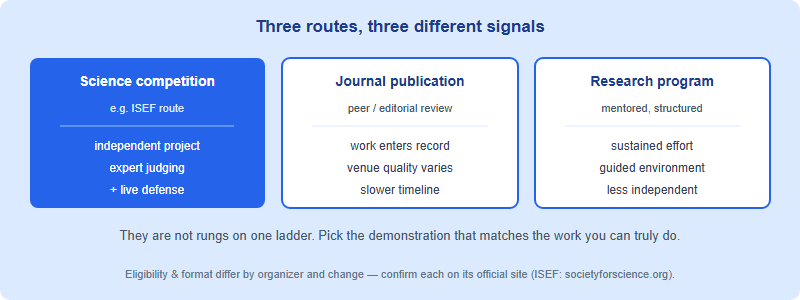
At Embark we are a research school, not a prep shop, and the first thing we push back on is the idea that one credential universally beats the others. A competition like ISEF, a peer-reviewed publication, and a structured research program are not rungs on a single ladder — they are different demonstrations. One shows that independent work survived expert judging and a live defense. Another shows that work cleared a review process and entered the record. A third shows sustained effort inside a mentored environment. Admissions readers, and the scientists who sometimes advise them, can tell these apart.
For an international applicant from a Chinese school, this distinction is practical, not abstract. Some routes have eligibility or geographic structures that shape whether and how you can participate; some reward a single strong project, others reward a longer arc. Choosing well means matching the route to the work you can genuinely do at a high level — and being able to talk about why you chose it. A student who can explain their reasoning reads as a scientist; a student collecting credentials reads as a résumé.
Two ground rules before any comparison. First, eligibility and format for every one of these routes are set by their own organizers and change over time — for ISEF specifically, confirm rules on societyforscience.org, and for any other program confirm on that program's official site. Second, no route guarantees an admissions outcome. We help students do strong work and present it honestly; we never promise a result, and you should be skeptical of anyone who does.
What each route actually signals
Strip away prestige and look at what a reader infers from each:
- A science competition like ISEF signals that you produced an independent project and defended it to expert judges in person. The live interview is hard to fake, which is part of why it carries weight — it tests whether you understand your own work, not just whether the work exists.
- A journal publication signals that your work passed a review process and entered the permanent record. The signal's strength depends heavily on the venue's rigor; a serious, selective venue says a great deal, while a pay-to-publish outlet says little and can even raise doubts. The timeline is also longer and less predictable.
- A mentored research program signals sustained engagement and the ability to contribute inside a real lab or structured setting. It is often more accessible as an entry point and builds genuine skill, but it typically demonstrates less independence than a self-driven competition project, because the framing and supervision come from the program.
- Other competitions vary widely in selectivity and structure. Some are strong national or international stages; others are local. Read each one's actual selectivity rather than assuming a competition name equals a strong signal.
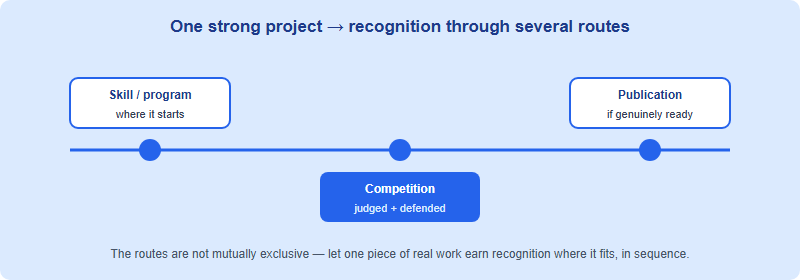
The practical insight is that these are not mutually exclusive. A single excellent project can, over time, be presented at a competition and also written up for a venue; a research program can be where a project that later goes to a competition was born. The mistake is collecting routes for their own sake instead of letting one strong piece of work earn recognition in the ways that fit it.
A comparison table for choosing
Use the dimensions below to weigh routes against your own situation. The point is not to crown a winner but to surface which trade-offs you are accepting.
| Dimension | ISEF route | Journal publication | Research program |
|---|---|---|---|
| Core signal | Judged independent work + live defense | Reviewed work in the record | Sustained mentored contribution |
| Independence shown | High | Varies by authorship | Lower (guided) |
| Timeline | Tied to the annual fair cycle | Often long, unpredictable | Fixed program length |
| Main quality risk | Project must clear competitive judging | Weak-venue publication signals little | Less ownership of the idea |
| Best when… | You have a strong, defensible project | Work is genuinely publication-grade | You're building skills toward a project |
For international students, layer two more questions on top. Does the route have eligibility or geographic structure that affects how you participate? And can you sustain the route's timeline alongside school and exams? A route you can execute at a high level beats a more prestigious one you can only do halfway. Whatever you choose, verify the current eligibility and format on the organizer's official site — for ISEF, that is societyforscience.org — because these details are set annually and are not safe to assume.
If you're leaning toward the ISEF route
When a student's strength is a genuinely independent project they can defend, the competition route tends to fit well, because that is exactly what it tests. The work then is to make the project strong and the path navigable. Two starting points matter most: framing a question that can actually carry a year of research — see how to choose an ISEF research topic — and understanding the qualification structure so you plan realistically, which we lay out in every path to the ISEF finals.
And whichever route you pick, the meta-skill is the same one universities are really screening for: can you do honest, rigorous work and explain it clearly? A competition tests that through a live defense, a publication through review, a program through sustained contribution. Build the underlying capability, choose the route that showcases it best for your project, and present it without inflation. That is a stronger application than any single trophy, and it is the standard we hold students to.
Frequently asked questions
Is ISEF better than getting published?
Neither is universally better — they signal different things. A competition tests independent work via live defense; a publication shows reviewed work in the record, with strength depending on the venue.
Can one project do more than one route?
Often yes — a strong project can be presented at a competition and later written up. The error is collecting routes for their own sake instead of doing one piece of work well.
Do research programs count as much as competitions?
They demonstrate sustained mentored effort and build real skill, but usually show less independence than a self-driven competition project. The right one depends on your goal.
Does any route guarantee admission?
No. Strong, honestly presented research helps, but no competition, publication, or program guarantees an outcome — be wary of anyone who claims otherwise.
Work with Embark
Embark is the international competition team of Youfang Education — a research school, not a prep shop. We help students choose the research route that fits their actual project and goals, then do the work to a standard they can defend. If you're deciding between ISEF and another path, talk it through with us.
Embark is an independent research-coaching organization, the international competition team of Youfang Education. It is not affiliated with, endorsed by, or sponsored by the Society for Science or Regeneron ISEF. Any results referenced reflect Embark's own published record (per Embark). Competition facts — eligibility, deadlines, format, and judging — are set by each organizer and should be confirmed on the official site (ISEF: societyforscience.org). Errors will be corrected within 7 working days.