A survey looks like the accessible ISEF project: no lab, no equipment, just questions and people. In practice it is one of the harder categories to do well, and it carries a hard procedural gate. Per the official rules, research involving human participants must be reviewed and approved by an Institutional Review Board before any interaction — including recruitment — may begin. Design first, collect second.
Why students choose survey projects, and why so many underperform
If you attend an international school in China without a university lab down the road, a human-participant study is genuinely attractive. Your school is a population. A questionnaire costs nothing. You can run the whole project on a laptop and a shared link. For students shut out of wet-lab work, Behavioral and Social Sciences and related areas are a legitimate and serious route into research, not a consolation prize.
The trouble is that the low barrier to starting hides a high barrier to defending. Anyone can write ten questions and post them in a class group chat. Almost nobody can then explain who the respondents represent, whether the questions measured what they claim to measure, or why the observed pattern is not simply an artefact of who happened to reply. A judge does not need to be a psychologist to ask those three questions, and a survey project that has not answered them collapses fast.
There is a second, quieter problem. Because the method feels casual, students often skip the design phase entirely and start collecting on day one. That is exactly backwards for human-participant work, where the rules require approval before you contact anyone, and where a badly designed instrument cannot be fixed after the fact. Choosing this route well means treating question design with the same seriousness a chemist treats a protocol — a point worth settling when you first pick your research topic, not in month six.
What actually counts as human-participant research
Students consistently underestimate this definition, and the mistake is expensive: work started before approval may not be usable. The official rules treat research as involving human participants when you obtain data through intervention or interaction with a person, or when you use identifiable private information. That is broader than “an experiment on people.”
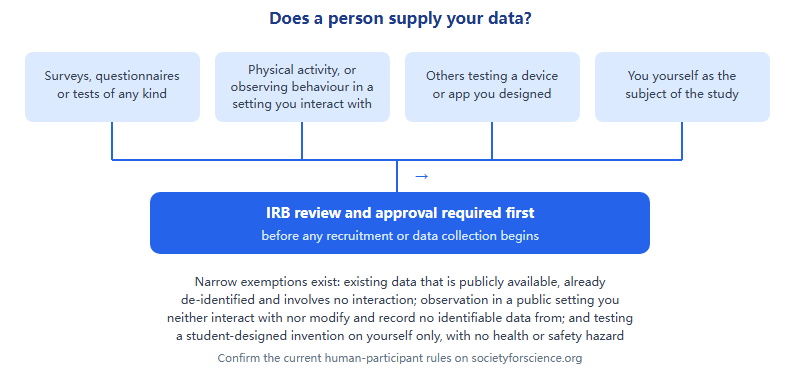
Read that diagram carefully if you are building something. A student who designs an app, then asks twenty classmates to use it and rate it, has run a human-participant study — even though they think of the project as engineering. So has a student who observes behaviour in a setting they have modified, or who runs the protocol on themselves. Non-anonymous data collection also brings a project into scope. If any of these describe your plan, and none of the narrow exemptions below applies, the approval requirement applies to you — and it applies before you send the first message.
There are a few narrow off-ramps. Analysis of existing datasets may fall outside the requirement when the data are publicly available, already de-identified, and your work involves no interaction with the people in them. Two others are worth knowing: observation of behaviour in a public setting can be exempt where you have no interaction with the people observed, do not manipulate the environment in any way, and record no personally identifiable data; and testing a student-designed invention, prototype, application or product can be exempt where you (or your team) are the only person testing it and the testing poses no health or safety hazard. For students with limited access to participants, the existing-dataset route is worth considering seriously — large public datasets support real research questions. But every one of these exemptions is conditional and its exact wording matters, so confirm the current rules and check with your adult sponsor rather than assuming your study qualifies.
Consent, minors and risk: the part that is not paperwork
Consent is often treated as a signature to collect. It is better understood as a design constraint that improves your study. Under the official rules, adults give their own informed consent; where participants are minors — which, if you are surveying classmates, means most of them — you need both the student’s assent and written parental permission. For surveys of minors, the instrument itself must be attached to the consent documentation before parents are asked to approve it.
That single requirement quietly enforces good practice. If a parent has to read your questionnaire before agreeing, you cannot bolt questions on later, and you cannot include an item you would be embarrassed to have an adult read. Your instrument must be finished, considered and defensible before recruitment — which is precisely the discipline that separates a survey study that holds up from one that does not.
Participation must also be genuinely voluntary. Participants have to understand that they may take part or decline with no adverse consequences, and consent cannot be obtained through coercion. This is worth thinking about concretely in a school setting: a survey circulated by a student to their own classmates, or with a teacher’s visible endorsement, carries social pressure even when nobody intends it. Anonymity, a neutral distribution channel, and explicit wording that declining is fine are not just ethical niceties — they also reduce the response bias that would otherwise weaken your data.
Finally, your research plan must document potential risks and how you minimise them. The rules are explicit that risk is not only physical: psychological, temporal, social and legal risks all count. A questionnaire about stress, family, body image or academic pressure carries psychological risk. A long protocol carries a real cost in participants’ time. Naming these honestly, and describing your mitigation, is a mark of a serious researcher — and judges notice when a student can discuss the ethics of their own design without being prompted.
The five design decisions that decide whether your study survives
Compliance gets you permission to run. Design decides whether the result means anything. These five choices account for most of the distance between a survey project that stalls and one that a specialist takes seriously.
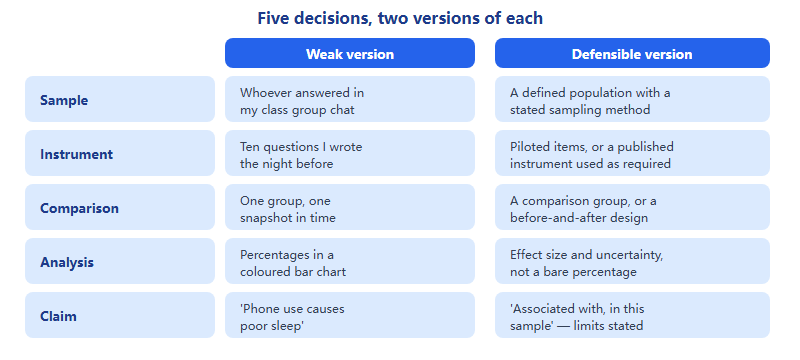
On the sample: your population is not “teenagers.” It is whoever could plausibly have answered your link. Say so. A study of 140 students at two international schools in one city is a real study with a real boundary; the same study described as evidence about adolescents in general is over-claiming, and a judge will say so. Naming your sampling frame precisely costs you nothing and buys you credibility.
On the instrument: a question you wrote yourself is an unvalidated measurement device. That is not fatal — plenty of good research uses new items — but you then owe the judges evidence that it measures what you claim. Pilot it on a handful of people, ask them what they thought each item meant, and fix the ambiguous ones. If instead you use a published instrument, note that the rules require any published instrument that is not in the public domain to be administered, scored and interpreted by a Qualified Scientist. Check the instrument's status before you build your study around it, and confirm the current wording on societyforscience.org.
On the claim: this is the single most common failure at the booth. Cross-sectional survey data show association, not causation, and a judge will test whether you know the difference. The stronger move is to name the confound yourself — “students who report more screen time also report later bedtimes, so I cannot separate the two with this design” — and explain what design would separate them. That answer scores better than a confident overstatement, every time. Our guide to what ISEF judges look for at the booth covers how this line of questioning tends to unfold.
Sequencing a human-participant project
Because approval must precede contact, the order of operations differs from a bench project. Build the study on paper first; the approval step then becomes a checkpoint rather than an obstacle.
| Stage | What you do | Why it comes here |
|---|---|---|
| 1. Question | Narrow to a comparison you can actually make with people you can actually reach | A question you cannot sample is not a project |
| 2. Design | Choose your comparison group or pre/post structure; decide your analysis in advance | Deciding the analysis after seeing data invites cherry-picking |
| 3. Instrument | Write and pilot every item; check whether a published instrument is in the public domain — if it is not, a Qualified Scientist must administer, score and interpret it | Minors’ consent documentation includes the survey itself |
| 4. Risk and consent | Document physical, psychological, temporal, social and legal risks and your mitigations | Required in the research plan, and it improves the design |
| 5. Review | Submit for IRB review with your adult sponsor | Approval is required before any recruitment or data collection |
| 6. Collect | Recruit and run exactly the approved protocol | Deviating from what was approved undermines the whole study |
| 7. Analyse and interpret | Run the pre-planned analysis; report uncertainty; state limits | Honest limits are an asset in judging, not a weakness |
An Embark coach view
Per Embark, the students who do outstanding human-participant work are usually the ones who spent an uncomfortable amount of time on the instrument before touching a participant. That front-loading feels slow. It is what makes the rest of the project defensible, because a question that was ambiguous to your pilot respondents will be ambiguous in your dataset forever, and no analysis rescues it.
The second thing we push hard on is the difference between a topic that is emotionally compelling and a question that is answerable. Adolescent mental health, academic pressure and social media are genuinely important, and students are drawn to them for good reasons. But “how does social media affect teenagers?” is not a study; “do students who use a scheduled-check habit report different self-rated concentration than those who do not, in this defined population?” is. Narrowing is not lowering your ambition. It is the only way to say something you can actually support.
We are a research school, not a prep shop, and that shapes how we coach this route in particular. We will not help a student reverse-engineer a survey to produce a headline finding, and we tell students plainly that a null result from a well-designed study is a better project than a striking result from a broken one. If you want to see how this category sits alongside the other routes into the finals, our overview of every path to the ISEF finals gives the wider map. Get the design right and the human-participant route is not the easy option — it is a serious one.
Frequently asked questions
Does a simple class survey need IRB approval?
Yes. Surveys and questionnaires of any kind count as human-participant research, and review and approval must come before any recruitment.
Can I survey classmates who are under 18?
Yes, with both the student’s assent and written parental permission. For minors, the survey itself attaches to the consent documentation.
Does testing my own app on friends count?
Yes. Others testing a student-designed invention is treated as human-participant research even if you consider the project engineering.
Can I analyse an existing public dataset instead?
Often yes. Publicly available, already de-identified data with no interaction may be exempt. Confirm the current rules officially first.
Work with Embark
Embark is the international competition team of Youfang Education — a research school, not a prep shop. Our coaches are working researchers who help students narrow a human-participant question, pilot the instrument properly, and plan the analysis before a single response comes in. We do not sell shortcuts or guarantee outcomes; we teach the craft.
Embark is an independent research-coaching organization, the international competition team of Youfang Education. We are not affiliated with, endorsed by, or sponsored by the Society for Science or Regeneron ISEF. Any results cited reflect Embark's own published record (per Embark). Rules summarised here change between cycles — please confirm all human-participant requirements and review procedures on societyforscience.org; we correct any errors within 7 working days.