A machine-learning project becomes ISEF research at the moment you can show what your model is being compared against. Regeneron ISEF has 22 categories and none of them is called “machine learning” — the work is spread across Software Design, Robotics and Intelligent Machines, Embedded Systems, Computational Biology and Bioinformatics, and every domain category where a model is a tool. Category choice is the easy part. The hard part is evidence.
Where machine-learning work actually sits among the 22 categories
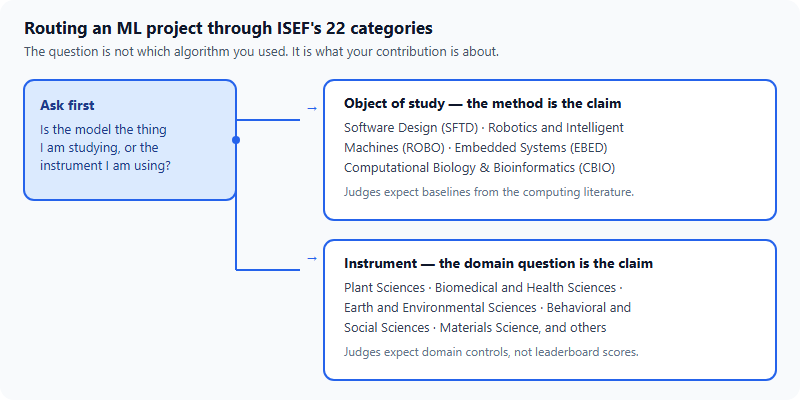
Society for Science lists 22 categories for Regeneron ISEF 2026. The ones students with computational projects gravitate toward are Computational Biology and Bioinformatics (CBIO), Embedded Systems (EBED), Robotics and Intelligent Machines (ROBO), Software Design (SFTD) and Technology Enhances the Arts (TECA). The category page is explicit that “finalists are fully responsible for selection of the category,” and that the choice should be based on what most accurately describes the project rather than the category used at an earlier competition — so the category you were assigned at a regional fair is not binding at the finals.
The routing question is not “did I use a neural network?” It is whether the model is the object of study or the instrument. If your contribution is a method — a new architecture, a compression technique, a scheduling algorithm, an on-device inference pipeline — the computing categories are where reviewers can evaluate you. If the model is a measuring device pointed at a biological, environmental or behavioural question, the domain category usually gives you a panel that can actually judge the contribution. A leaf-disease classifier whose real claim is about early detection in a specific crop is often better served in Plant Sciences than in Software Design, because the interesting part is agronomic, not architectural. This is the same decision logic that governs choosing a research topic that can actually win: pick the frame in which your strongest evidence counts.
Science rubric or engineering rubric — it changes what “finished” means
Grand Award judging runs on a 100-point scale, and the science and engineering versions differ in exactly one line — but that line decides what your last two months of work should be.
| Criterion | Science project | Engineering project | Points |
|---|---|---|---|
| Opening | Research Question | Research Problem | 10 |
| Method | Design and Methodology | Design and Methodology | 15 |
| Execution | Data Collection, Analysis, Interpretation | Construction and Testing | 20 |
| Originality | Creativity & Potential Impact | Creativity & Potential Impact | 20 |
| Presentation | Poster 10 + Interview 25 | Poster 10 + Interview 25 | 35 |
Under the science framing, “Execution” means analysis and interpretation. An accuracy number is not an interpretation. You owe uncertainty, repeated runs, and a statement of what the result would look like if your hypothesis were wrong. Under the engineering framing, “Execution” means construction and testing — you must have written down design criteria before you built, then tested against them. Students who never choose a framing tend to produce the worst of both: a system with no stated design requirements and results with no error bars.
The four pieces of evidence that turn a model into a project
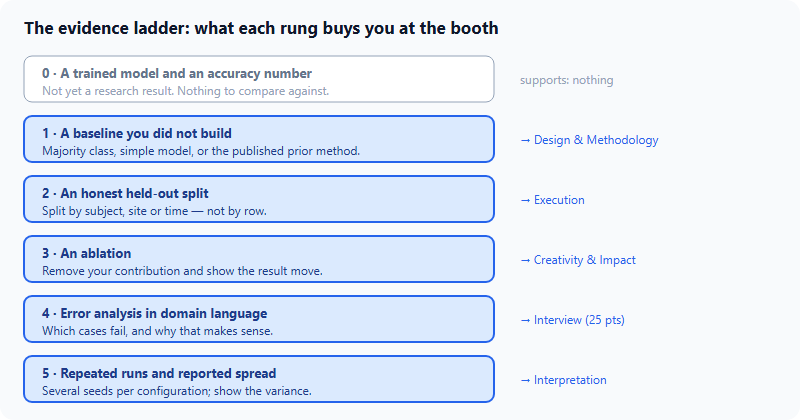
Almost every weak computational project we read is missing the same four things. None of them requires expensive compute; all of them require deciding, early, that you are running an experiment rather than chasing a number.
- A baseline you did not build. Majority-class prediction, a simple linear or tree model, or the published prior method. Without it, a stated accuracy has no meaning — a 92% classifier is a failure if predicting the majority class gets 91%.
- An ablation. Remove one component — a feature group, an augmentation, a loss term — and report what happens. This is the single cheapest way to show that your contribution, not the general machinery, is doing the work.
- A held-out evaluation with an honest split. Split by subject, site or time, not by row, whenever rows from the same source can leak across the boundary. Tuning on the test set once means it is no longer a test set.
- Error analysis. Where does it fail, and does the failure pattern make sense in the domain? A judge who hears “it misclassifies early-stage samples because the visible symptom has not appeared yet” is hearing a scientist. A judge who hears “I would need more data” is hearing a leaderboard.
Add one habit to those four: run each configuration multiple times with different random seeds and report the spread. A great deal of student ML work reports a single run, and a one-point difference between two single runs is usually noise. Showing variance is not a weakness in your project; it is the part that makes the comparison credible.
The difference this makes is easiest to see across the project ideas students bring us most often. The idea is rarely the problem; the comparison structure almost always is.
| Project idea | Weak version (a demo) | Strong version (a study) |
|---|---|---|
| Plant disease classifier | Fine-tune a pretrained network on a public image set; report 96% accuracy | Test whether the model detects disease before visible symptoms; split by field and season; compare against an agronomist's visual scoring |
| Air-quality prediction | Train on a public sensor archive; report low error on a random split | Split forward in time, compare against a persistence baseline, and report where the model fails during pollution events |
| Assistive detection device | Run inference on a laptop; show a live demo | State latency, power and cost design criteria first; build on the target board; test against those criteria (an engineering-rubric project) |
| Mental-health text classifier | Scrape social posts and classify sentiment | Use a published de-identified corpus under its licence, or obtain IRB/SRC approval before collecting anything; report subgroup error rates |
| Protein or genomics model | Reproduce a tutorial pipeline end to end | Ablate one component of that pipeline on a held-out organism and explain the biological reason for the drop (a CBIO project) |
Your dataset is a compliance decision, not just a download
This is where computational students get blindsided, because it feels like nothing about a CSV file could involve a review board. The ISEF human-participants rules are specific about existing data. Data or record review studies that use preexisting data sets which are publicly available and/or published, and involve no interaction with human participants, are listed as exempt from IRB pre-approval — confirm what your own SRC still requires on societyforscience.org. Projects in which the student receives pre-existing or retrospective data “in a de-identified/anonymous format” are also treated as exempt when a qualified professional certifies that the data were appropriately de-identified and comply with privacy laws.
The line moves the moment you generate data yourself. If you build the dataset — a survey of classmates, photographs of participants, wearable readings, an app that logs users — you are doing human-participant research, and the rules require review and approval by an IRB or SRC prior to the start of experimentation. Approval after the fact does not fix it. Separately, if your work sits inside a larger professional study, the rules state that the project you present must be only your own portion of that study.
Two practical habits protect you: record the dataset name, version, licence and download date in your lab notebook the day you get it; and write one paragraph describing exactly how each record came to exist. If you cannot write that paragraph, you cannot answer the judge who asks it — and that question comes up more often than students expect, as our note on what ISEF judges look for at the booth describes.
The interview is where computational projects are won or lost
The interview is worth 25 of the 35 presentation points. For ML projects, judges tend to converge on a short list of questions, and every one of them is answerable if you built the ladder above: What is your baseline, and where did it come from? How did you split the data, and could anything leak across the split? Why this metric and not another? How many runs is that number from? What result would have made you abandon your hypothesis?
One rule that catches multi-year students: if the project is a multi-year effort, the interview is supposed to focus only on the current year's work, and judges review the abstract and the continuation form to clarify what progress was completed this year. Practically, that means the pipeline you built last summer is context, not credit — your talking points should be organised around what changed in this cycle. The route from a regional fair to that booth is laid out in our guide to every path to the ISEF finals.
What we see go wrong, and how we coach around it
Embark is the international competition team of Youfang Education, and our position on computational projects is a consequence of being a research school rather than a prep shop: we would rather a student present a modest model with four kinds of evidence than an impressive-sounding system they cannot defend for eight minutes. Across coaching seasons, per Embark, our team has supported projects spanning ISEF's 22 categories, and the failure modes in the computational ones are remarkably consistent — the leaderboard project with no baseline, the wrapper project where the student cannot say what they wrote versus what they imported, and the dataset the student cannot account for.
The fix is scheduling, not talent. Decide your framing — science or engineering — before the first experiment. Write the baseline into the plan rather than adding it in April. Keep a notebook entry per experiment with the seed, the configuration and the result, so that in the interview you can answer “how many runs?” without guessing. Students who do this find the last month becomes writing and rehearsal, instead of a panic to generate results a rubric already told them they needed.
FAQ
Does ISEF have a machine-learning category?
No. Per Society for Science there are 22 categories; ML work usually enters through Software Design, Robotics, Embedded Systems, CBIO, or the relevant domain category.
Can I use a public dataset for my ISEF project?
Data/record review studies using publicly available or published datasets with no human interaction are listed as exempt from IRB pre-approval, not from all review. Confirm your case on societyforscience.org.
Do I need IRB approval if I survey classmates for training data?
Yes — human-participant research requires IRB or SRC review and approval before experimentation begins. Approval cannot be obtained afterwards.
How much of my grade depends on the interview?
Presentation is 35 of 100 points, of which the interview is 25 and the poster 10, per the published Grand Award criteria.
Work with Embark
If you are building a computational project this cycle, the useful conversation is about your baseline and your data provenance — not your model size. Bring the idea you have and we will tell you honestly what evidence it still needs.
Embark is an independent research-coaching organisation, the international competition team of Youfang Education. We are not affiliated with, endorsed by, or sponsored by the Society for Science or Regeneron ISEF. Any results cited reflect Embark's own published record (per Embark). Rules, categories, criteria and dates change between cycles — confirm all competition details on societyforscience.org. Factual errors are corrected within 7 working days of notice.