English is the official language of Regeneron ISEF: project boards and abstracts must be in English. And on the 100-point Grand Award rubric, the judging interview alone is worth 25 points — the single largest line item, two and a half times the poster. For a student whose first language is not English, that is not a footnote. It is the largest single scoring block in the competition.
The rubric says the quiet part out loud
Students and parents tend to treat the board as the deliverable and the conversation as the thing that happens afterwards. The official Grand Award judging criteria invert that. For both Science and Engineering projects, the 100 points break down like this:
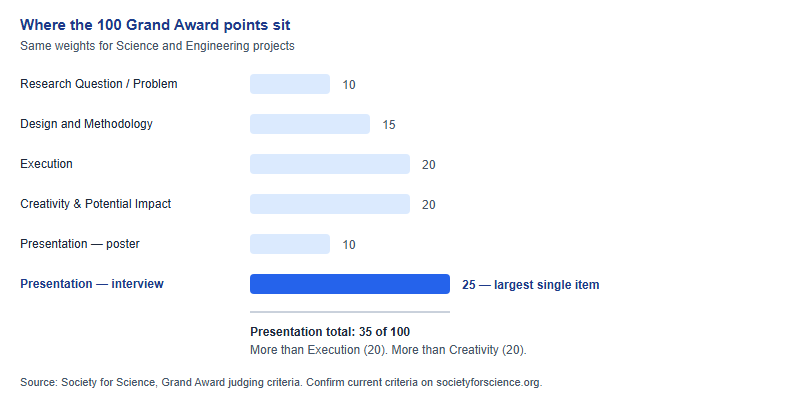
Read alongside two other official facts, the weighting becomes concrete. About 1,000 science, engineering and industry professionals serve as judges each year, and each entry is judged at least four times. So the 25 points are not awarded once by one sympathetic person — you have the same conversation repeatedly, with different specialists, and your fourth attempt should be your best rather than your most exhausted.
What “English is the official language” actually obliges you to do
The rule is narrower than students fear and wider than they hope. What it explicitly requires is that student project boards and abstracts be in English. That means two written artefacts, produced under your control, on your own timeline, with as many drafts as you want:
- The abstract — maximum 250 words, one page, submitted after experimentation. It is short enough to polish sentence by sentence, and it is often the first English any judge reads from you.
- The board — the text is fixed weeks in advance. Nothing about it needs to be improvised.
Notice what this implies. The written half of your English is a preparation problem, and preparation problems are solvable. The interview is the only part that happens in real time — which is why it deserves the largest share of your rehearsal, not the largest share of your anxiety. A second-language student who over-invests in board wording and under-invests in speaking has optimised the 10-point item and left the 25-point item to chance.
One practical consequence: write the abstract yourself, early, and then read it aloud. Terminology you cannot pronounce comfortably is terminology you will avoid under pressure, and avoiding your own key terms in front of a specialist judge reads as shaky command of the work rather than as an accent.
Yes, interpreters exist at the finals — and no, that is not the plan
This is the part most Chinese families have never been told. The Society for Science recruits interpreter volunteers for the finals and assigns them to specific projects, to help finalists who do not speak English through the question-and-answer exchange with judges. Interpretation shifts run on the Grand Award judging day, and interpreters typically have some time with their finalists before judging starts. The Society has also noted that interpreters are not required to have professional or STEM backgrounds — in part because much of the technical vocabulary is already in English.
| What is documented | What it means for you |
|---|---|
| Interpretation is listed as a volunteer role at Regeneron ISEF, helping interpret for finalists during judging | Language support at the finals is a real, organised function — not an improvised favour |
| The published list of needed languages includes Mandarin and Cantonese, alongside Arabic, Japanese, Korean, Portuguese, Spanish, Thai, Turkish, Vietnamese and others | Chinese-language finalists are an anticipated group, not an edge case |
| Interpreters are assigned to specific projects and are described as having time with their finalist before judging | If you are assigned one, brief them on your own terms and pronunciations first |
| Boards and abstracts must still be in English | Interpretation, where available, covers the spoken exchange — not your written materials |
| Availability, allocation and any request process are set by the organisers, and affiliated fairs run their own arrangements | Never assume support will be there. Confirm with the Society and with your own fair |
Here is the honest coaching position. Knowing interpretation exists should lower your fear, not your preparation. An interpreter can carry meaning across a language gap; they cannot supply an answer you do not have, and they add a round trip to every exchange in a conversation that is already dense. In our coaching experience, a finalist who leans on interpretation still needs to know their own project cold in English, because the follow-up questions are where the 25 points move.
The three things judges probe — and where second-language students lose marks
The published criteria tell you what the interview is testing. Judges assess understanding through responses on the basic science relevant to the project, the interpretation and limitations of results and conclusions, and the degree of independence in conducting the project. For team projects, every member must show significant contributions to and an understanding of the project — there is no quiet seat.
Across those three, the losses cluster in predictable places:
- Basic science relevant to the project. The trap is a memorised paragraph. It survives the first question and collapses on the second, because a script has no branches. Judges are specialists; they will step one level down from whatever you say.
- Interpretation and limitations. This is where second-language students systematically under-answer, and it is rarely a vocabulary problem. Naming your own limitations feels, in many classrooms, like admitting failure — so students hedge, minimise, or skip. On this rubric, stating limitations precisely is evidence of understanding. Rehearse it as its own answer.
- Degree of independence. Answer in specifics: which decisions were yours, where a mentor advised, what you would change. Vague modesty (“my teacher helped me a lot”) is heard as an unclear ownership line, not as politeness.
If your project is a continuation, note a rule that quietly protects you: for multi-year efforts the interview should focus only on the current year's work, with Form 7 identifying what progress happened this year. You are being asked to defend this year, not to narrate three. For the broader picture of what judges reward, see what ISEF judges look for at the booth.
A rehearsal protocol that builds language, not a script
Embark's academic director's reading is blunt on this point: a finalist's presentation carries as much weight as the data, so communication is not a finishing touch to be added the week before the fair. That is a claim about sequencing. Language work belongs in the middle of the project, while the methods are still fresh in your hands.
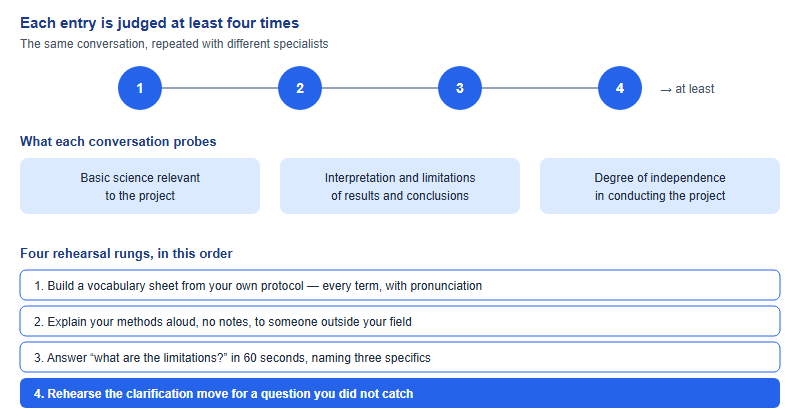
Two rungs deserve expanding, because they are where the accent stops mattering.
The vocabulary sheet is built from your protocol, not from a word list. Go through your own methods section and pull every technical term you will have to say out loud — instrument names, reagents, statistical tests, units. Twenty to forty terms, said until they are automatic. This is why the Society's observation that much technical language is already in English is genuinely reassuring: the hardest words on your board are probably the ones you already know in English from reading papers. What trips students is the connective language around them — “we controlled for,” “the effect was not significant,” “this only holds when.”
The clarification move needs a rehearsed sentence. When you do not catch a question, the instinct is to answer the words you did hear. That produces an off-target answer and costs more than the pause would have. Have one line ready and say it without apology: “Could you rephrase that — do you mean X or Y?” Offering two interpretations shows you understand the territory even when you missed the phrasing, and it hands the judge an easy way to help you.
One last framing point. A project chosen because it genuinely connects to your own interests is far easier to defend in a second language than one assembled to fill a line on an application, simply because you already have opinions about it — that is the case we make in how to choose an ISEF research topic. And if you are still working out which fair you would be presenting at, and therefore which arrangements apply to you, start with every path to the ISEF finals. For context on the coaching side, Embark reports 24 awards at the 2026 final with finalists across 13 categories (per Embark — our own record, not an official statistic; results vary, and nothing here predicts an individual outcome).
Questions students ask
Does my ISEF project board have to be in English?
Yes. The official rules state that English is the official language, and student project boards and abstracts must be in English.
Are interpreters available at ISEF?
Interpretation is a volunteer role at the finals for finalists who do not speak English, and Mandarin and Cantonese are on the needed-languages list.
How much of the ISEF score is the interview?
Twenty-five of 100 points on the Grand Award criteria — more than the poster (10) and more than Execution (20).
Should I memorise my ISEF presentation?
No. Memorised scripts break on the second question. Rehearse your methods, your limitations and your own decisions until you can answer flexibly.
Work with Embark
Interview rehearsal works best while the methods are still in your hands — months before the fair, not the week of it. If you want mock judging in English from people who ask the second and third questions, let's talk about where your project is now.
Embark is an independent research-coaching organisation, the international competition team of Youfang Education. We are not affiliated with, endorsed by, or sponsored by the Society for Science or Regeneron ISEF. Any results cited reflect Embark's own published record (per Embark) and are not official ISEF statistics; results vary and nothing here predicts an individual outcome. Rubric weights, language rules and volunteer arrangements described here summarise published guidance that changes between cycles, and affiliated fairs set their own arrangements — confirm all current rules, judging criteria and any language-support process on societyforscience.org and with your affiliated fair before relying on them. Factual errors are corrected within 7 working days of notice.