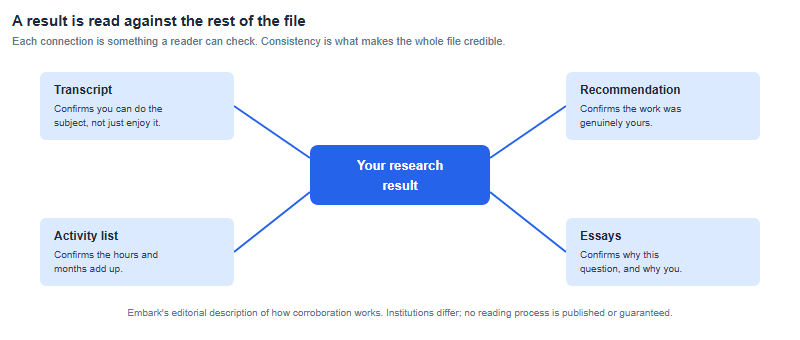
An ISEF result does not work as a standalone credential. It works by corroboration. An admissions reader checks an award against the transcript, the activity list, the essays and the recommendations, and asks whether those four things describe the same student. When they do, the whole file becomes more believable. When they do not, the award raises questions instead of answering them.
Cross-validation is the mechanism, not the metaphor
Think about what a reader is actually doing. They have a folder of claims, almost none of which they can independently verify, assembled by a seventeen-year-old with an obvious interest in the outcome. Their working problem is not “is this student impressive?” It is “is this file internally consistent?”
A research result is unusually useful in that context because it is checkable in several directions at once. It has a named external organiser. It sits in a category. It has a date, a duration and a set of adults who supervised it. And it produces artefacts — an abstract, a research plan, a body of data — that a teacher can speak about specifically. That gives a reader four or five independent places to test the same claim.
Which is why a strong result inside a thin file reads differently from the same result inside a coherent one. The award has not changed. What has changed is whether anything else in the folder confirms it.
Describe the result precisely — this is where students lose credibility
In our experience the most common self-inflicted damage here is not exaggeration in the essay. It is imprecision in the award line, usually written quickly, often by a student who genuinely is not sure what they are entitled to say.
The distinctions matter because readers at selective universities see many of these files, and the vocabulary is not decorative. Competing at an affiliated fair is not the same as competing at ISEF. Competing at ISEF is not the same as winning an award there. And a Special Award from a sponsoring organisation is a different thing from a Grand Award — the two tracks run separately.
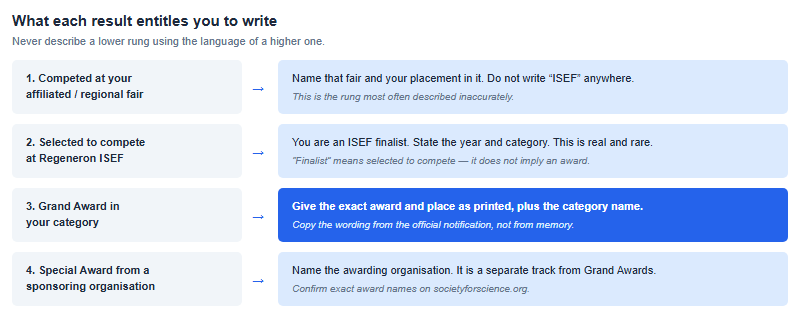
If you are unclear which rung you are on — and every year some students genuinely are, particularly where a regional fair uses ISEF branding in its own name — the routes into the ISEF finals sets out how the affiliated-fair system connects to the finals, which is usually enough to settle it. When still in doubt, ask your fair director in writing and use their wording.
The four places it appears, and what each one is for
| Where | What it is for | The common mistake |
|---|---|---|
| Honours / awards section | The precise, verifiable line: award name, level, year. Nothing else. | Inflating the level, or padding one result into three entries by listing the fair, the category award and the special award as separate honours in a way that implies more than happened. |
| Activity list entry | Duration, weekly commitment and your actual role. This is where the reader tests whether the timeline is plausible. | Hours that do not survive arithmetic. If you claim 20 hours a week for 12 months alongside a full IB load, someone will notice. |
| Essay or supplement | Why this question, what surprised you, what you got wrong. The reasoning, not the trophy. | Retelling the result. The award is already in the honours section; the essay’s job is to show a mind working. |
| Teacher recommendation | Independent confirmation that the work was yours — the single hardest thing for a reader to verify any other way. | Asking a teacher who never saw the project. Brief your supervising teacher on specifics they personally witnessed. |
The activity-list row rewards a moment of thought. ISEF permits a project to include no more than 12 months of continuous research — confirm the current window on societyforscience.org — and that constraint is quietly helpful when you write the entry, because it gives you an honest, defensible duration to state. A student who writes “research project, 12 months” and can name what happened in each phase is telling a story that holds together with the abstract, the notebook and the recommendation. A student who rounds it up to three years is creating a discrepancy for no gain.
Writing the essay: the part that actually differentiates
The honours line does the credentialling. The essay has a completely different job, and students who use it to narrate the competition waste the most valuable space in the file.
What a research year genuinely supplies is material almost nobody else has: a record of thinking under uncertainty. You chose between two methods and can explain why. Something failed and you diagnosed it. You found the limitation in your own result before a judge did. That last one is worth dwelling on, because it is also what the booth interview probes — the published Grand Award rubric puts 35 of its 100 points in presentation, 25 of them in the interview, and the criteria there include understanding the limitations of your own results and your degree of independence. A student who has genuinely been through that questioning has something specific to write about. If you have not yet, what judges look for at the booth describes the standard.
Three concrete tests for the essay draft:
- Could another finalist have written this paragraph? If yes, it is about science fairs rather than about you.
- Does it contain a thing you got wrong? Files that admit a real error read as more credible, not less — and the correction demonstrates the judgement the award only asserts.
- Does it connect to what you say you want to study? A result in one field and a stated intention in an unrelated one is not disqualifying, but it needs a sentence of thread, or it reads as two separate people.
That third point starts much earlier than application season. A question rooted in something the student is actually near — their city’s water, a condition in their family, a system they use — produces a coherent file almost automatically, because the same thread runs through the topic, the essay and the intended major. A borrowed prestige topic has to be retrofitted to a narrative in Grade 12, which is difficult and usually visible. This is one of the underrated reasons choosing a topic that can actually win is a Grade 10 or 11 decision.
What it does not do
Some honest limits, because the version of this article that omits them would be selling something:
- It does not substitute for the transcript. Corroboration runs both ways: a research award alongside weak grades in the relevant subject creates a question rather than answering one.
- It does not guarantee any outcome anywhere. Selective admissions decisions turn on many factors, most of them outside your control and none of them purchasable with a result.
- It is not a number you can compare. There is no published conversion between an award and an admissions probability, and anyone quoting one to you has invented it. Be sceptical of statistics offered without a named source — including ours: figures we publish are our own record, not official ISEF or university data.
- It rewards the work, not the entry. Society for Science describes an event where roughly 1,700 to 1,800 finalists compete each May, drawn from hundreds of affiliated fairs across dozens of countries; most finalists do not take an award, and being there is itself the uncommon part. Confirm current figures on societyforscience.org.
Per Embark, our students have reached finalist places across 13 categories, and over 2023–2025 took more than 60 grand awards; these are our own published figures rather than official ISEF statistics, and individual results vary considerably. We mention the spread rather than the totals for the same reason this article is about description rather than accumulation: what makes a research record work inside an application is that every part of it can be checked and holds up. The students whose files read best are not the ones with the longest award list. They are the ones whose award, transcript, activity entry, essay and recommendation all quite obviously describe the same person doing the same work.
Frequently asked questions
Can I call myself an ISEF finalist?
Only if you were selected to compete at ISEF itself. Competing at an affiliated or regional fair is a different claim.
Does an ISEF award guarantee admission anywhere?
No. It is one corroborating signal, read alongside your transcript, activity list, essays and recommendations.
Should my essay be about my ISEF project?
It can be, but write the reasoning and the mistakes, not the result. The award already appears in your honours section.
How do I list research hours honestly?
State the real weekly commitment and duration. ISEF's 12-month research window gives you a defensible figure that matches your other documents.
Work with Embark
Embark is the international competition team of Youfang Education — a research school, not a prep shop. Our discipline mentors help students build a research record that is genuinely theirs, which is the only kind that survives being checked from four directions. Per Embark, our students have reached finalist places across 13 categories; results vary by student and season.
Embark is an independent research-coaching organisation, the international competition team of Youfang Education. We are not affiliated with, endorsed by, or sponsored by the Society for Science or Regeneron ISEF. Results cited reflect Embark’s own published record (per Embark) and are not official ISEF statistics; individual results vary and no outcome is guaranteed. We describe how applications are commonly read; admissions processes differ by institution and are not published by us. Award names, rules and criteria change — confirm all competition details on societyforscience.org and with your affiliated fair. Errors of fact are corrected within 7 working days of notification.