Many students preparing for the ISEF Research Programme: Comparing Lab Access, Mentoring and Student Ownership wonder exactly how much help a mentor should provide. The real difficulty is not finding a lab or learning techniques—it is drawing a clean line between student decisions (what to study, why it matters, how to interpret results) and technical assistance (how to run an instrument, debug code, or follow a safety protocol). When that line blurs, a project loses the student-ownership signal that judges look for.
Why the Distinction Matters for ISEF
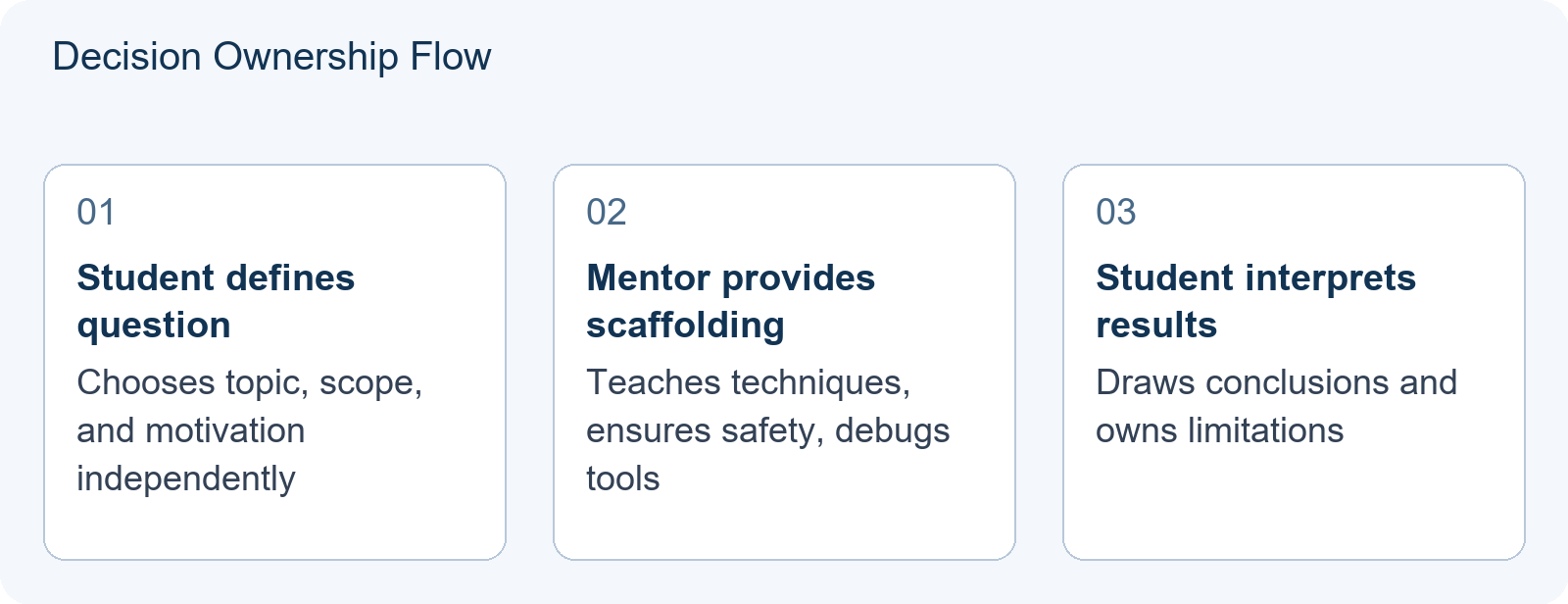
ISEF judging criteria emphasize independent inquiry. A mentor who designs the hypothesis, selects variables, or writes conclusions on behalf of the student undermines the very competency the competition aims to assess. At the same time, expecting a high-school researcher to master every laboratory technique without guidance is unrealistic and often unsafe. The productive middle ground is a clear separation: the student owns the intellectual architecture; the mentor supplies scaffolding.
This article works through two teaching illustrations, contrasts a common mistake, and offers a practical diagnostic you can apply to your own project.
Case A: A Well-Balanced Mentoring Relationship
Imagine a student interested in water quality in her community. She meets a graduate student mentor at a local university.
What the student decides
- She chooses the specific creek and the seasonal comparison question after reading local environmental reports.
- She sets the threshold for what counts as “concerning” contamination based on EPA guidelines she found herself.
- She interprets the final data and writes the discussion section, including the limitation that her sampling was limited to three months.
What the mentor assists with
- Training her on the spectrophotometer and checking her calibration curve.
- Suggesting she run triplicates after noticing her first replicate varied widely.
- Reviewing her safety protocol for fieldwork near road access.
In this case, the mentor never touches the research question, the hypothesis, or the conclusion. The student can explain every choice under questioning. The technical assistance was necessary, bounded, and documented.
Case B: Where the Shortcut Fails
Now imagine a student working on a machine-learning project for image classification. His mentor is a PhD candidate with deep expertise.
What initially looks like help
- The mentor suggests using a specific pre-trained ResNet architecture.
- The mentor writes the data-augmentation pipeline after the student mentions struggling with image preprocessing.
- The mentor adjusts hyperparameters when early runs underperform.
Why this collapses under scrutiny
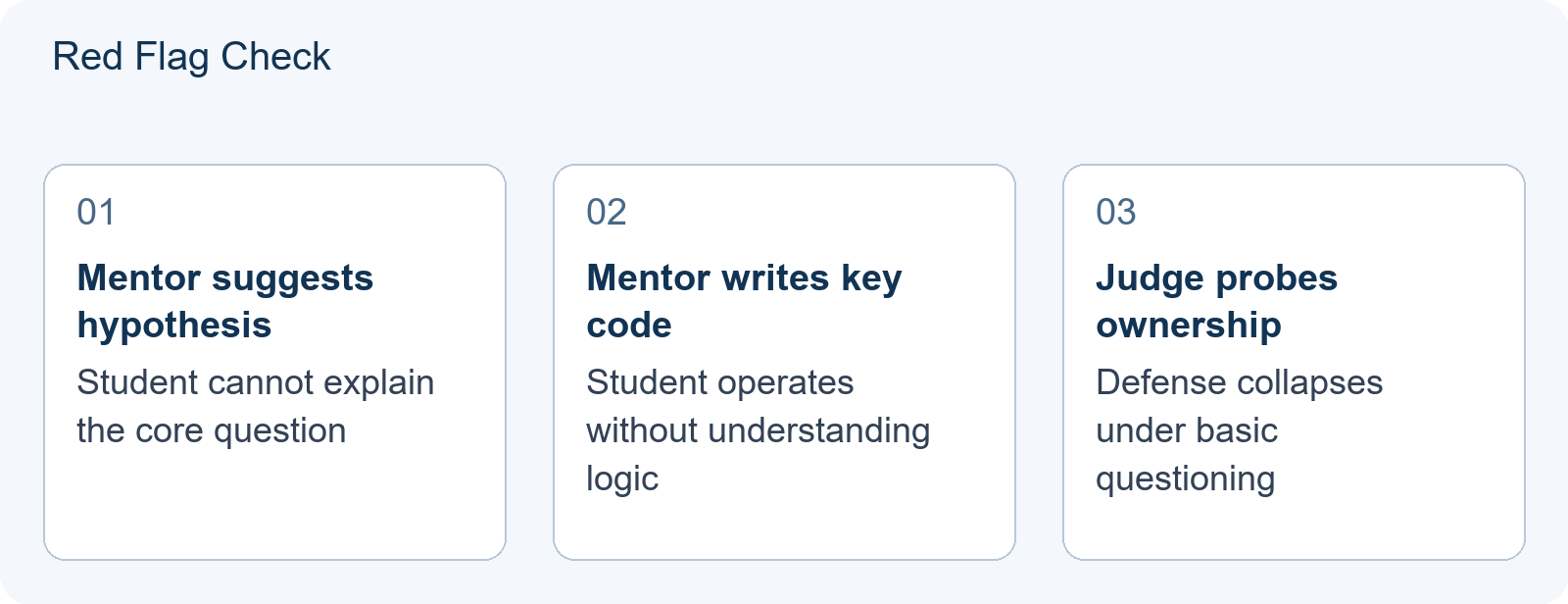
At the regional fair, a judge asks why ResNet was chosen over a simpler model for the dataset size. The student cannot answer—he did not evaluate alternatives. He cannot explain the augmentation choices or the hyperparameter logic. The technical assistance swallowed the intellectual decisions. What looked like efficient mentoring became substitution.
The key difference from Case A: in Case B, the mentor made design decisions that the student should have owned. The student became an operator, not a researcher.
Diagnostic: Are You Owning the Right Things?
Use this table to audit your own project. If you answer “mentor” to any question in the left column, that is a signal to reclaim that decision.
| Decision area | Should be owned by | Red flag |
|---|---|---|
| Research question and motivation | Student | Mentor suggested the topic |
| Hypothesis or expected outcome | Student | Mentor wrote the hypothesis |
| Experimental design and variables | Student | Mentor chose controls or conditions |
| Data interpretation and limitations | Student | Mentor drafted the conclusion |
| Instrument operation and safety | Mentor (assistance) | Student refuses any training |
| Technique troubleshooting | Mentor (assistance) | Mentor does not explain the fix |
A Practice Sequence for Students
If you are currently working with a mentor, try this sequence before your next meeting:
- Write a one-paragraph project summary without asking your mentor for input. Include the problem, your hypothesis, and why you chose your approach. If you cannot finish it, that gap is your agenda for discussion—not a prompt for your mentor to fill.
- List three alternatives you considered for any major method or model choice. You do not need to pursue them, but you should be able to explain why you rejected them.
- Ask your mentor to teach, not decide. Frame requests as: “Can you show me how to evaluate whether this model is overfitting?” rather than “Is this overfitting?”
For guidance on how lab access and mentoring fit into broader ISEF preparation, see ISEF Research Programme: Comparing Lab Access, Mentoring and Student Ownership.
What You Should Be Able to Demonstrate Next
After applying this framework, you should be able to:
- Articulate your research question in one sentence without referencing your mentor’s interests.
- Defend every major methodological choice as your own, even if the technique itself was taught to you.
- Identify at least one limitation of your work that you recognized independently.
These are exactly the signals that ISEF judges assess in interview settings. Technical competence matters, but ownership matters more.
Preparing for a Consultation
If you are considering external ISEF research mentoring support, prepare these items before any discussion:
- A draft research interest statement (even if rough) so the conversation can focus on fit rather than generic options.
- Your current access situation—whether you have a lab affiliation, equipment, or are starting from literature review.
- Specific skill gaps you want to close yourself versus areas where you genuinely need guided training.
This preparation keeps the consultation focused on your actual trajectory rather than a standardized sales conversation.
For students weighing whether to extend prior work, ISEF Continuation Projects: Deciding Whether to Extend Last Year’s Research offers additional guidance on maintaining ownership across project iterations.
For field-based projects, review ISEF Field Research: Water, Soil and Wildlife Sampling Rules, and the Field Work Safety Plan (2026-27) to understand how safety protocols and mentor oversight intersect with student-led design in outdoor settings.
Note: Regeneron ISEF is organized by Society for Science. This article is prepared from the Hanlin/Embark ISEF coaching perspective and is not affiliated with or endorsed by the official organizer. The cases above are teaching illustrations, not official past-paper questions or claimed official marking criteria.
Frequently Asked Questions
How do I ask my mentor for help without handing over decisions?
Frame requests around learning the process rather than obtaining answers. Ask ‘Can you walk me through how you would compare these two methods?’ rather than ‘Which method should I use?’ This keeps the mentor in a teaching role while you retain evaluative control.
What if my mentor insists on making design choices for me?
Politely request explanations for any suggestion, then independently verify and document your own reasoning. If the pattern persists, discuss explicitly with your mentor that ISEF judging values your independent understanding, and ask to be involved in every decision step.
Does getting substantial technical help hurt my ISEF chances?
Technical assistance itself does not hurt your chances. What harms you is inability to explain or defend your project’s intellectual decisions. Judges expect students to learn techniques; they also expect students to own the research design.